People say that God laughs at our plans. If so, it is hard to hear, let alone join, this divine mirth while we weep over the wreckage of our hopes. Like generations of students reading Dante, we feel that any divine comedy has left us stuck in hell.
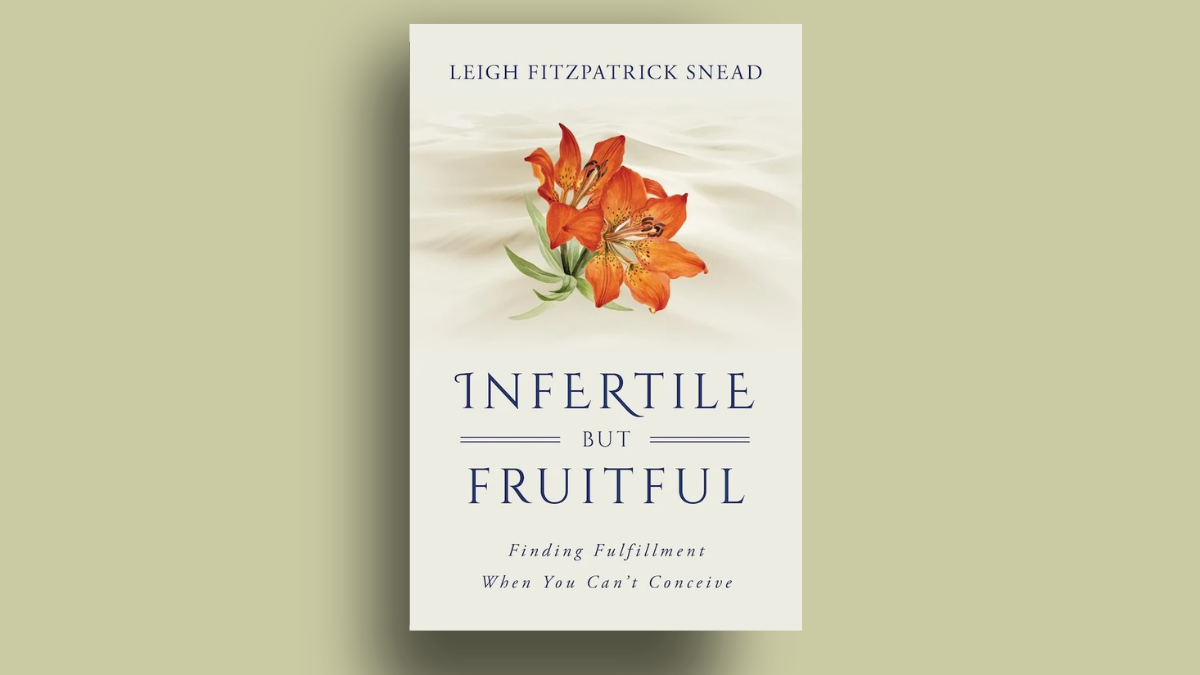
But as Leigh Snead’s beautiful recent book, Infertile but Fruitful: Finding Fulfillment When You Can’t Conceive shows, the story need not end there. Snead has written an account of a sorrow that no one wants, and that few want to discuss. As she put it, “I never asked to be known as the ‘infertility girl’ or the ‘adoption mom’ in my professional work. Perhaps a philosopher, a policy wonk, a photographer — or, when I was five, a zookeeper.” Nonetheless, she has written a book that will bless many, one that is, as she puts it, “the book I wish I’d had twenty years ago … a book for women who feel alone in their frustrated efforts to conceive a child.”
As this indicates, Snead wrote Infertile but Fruitful primarily for women, especially Catholic women like herself who are enduring infertility. Indeed, the germ of this book was a personal essay she wrote that went viral because it resonated with so many women. But this book is also an excellent resource for others — husbands, friends, pastors, counselors, and more — who seek to provide solace and advice. As Snead noted, “those of us suffering from infertility, are too often doing so in silence, isolation, and even shame.” This book will help rectify that. Snead shares her sorrows and consolations, as well as lessons she learned along the way — often the hard way.
Despite the suffering, she believes that hers is “a happy ending,” though it is not what she “would have written at twenty or thirty or maybe even forty years of age.” Nor, she acknowledges, is it what readers currently enduring infertility might regard as a happy ending for themselves. Nonetheless, she concludes that “for me at least, it’s a happy, even joyous ending.” It is not that all her sorrow and labor are over, but that she has found life and joy on the other side of the anguish of infertility.
And that joy is also present in her writing. Snead recounts her story in a warm and amusing style, beginning with the tale of a girl who went to college, met a boy, fell in love, got married, and settled down hoping to have babies. She shifts easily from cute stories about dating — she writes of their kinda-sorta first date at the Pitt-WVU game, “Carter flirtatiously asked me what I would give him in return for his fetching my drink. ‘If you bring me a diet Coke with ice,’ I said without thinking, ‘I will marry you’” — to reflections on religion, family, and marriage.
For a while, everything was great for Leigh and Carter. They got married after she finished her undergrad degree and settled down in D.C. where he worked for a law firm while she started a philosophy Ph.D. They were young, in love, and doing well. And they wanted kids, but not quite yet. She recalls that despite their faith, they were “still vulnerable to the secular idea that we were too young to start having kids as soon as we got married.” And so they used natural family planning methods as a sort of Catholic birth control while they waited to have the children they wanted.
But then, “after almost five years of marriage, we were ready to roll,” and so they “kicked off the baby-making” with a tropical vacation. After all, she recalls thinking, “What could be more romantic and perfect? A baby conceived on a tropical holiday and born right after my last final!”
That perfect plan didn’t work out; she didn’t get pregnant on the trip. Or the next month. Or the next. Instead, her “world began to revolve around nothing else but trying to get pregnant. And failing. Month after month, and nothing.” Her account of those days is raw and rings true for those who have been through the wringer of infertility — one of the worst parts of which is the tendency to poison the joy of good news for others. Snead recounts that even suspecting that a friend was newly pregnant “would send me to the lady’s room, where I would sit in a stall in misery, fighting back angry, jealous tears, until I could manage a return to the party with my game face on.” Likewise, her “heart broke with each new baby shower invitation.”
An Unexpected Happy Ending
Though she could get her “game face” back on in public, in private she was falling apart. Leigh recounts that while Carter was working long hours as a lawyer, “I was spending my days pretending to study for my comprehensive exams and writing my thesis. In reality, I was sitting at home and watching chick flicks in my pajamas. Not good.” It was not, and Leigh and Carter started seeing a local fertility doctor in hopes of finding and fixing whatever the problem was. But instead of answers, they ended up with a diagnosis of unexplained infertility, and a doctor who kept pushing them to try IVF despite their religious objections. As she recalls:
Our doctor also reminded us at every visit that he himself was “a cradle Catholic,” as if that should lead us to change our minds on the issue. And then, after a few months of our trying different medications, he grew so frustrated — not that I was still not pregnant, but that he had not yet convinced me, a young twenty-something with good eggs, to acquiesce to his IVF entreaties — that he lost his composure. “I’m creating life back there,” he yelled, pointing in the direction of his surgical rooms, “not destroying it!” That was it. I looked at Carter in shock, horror, and disbelief. He immediately grabbed my hand and led me safely out the door. We never went back.
In a culture where most Americans — even if they are Catholic, even if they are pro-life — embrace IVF, rejecting it may seem bizarre, just as it did to the fertility doctor. Thus, Snead provides a short explanation of Catholic teaching on marriage, sex, and procreation, offering both clarity and the credibility of someone who has lived by these teachings even when they are difficult.
Her witness on IVF is especially timely, as many Protestant churches who proclaim from the pulpit that human life begins at conception are unprepared to reckon with the life-destroying practices endemic in the IVF industry. Pro-life Christians cannot keep looking the other way on IVF, and Protestants who have overwhelmingly accepted IVF must consider whether the Catholics were right that these evils arise from IVF being intrinsically dehumanizing.
But moral convictions don’t overcome infertility, and saying no to IVF often feels like the end of the line for the hope of conceiving children. Doing what she thought was right didn’t keep Leigh from depression. Her “self-esteem had taken a serious nosedive.” She also “knew, deep down, that I would never finish my Ph.D., but that was a secret I kept from everyone, though surely Carter had his suspicions.” And she developed “deep insecurities about my essential femininity and attractiveness. I couldn’t get the word ‘barren’ out of my mind.”
Love naturally longs to be fruitful and multiply, for the physical union of the marriage bed to be made permanent through the begetting of new persons. And losing hope for that was debilitating for a time. Therapy helped get Leigh out of the slough of despond. Then she and Carter turned to adoption, a vocation that infertile couples are often called to.
Unlike their attempts to conceive, everything went quickly, almost too quickly for them to get things ready in time. And then Leigh was finally a mother. She was even able to induce lactation and breastfeed her son — which was a joy and relief, as finally something in her body worked to nurture a child.
Though it was a turning point, it was not the end of her trials. She and Carter still wanted more children, and their son also wanted siblings. And so Leigh turned to a new doctor, a respected Catholic physician who specialized in treating fertility problems within the limits of Catholic moral teaching. As she recalls, “By this time, I was thirty-three. I — we — had spent almost seven years trying to get pregnant, which sounds like fun, except when you’re not getting pregnant, and you want desperately to get pregnant.” As she recalled, the sorrows of infertility can often poison the joy of intimacy.
She had new hope as her doctor gave her good odds of getting pregnant. But good odds are not a guarantee, and conflating them made her disappointment especially bitter as she remained unable to conceive.
Eventually, instead of clinging to the bitterness, she accepted the cross of infertility. This was not what she had wanted or planned, but it was what she had been given, and rather than dwelling on what she could not have, she sought what she had been called to. She chose to stop pursuing treatments and try adoption again, and she and Carter were quickly chosen as adoptive parents once more, this time of twin boys. Raising them pushed back any further adoptions for years. But then she and Carter looked into adopting one last time, and once again were quickly matched with a baby boy, 17 years after their first adoption.
Leigh received an unexpected happy ending. Her sorrows gave way to joy as her barrenness turned to another form of fruitfulness. But the sorrow was still real and reasonable. It is right to mourn infertility, and to speak of it as a cross to be carried.
There Is Always a Cross
It is, thankfully, a cross most couples do not have to carry, and those who do have widely different experiences and endings. Some of us eventually conceive. Others, such as the Sneads, adopt. Some never become parents, though they may be fruitful in other ways, such as providing spiritual guidance and support. Snead gives a glimpse of this variety at the end of the book by telling the tales of friends of hers who also struggled with infertility.
There is variety, but all Christians, single or married, fertile or infertile, are called to take up our crosses. And most of us have something to bear when it comes to sexuality and family life. For some, it is the cross of infertility. For others, it is the cross of celibate chastity as an unmarried man or woman. For others, there are the burdens of parenthood. There are also the crosses of adoption — whether it’s a mother giving up a child she cannot care for, or a family taking in a child (or several) as part of their family.
There is always a cross. Whatever our vocation or place in life, the Christian life is a call to take up our crosses. We understandably shy away from this — bearing a cross was a painful march to the place of execution. Yet the death march of taking up our crosses is also the way of life. As Jesus told us, when we seek our lives, we lose them, but when we lose our lives, we find them.
It is love that explains this seeming paradox. Love demands that we let go of our lives and become vulnerable. Only by doing so are we able to really live, for we were created to love and be loved. Thus, it was through taking up the cross of infertility that Leigh found fruitfulness and love. And through this book, her wounds will become a source of healing and comfort for others.