Expanding exports of energy from the United States has become a hallmark of President Donald Trump’s second presidency, and his administration is turning to Alaska to usher in a wave of trade deals and commitments to meet its goals for selling more fossil fuels abroad.
Trump established on his first day in office that “unleashing” Alaska’s resources, including oil and natural gas, would be a priority for him and his administration over the next four years.
It has become clear that not only is this intended to boost domestic energy stockpiles, support national security, and foster economic growth in the state, but increasing energy production in Alaska is proving crucial for finalizing international trade agreements with Asian allies.
And at the same time, these possible trade commitments with Japan, South Korea, Taiwan, and maybe even China could provide a significant chunk of the financing needed to accelerate the production of Alaskan fossil fuels.
Alaska’s history as trade carrot
This is not the first time Alaska has found itself in a crucial role within international trade negotiations, as the state’s exports of energy products abroad can be traced back more than half a century.
In 1969, the very first exports of U.S.-produced liquefied natural gas were shipped from the Kenai LNG facility in Nikiski, Alaska, just southwest of Anchorage, to Japan.
TRUMP PROPOSES ALASKA, CALIFORNIA, AND GULF COAST OFFSHORE OIL AND GAS LEASES IN FIVE-YEAR PLAN
This was the only existing LNG facility in the U.S. for a long time and the longest, continuously operating LNG plant in the world before it was mothballed in 2017, due to challenges of diminishing supply of gas from the nearby Cook Inlet basin and growing domestic demand.
“Alaska has this very long history of both a commercial gateway to Asia and energy exports as a crucial part of our economy,” Philip Wright, an associate professor and energy and environmental historian at the University of Alaska Fairbanks, told the Washington Examiner.
Alaska’s energy exports expanded in the Pacific Rim in the 1980s, as the U.S. shipped low-sulfur Alaskan coal to South Korea, Chile, and Japan. These exports dramatically shrank and stopped altogether by the mid-2010s.
“This is not a new phenomenon,” Wright said, arguing that even when Alaska was purchased in 1897, U.S. officials who negotiated the treaty, including Secretary of State William Seward, saw the state as a “commercial gateway agent.”
Alaska has also seen minimal exports of crude oil to Asia. The state has only been permitted to export oil since 1996, and between then and 2004, saw more than 95 million barrels of Alaskan crude oil exported to China, Japan, South Korea, and Taiwan, according to the Energy Information Administration.
As demand grew within the U.S. and Alaskan production experienced a sustained decline, the state paused foreign exports of oil for about 10 years. Exports picked back up in 2014.
In the last 10 years, much of Alaska’s energy exports have been focused on meeting domestic supply needs — for both the state and the Lower 48.
Interest in sending more oil and gas abroad has not disappeared, though, as state officials have, for decades, attempted to build an LNG pipeline from the North Slope to the southern end of the state to facilitate more exports of natural gas.
Trump’s push for Alaskan energy
Republican lawmakers and state officials are confident that the Trump administration will be able to export more energy from the state than ever before.
Trump signed an executive order on his first day in office aimed at unleashing oil and gas development in Alaska, calling it “key” to U.S. national security and energy dominance.
In the months that followed, agencies such as the Interior Department have taken steps to facilitate increased fossil fuel development by proposing lease sales in large swaths of water in the High Arctic, lifting Biden-era protections on the National Petroleum Reserve of Alaska and Arctic National Wildlife Refuge, as well as approving construction of a mining access road.
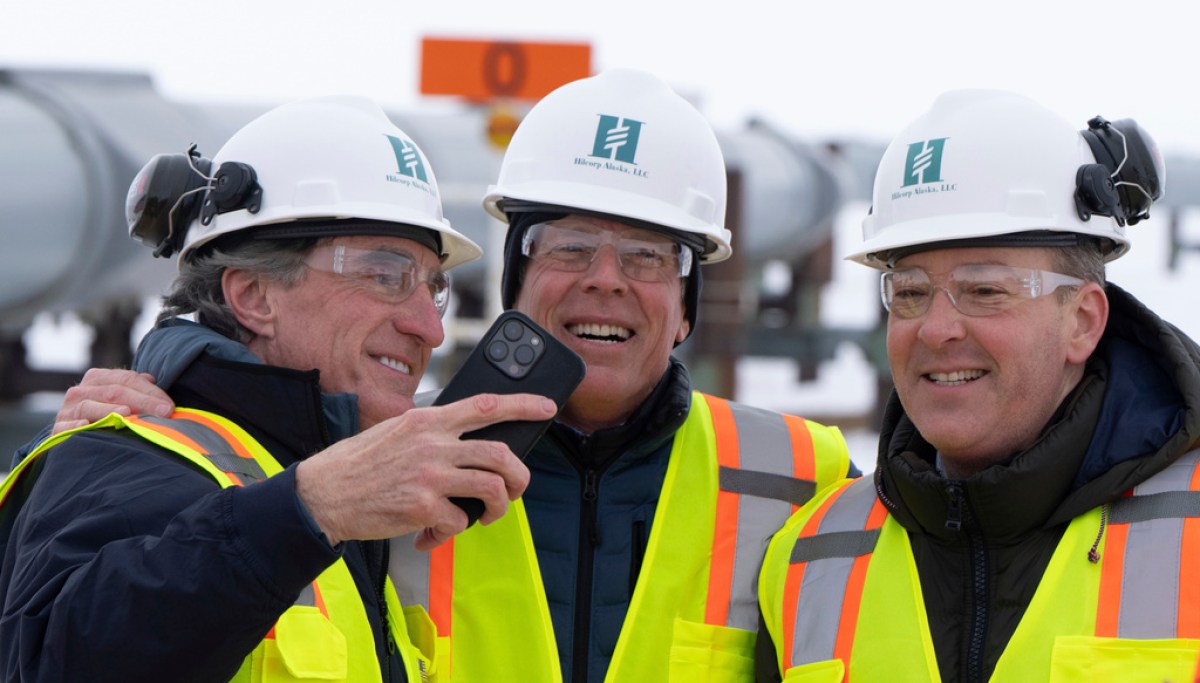
The administration has also directly endorsed plans to build the LNG pipeline across the state. The 800-mile pipeline is intended to start in Prudhoe Bay along the Arctic Ocean, where the existing Trans-Alaska oil pipeline, also around 800 miles, begins.
Advocates of the pipeline say it would allow the state to tap into hundreds of trillions of cubic feet of natural gas in Alaska’s North Slope borough, which Rep. Nick Begich (R-AK) says is necessary as supply in the Cook Inlet continues to be depleted.
“As those assets have declined in the field, it’s become necessary for us to tap into additional resources, and in so doing, we have the ability to strengthen our allied relationships by actually exporting a great deal of energy to them,” Begich told the Washington Examiner.
Some risks
Building the Alaskan LNG pipeline is expected to be an expensive endeavour, with the cost projected to be around $44 billion. By comparison, the first phase of the Keystone Pipeline, which stretches more than 2,000 miles from Alberta, Canada, to Nebraska, cost around $5.2 billion to build.
The Alaskan LNG pipeline has long been dubbed a “risky” project, due to its high capital costs, tough and icy terrain, as well as pushback from environmentalists looking to curb fossil fuels.
“This is an inherently risky project, because it just takes so much capital up front in order to monetize this resource, and that’s why it hasn’t happened up until now,” Wright said. “You have not been able to make the stars align between the producers on the North Slope that actually produce this gas, and the state and the buyers.”
Gov. Mike Dunleavy (R-AK) hit back against these concerns, telling the Washington Examiner that the state already has the gas it wishes to transport, the necessary permits and right-of-way for construction, and legally defended the project in court.
He insisted the project will move quickly over the next two years, as piping is expected to be ordered in January 2026 and on the ground in the state next August.
“People are thinking 20 years ago,” Dunleavy said. “The permits are all there, the right-of-ways are all there. We’re not hacking through virgin wilderness. This is going to parallel the oil pipeline, which has a road next to it, all the way down to almost Fairbanks.”
An opportunity for Asia
As Asian allies, including Japan and South Korea, have expressed interest in increasing imports of LNG to reduce reliance on dirtier fossil fuels such as coal, many are confident this administration will be able to leverage trade negotiations to secure the financial backing needed for the project.
“There’s an opportunity to use trade negotiations as a way of getting foreign capital … potentially pooled with private capital from the U.S. and other investors that all put together might make it possible to capitalize what are usually more expensive capital projects in Alaska,” said Aaron Padilla, vice president of corporate policy at the American Petroleum Institute.
Late last month, Japan and the U.S. signed a trade and investment agreement that included a pledge from Tokyo to invest $550 billion in U.S. sectors, including energy infrastructure, critical minerals mining, and LNG.
Private gas and energy firms, including Tokyo Gas and JERA, have also signed letters of intent signifying that they will buy millions of tons of LNG from the proposed pipeline.
LNG major Glenfarne, which is developing the pipeline project, also signed an agreement in September with South Korea’s POSCO to obtain a significant portion of the steel requirement for the pipeline. This agreement, the final terms of which are still being negotiated, will result in the export of around 1 million tons of LNG each year.
Dunleavy confirmed that negotiations are active among these players, as well as others in Taiwan. While it may take several months to finalize, he insisted that all interest is a sign that the project is headed in the right direction.
In late October, Trump even said China was possibly interested in purchasing Alaskan oil and gas. While Begich called it “natural” for the Asian superpower to want to increase its natural gas imports, he said the U.S.’s focus should be elsewhere.
“When we look at the actual investment in infrastructure, I think we need to keep that to our allies,” Begich said, adding “At the end of the day, if someone out there wants to buy our gas, that’s one thing, but when it comes to investment, we need to keep that among our allies and our friends.”
Without Asian partners on board, some Alaskan energy experts have warned that the LNG pipeline project faces more financial hurdles and additional risks.
Push to expand offshore oil production faces headwinds
However, state officials remain confident that allies, including Japan, South Korea, and Taiwan, will move forward with long-term agreements.
“We’re doing exactly what we’re supposed to do,” Dunleavy said. “We are providing energy opportunities for our country, our state, and our Asian allies. … Our place on the globe is unlike any other. We’re nine hours from every industrialized place in the Northern Hemisphere, on this planet … so our place on the globe, our resource, just like Seward had intended, is coming to fruition as a result of the Trump administration.”