In the silence of a shuttered world, something unexpected emerged: a generation of young men rooted in faith, discipline, and tradition. At St. Louis de Montfort Academy, education is more than academics—it’s formation for the future. And in a culture losing its way, that may be everything.
During the chaos of COVID‑19, with churches shuttered and sanctuaries silenced, I made the trek to the now former Carmelite Monastery in Elysburg, Pennsylvania a sanctuary soaked in generations of prayer, where Mass was still being celebrated but in the Latin Rite.
In my youth, the tides of Vatican II swept through the Church, ushering in the Novus Ordo Mass spoken in the languages of the people and exiling the Latin that decreed the liturgy for centuries. The shift left many adrift in a liturgical landscape suddenly unfamiliar in a Church eager to seek ecumenism.
They were inhabiting a tradition that had formed saints, scholars, missionaries, and martyrs. They were stepping into a stream that had never actually dried up – just diverted.
In the midst of the pandemic, it rekindled an unexpected and renewed encounter with tradition, proving that even in confusion and turmoil, grace finds a way.
However, that wasn’t its only revelation.
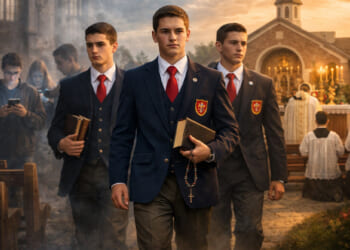
On that fateful day, what entered the chapel were boys, young men, really, all dressed in a jacket and tie whose bearing instantly set them apart as their posture, precision and demeanor was reverent without pretention.
It was as if someone had opened a window and a gust from the age of cathedrals entered carrying with it the sense that faith and formation still matter. They moved with the kind of quiet discipline that can’t be faked and rarely appears in boys their age as they filed into the pews with a seriousness seldom witnessed.
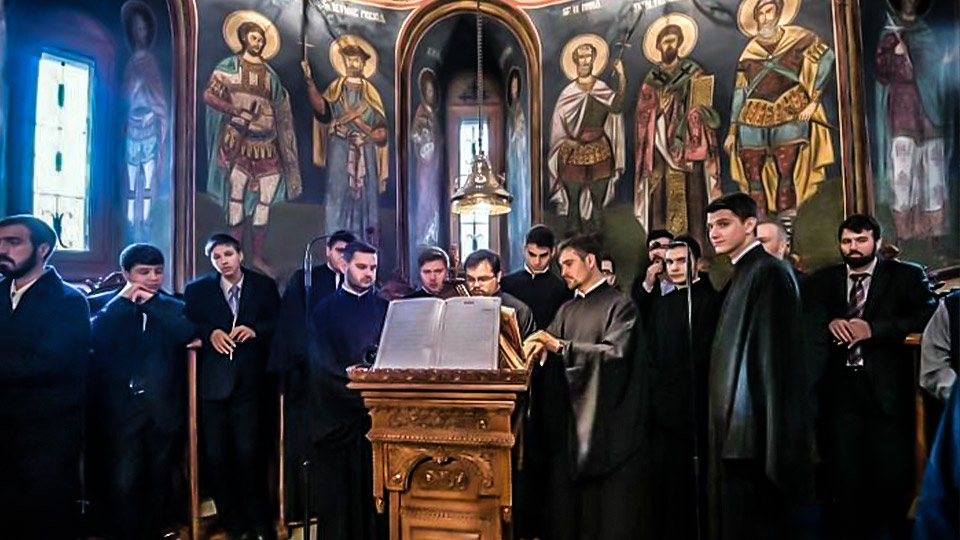
When the group broke out into Gregorian chant as the High Mass began, it lifted the chapel into that ancient, resonant ambiance where every note seem to breathe with the grandeur of St. Peter’s in Rome possessing the power to transfigure a soul in an instant.
It was a glimpse of what young men can become when they are given structure, meaning, and a mission worthy of their strength.
In a culture that often feels defined by drift, distraction, and the erosion of purpose, their presence felt like a small but unmistakable sign of hope.
They were inhabiting a tradition that had formed saints, scholars, missionaries, and martyrs. They were stepping into a stream that had never actually dried up – just diverted. The Latin, the reverence, the sense of the sacred – all of it was still alive, waiting for a generation willing to claim it again.
And here they were.
They are students of St. Louis de Montfort Academy of nearby Herdon. The Academy’s vision is unapologetically clear and concise: to form young men who understand their faith intellectually and live it with courage and commitment. It is a credo that refuses to separate the mind from the soul and academic rigor from moral formation.
What struck me then in the monastery, and strikes me still, is how rare such formation has become.
The Academy’s model is not just about producing dutiful students who excel. It is about shaping young men who can confront a culture that often encourages the opposite. Their daily pulse of prayer, scholarship, music and outdoor activities reflects a holistic formation. It is an arrangement that demands something and in return provides what the contemporary world struggles to offer: identity, discipline, and delight rooted in something greater than themselves.
The boys are not being prepared for a world that no longer exists; they are being prepared to rebuild the one that does.
The Academy’s commitment to mentorship remains central to its mission. With the school’s trademark 5:1 student-teacher ratio it ensures that each student is known, guided, and challenged. In an era when education is often automated and impersonal, the results live through their students who grow in confidence, discipline, and intellect prepared not only to succeed in the classroom but to lead with character well beyond it.
Equally significant is the Academy’s resolve to keep education accessible. Through its Scholarship Committee, the school upholds affordability so that financial circumstances never become a barrier to a faith-centered education. This commitment reflects the Academy’s creed that its mission is not reserved for the few but is meant to serve families who desire something more substantial for their sons than the trappings of contemporary society.
When I witnessed that first day was the fruit of a formation model that refuses to compromise. It was a glimpse of what young men can become when they are given structure, meaning, and a mission worthy of their strength. In a time when so many institutions are unsure of themselves, the Academy’s confidence is almost startling. And for those of us who sometimes wonder what future awaits the next generation, it offers something rare and necessary – hope grounded in evidence.
In an era where institutions crumble under the weight of their own contradictions, this school stands like a lighthouse where education and faith still matters and students deserve more than the soft bigotry of low expectations.
Perhaps that is the true story in a world sprinting toward the next diversion, there is a school quietly teaching boys how to think critically and grow into the kind of men we can trust with the future.
The boys are not being prepared for a world that no longer exists; they are being prepared to rebuild the one that does. The Academy does not simply give me hope for the future. It reminds me that the future is already arriving, quietly, and reverently with one well-formed student at a time.