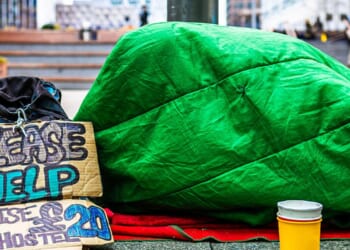
- Homelessness Strategy published as rough sleeping hits new post pandemic high.
- There was a 94 per cent increase in rough sleeping from July 2021 to July 2025, when 9,574 people were on the streets.
- Strategy risks failing to tackle asylum crisis putting continued pressure on homelessness services.
The Homelessness Strategy makes a welcome pivot towards prevention, but must go further to restore control, order, and hope to British streets, says the Centre for Social Justice (CSJ).
Preventative policies outlined by minister Alison McGovern will make a significant difference in easing the pressures faced by local authority homelessness services, whilst new investment in supported housing will help many vulnerable people.
However, the government’s pledge to halve the number of long term rough sleepers is underpowered and lacks ambition. Here, the strategy lacks radicalism and reads more like business as usual.
A report by the CSJ, No Place Like Home, urged Ministers to take the opportunity of the new government to roll out Housing First across England, which is proven to break the cycle of rough sleeping and homelessness for the vast majority of participants.
Whilst we are pleased to see the government recognise Housing First as an effective intervention, evidence suggests that services are now in decline due to funding constraints and surging demand. A lack of government ambition to see Housing First scaled risks the future of vital services.
A recent letter signed by 41 Labour backbenchers urged the government to adopt the CSJ’s Housing First proposals, cautioning the government not to risk hard won progress from the national pilots in Greater Manchester, Liverpool City Region and the West Midlands.
The CSJ warns that without a greater commitment to Housing First, the government will be unable to restore control, order and hope to British streets. Those whose homelessness is compounded by severe mental illness, addiction, and criminal behaviour will be left to drift, passed between prisons, hospital wards, and hostels, at risk to the public and to the dangers of life on the streets.
The strategy is also undermined by a cross government failure to tackle the asylum crisis, which has continued to push up costs for the Home Office and local authority homelessness services.
Those who have had their asylum claim rejected, have overstayed their visa, or who are in the UK unlawfully should be required to return to their country of origin. This approach is not only fair to taxpayers and essential to maintaining trust in the immigration and asylum system, but also vital to sustaining public support for efforts to end rough sleeping and homelessness.
Josh Nicholson, Senior Researcher at the CSJ, said:

“Alison McGovern deserves credit for prioritising prevention in the Homelessness Strategy, including by recognising the importance of preventing family breakdown and investing in Family Hubs.
However, efforts to tackle rough sleeping lack ambition, and the strategy risks missing the historic opportunity of a Labour government to end rough sleeping for good.
We now need to see a clear prioritisation of interventions that are proven to end homelessness like Housing First. Support must be available to strategic authorities to design and implement Housing First services in their regions.”
The CSJ welcomes the recognition of family breakdown as a critical risk factor leading to homelessness, the strategy’s commitment to keep families safely together, and its promise to invest in Family Hubs.
Moreover, it is positive that the government has committed to removing the benefits cliff edge that traps many supported housing tenants out of work. In our Living Rent That Works report, we found that many people are better off staying unemployed to maintain access to higher housing benefit rates. The government’s plan to introduce four new income disregards will help fix this and ensure work always pays.
Other CSJ recommendations include:
- Appointing a Housing First programme director within the Ministry of Housing, Communities and Local Government (MHCLG) to support regions to utilise new funding for Housing First interventions.
- The planned Single Homelessness and Complex Needs Toolkit should outline a shared approach and vision for Housing First in England, ensuring that services meet minimum standards of support.
- Scrapping expensive civil service relocation expenses and cutting back the programme which moves them to the regions to fund a wider rollout of Housing First, saving £44.6 million by 2029/30.
- A UK and local connection test should be used to determine eligibility for high resource interventions like Housing First, ensuring that services are prioritised for rough sleepers who have a long term connection to the UK.
Notes to editors
The CSJ’s analysis of rough sleeping data is based on the July to September release of the Rough Sleeping Data Framework published by MHCLG.
Housing First provides ordinary settled housing alongside intensive, person centred support for people whose homelessness is compounded by multiple and complex support needs. Housing First is different from conventional interventions as it offers permanent housing immediately, dependent on an individual’s willingness to maintain a tenancy. Intensive support is provided to help the individual overcome complex problems in their life. In the national pilots, 84 per cent of service users sustained permanent housing after three years.