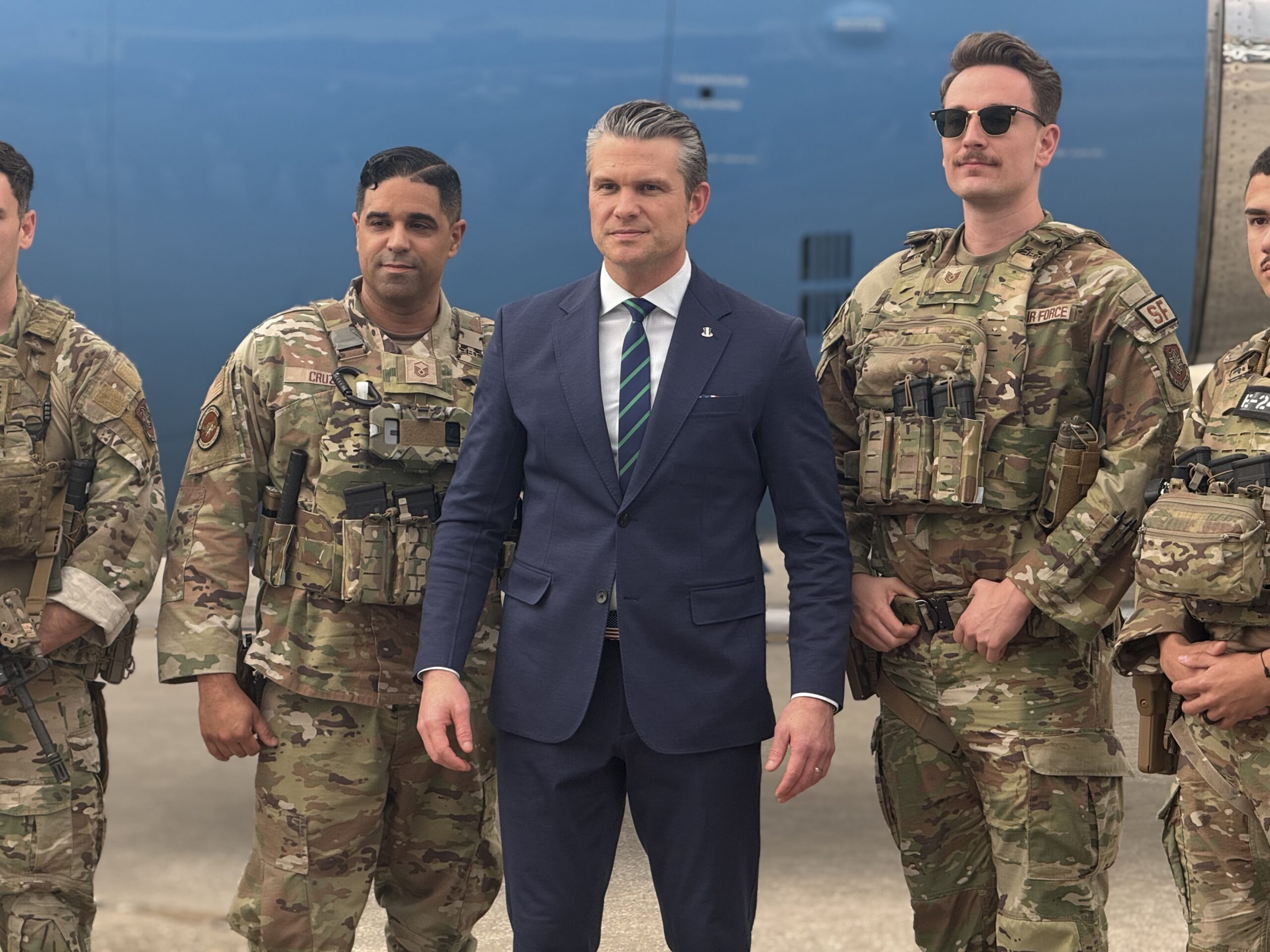
Secretary of War Pete Hegseth promised Tuesday that the Iran war “is not 2003” and will not look like another nation-building, regime-change war like in Iraq.
Giving an update ten days into the war, Hegseth was joined by Chairman of the Joint Chiefs of Staff Gen. Dan Caine at the Pentagon.
“This is not 2003. This is not endless nation-building under those types of quagmires we saw under Bush or Obama. It’s not even close,” Hegseth said. “Our generation of soldier will not let that happen again, and nor will this president, who very clearly ran against those kinds of never-ending, nebulously scoped missions — those days are dead.”
Hegseth just last week, however, did make comparisons to Iraq and the “Shock and Awe” campaign, stating the opening salvo in Iran included twice the air power as Iraq. He also suggested war in Iran could be protracted, and estimates have been all over the map, with some reports suggesting it could go into September.
However, President Donald Trump suggested on Monday that the war is almost over, telling CBS News, “I think the war is very complete.” Meanwhile, the War Department said, “We have only just begun to fight.”
Responding to concerns of a prolonged conflict, Hegseth said, “I want the American people to understand is this is not endless. It’s not protracted. We’re not allowing mission creep. The President has set a very specific mission to accomplish, and our job is to unrelentingly deliver that.”
“Now, he gets to control the throttle. He’s the one deciding — he’s the one elected on behalf of the American people — when we’re achieving those particular and so it’s not for me to posit whether it’s the beginning, the middle or the end,” Hegseth added.
The messaging denying that the Iran war is one of regime change and nation-building is inconsistent, however, as the regime did change and seems likely to change again after Trump said he was “not happy” with Mojtaba Khamenei, son of former Ayatollah Ali Khamenei, succeeding as supreme leader. Trump has also said he wants “unconditional surrender” from the Iranians, and that he wants to be involved with choosing their next leader.
Caine provided an update with some statistics about progress in the war, stating more than 5,000 targets have been struck and that U.S. Strategic Command dropped “dozens of 2,000-pound GPS penetrating weapons on deeply buried missile launchers across the southern flank.”
U.S. forces also struck several munitions factories as part of a primary objective to stop Iran’s ability to manufacture weapons.
“Today will be, yet again, our most intense day of strikes inside Iran. The most fighters, the most bombers, the most strikes,” Hegseth said. “Intelligence” is “more refined and better than ever.”
Hegseth also said that the last 24 hours have seen “the lowest number of missiles they’ve been capable of firing yet.”
Caine said that ballistic missile attacks are down 90 percent from where they started, and one-way attack drones are down 83 percent. Those are the same numbers as last week, but Hegseth clarified that those numbers represent a consistent ability to keep those capabilities away from Iranian use.
Iran’s navy continues to be decimated, according to Caine, which significantly limits their ability to be mobile in the Strait of Hormuz, where much of the world’s oil must pass through in order to get to market.
Both Caine and Hegseth suggested the U.S. would probably help oil vessels safely through the Strait if the need arose.
When asked about the concerns of Americans, many of whom support Trump but are extremely wary of another war in the Middle East, Hegseth said that “the President has made it clear to those concerns that we’re not getting pulled in any direction. We’re leading. The President is leading. He’s determining where we want to go, what the outcome will be, what the end state is, with a very keen eye.”
However, he also said that Israel sometimes acts autonomously, stating, “Israel has been a really strong partner in this effort. Where they have different objectives, they’ve pursued them. Ultimately, we’ve stayed focused on ours.”
“I understand those concerns, because I’ve heard from a lot of people who went through — I went through 20 years of those wars myself, worried about getting dragged in, worried about mission creep, worried about nation-building or democracy expansion,” Hegseth said. “That’s never the perspective the president has pursued on this. Just because previous presidents and previous secretaries have decided to just pour more resources and more people in toward some unguided end state, doesn’t mean that’s the way the world needs to look today.”
Breccan F. Thies is the White House correspondent for The Federalist. He is a co-recipient of the 2025 Dao Prize for Excellence in Investigative Journalism. As an investigative journalist, he previously covered education and culture issues for the Washington Examiner and Breitbart News. He holds a degree from the University of Virginia and is a 2022 Claremont Institute Publius Fellow. You can follow him on X: @BreccanFThies.