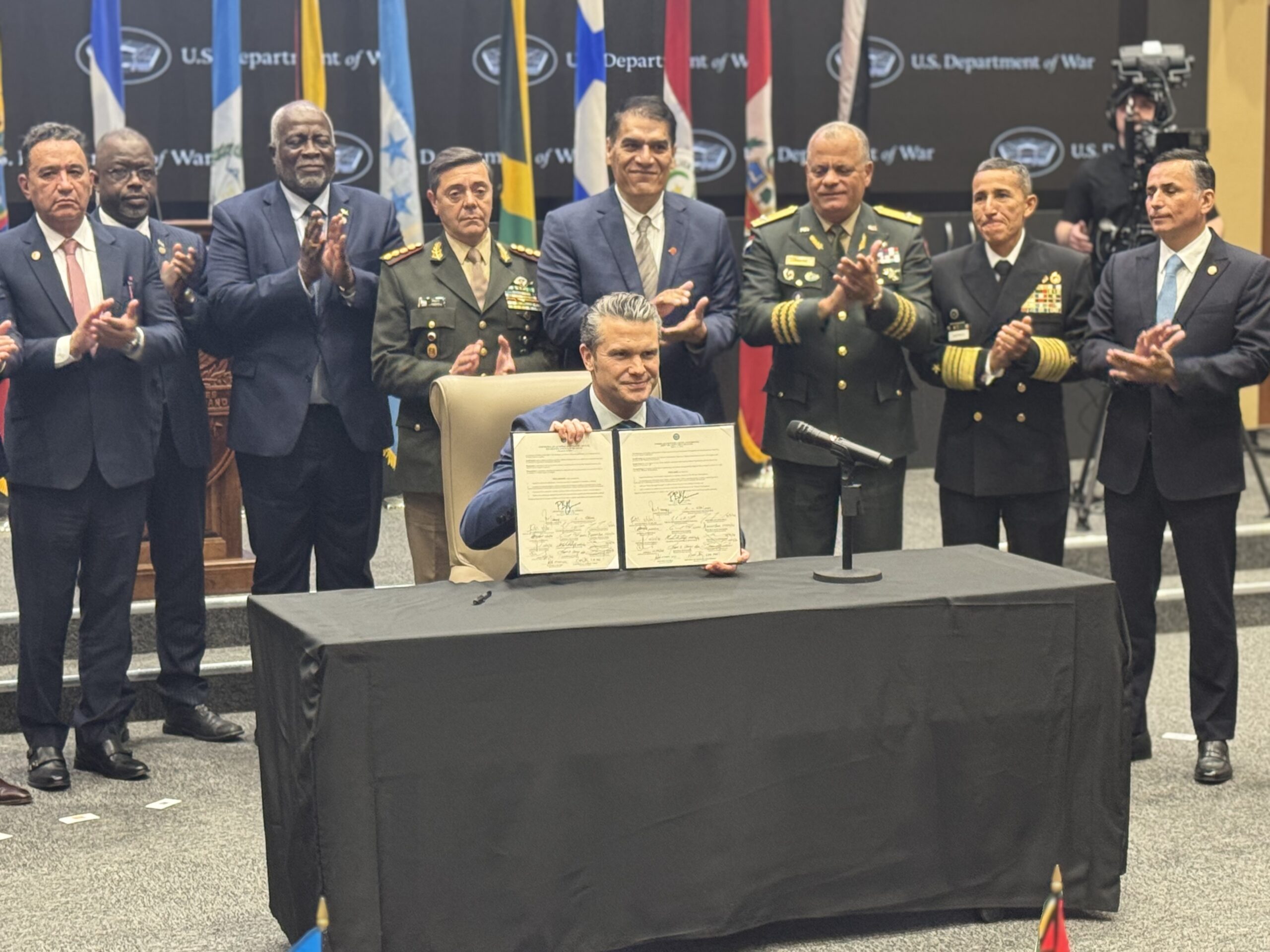
U.S. SOUTHERN COMMAND, DORAL, Fla. — Secretary of War Pete Hegseth signed a joint security declaration on behalf of the United States Thursday, partnering with 17 countries in the Western Hemisphere to establish a unified front against narcoterrorists in the region using military deterrence.
Hegseth signed the document at a meeting of security and defense officials from South American, Central American, and Caribbean countries at the U.S. Southern Command (SOUTHCOM) headquarters in Doral, Florida. The meeting included remarks from each delegation head, and Hegseth, White House Deputy Chief of Staff and Homeland Security Advisor Stephen Miller, SOUTHCOM Commander Gen. Francis Donovan, and acting Assistant Secretary of War for Homeland Defense and Americas Security Affairs Joseph Humire also spoke.
“When terrorist killers and cartels capture strategic infrastructure, resources, and entire towns or cities close to U.S. borders and U.S. shores, or profit from mass illegal migration, that is a threat to the United States homeland and a threat to all of you as well — to the Americas,” Hegseth said during his remarks.
“The same adversaries that threaten our shared heritage threaten our shared geography as well. They seek to displace the historic North-South relationship that we’ve always shared with some sort of a new ‘Global South’ that excludes the United States and other Western nations but includes non-Western powers and other adversaries. The answer to our challenge is not to ignore our geography in the name of global interests, but to embrace our shared geography in the name of national interests.”
The Americas Counter Cartel Conference Joint Security Declaration affirms the sovereignty of each signatory and states the intent to “expand multilateral and bilateral cooperation” in the hemisphere to combat narcoterrorism and other security threats. Under the Trump administration, the United States has pursued deterrence via strikes on drug boats in the Caribbean, but as Hegseth noted, they did not carry out strikes for several weeks in February because the deterrent effort had been effective. The 17 other countries that signed on to the declaration will join that deterrent effort.
“America is prepared to take on these threats and go on the offense alone, if necessary,” Hegseth said. “However, it is our preference, and it is the goal of this conference, that in the interest of this neighborhood, we all do it together with you, with our neighbors and with our allies who are eager and willing and capable.”
The signing countries are the Bahamas, Belize, Dominican Republic, Guyana, Jamaica, Trinidad and Tobago, Costa Rica, El Salvador, Guatemala, Honduras, Panama, Argentina, Bolivia, Chile, Ecuador, Paraguay, and Peru.
During his remarks, Chile Defense Minister Fernando Barros told Hegseth, and the United States more broadly, “welcome back” to being in a leadership role in the hemisphere. The U.S. military took part in a joint military operation with Ecuador against “designated terrorist organizations” on March 3, SOUTHCOM announced.
“The cartels that operate in this hemisphere are the ISIS and the al-Qaida of the Western Hemisphere, and should be treated just as brutally and just as ruthlessly as we treat those organizations,” Miller said.
Miller went on to state that “we are not going to cede an inch of territory in this hemisphere to our enemies or adversaries. Our national security, our homeland security, the safety and well-being of our people begins at home, begins in our neighborhood, begins in our home region, and for too long, we have allowed foreign enemies, foreign adversaries, and enemy terrorist organizations to control territory and spaces in this hemisphere where they can project power, project threats, and directly threaten the lives of your citizens and our citizens.”
Hegseth explained that President Donald Trump has a “new strategic map,” rejecting the NGO-peddled conception of a “Global South.” He noted that the strategic map, “greater North America,” restores the North-South relationship that existed during World War II. This new map, Hegseth said, actually takes geography into account, pointing to the Amazon Rainforest and the Andes Mountains as “two basic geographic barriers.”
The United States will simultaneously “enhance posture and presence” in the North, Hegseth added, while “strengthen[ing] partnerships through increased burden sharing [south of the equator]. This will enable you to take a greater role to defend the South Atlantic and the South Pacific, and to secure critical infrastructure and resources in partnership with us and other Western nations.”
Both Hegseth and Miller explained in historic and cultural context the importance of the new focus on the Western Hemisphere and the reinstatement of the Monroe Doctrine, which was referenced multiple times, with Hegseth saying that “some 200 years later we still marvel at the wisdom of President Monroe’s declaration.”
“We must first acknowledge what was lost and then understand what needs to be restored. All the nations represented in this room are offsprings of Western civilization,” Hegseth said. “Our nations are and always will be united by our heritage, our history, and geography in this New World. We share the same interests, and because of this, we face an essential test: whether our nations will be and remain Western nations with distinct characteristics — Christian nations under God, proud of our shared heritage with strong borders and prosperous people ruled not by violence and chaos, but by law, order, and common sense.”
Miller noted that national security and, by extension, the security of each country’s citizens to safely have families are a prerequisite to achieving the great successes Western civilization has brought throughout history.
“A country cannot pursue economic growth, cultural enrichment, art, architecture, education, science, if it doesn’t have fundamental security first,” he said. “For too long, we’ve been caught in a vicious cycle in this hemisphere where countries from Mexico down to the tip of South America do not provide their citizens with basic physical security. So those citizens in search of economic opportunity illegally immigrate to the United States — they pay the smugglers, they pay the cartels, who then grow richer, who then grow more powerful — and then your countries, in turn, become poor, because you’ve lost your citizens, you’ve lost your human capital, you’ve lost your opportunities to develop and to grow. So you get poorer, the cartels get more powerful, nothing changes, nothing improves.”
“You have to break that cycle,” Miller said, adding that the process “begins by dismantling these organizations that deal drugs, deal violence, assassinate, extort, blackmail, and also traffic illegally in human beings.”
Breccan F. Thies is the White House correspondent for The Federalist. He is a co-recipient of the 2025 Dao Prize for Excellence in Investigative Journalism. As an investigative journalist, he previously covered education and culture issues for the Washington Examiner and Breitbart News. He holds a degree from the University of Virginia and is a 2022 Claremont Institute Publius Fellow. You can follow him on X: @BreccanFThies.