Blessed Pius IX began his 1864 encyclical “condemning certain errors,” Quanta Cura, with a paragraph that made it perfectly clear that he understood the role of the Roman Pontiffs in guarding and guiding the Catholic Church:
“With how great care and pastoral vigilance the Roman Pontiffs, our predecessors, fulfilling the duty and office comitted to them by the Lord Christ Himself in the person of most Blessed Peter, Prince of the Apostles, of feeding the lambs and the sheep, have never ceased sedulously to nourish the Lord’s whole flock with words of faith and with salutary doctrine, and to guard it from poisoned pastures, is thoroughly known to all, and especially to you, Venerable Brethren. And truly the same, Our Predecessors, asserters of justice, being especially anxious for the salvation of souls, had nothing ever more at heart than by their most wise Letters and Constitutions to unveil and condemn all those heresies and errors which, being adverse to our Divine Faith, to the doctrine of the Catholic Church, to purity of morals, and to the eternal salvation of men, have frequently excited violent tempests, and have miserably afflicted both Church and State. For which cause the same Our Predecessors, have, with Apostolic fortitude, constantly resisted the nefarious enterprises of wicked men, who, like raging waves of the sea foaming out their own confusion, and promising liberty whereas they are the slaves of corruption, have striven by their deceptive opinions and most pernicious writings to raze the foundations of the Catholic religion and of civil society, to remove from among men all virtue and justice, to deprave persons, and especially inexperienced youth, to lead it into the snares of error, and at length to tear it from the bosom of the Catholic Church.”
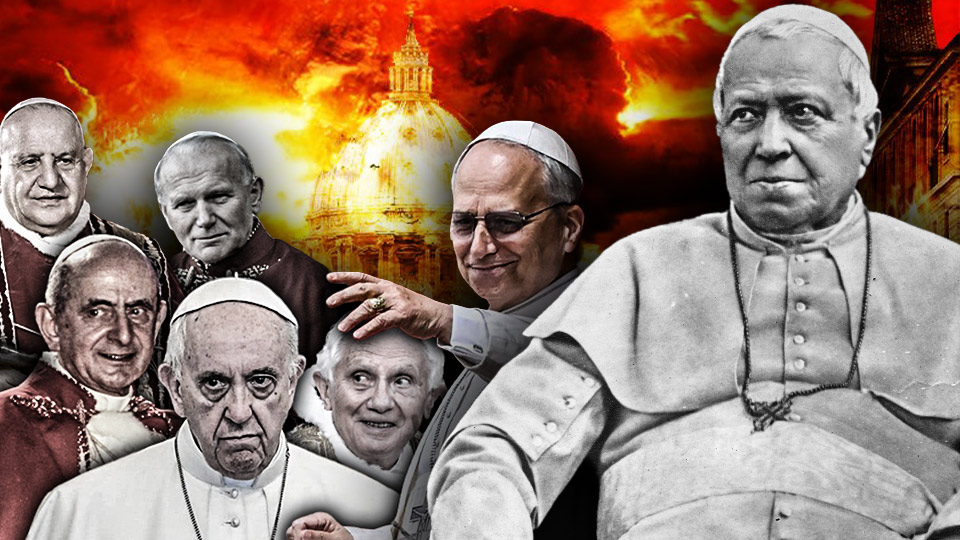
Without even considering the subject matter of Quanta Cura, we can already see that these words express ideas that we have not heard much from Rome since Pius XII. Pius IX saw his role in terms of guarding the lambs and sheep from poisoned pastures; unveiling and condemning heresies and errors; and constantly resisting the nefarious enterprises of wicked men. Did the popes stop thinking this way because the threats to Catholicism disappeared, or have the threats to Catholicism spread uncontrollably because the popes stopped thinking this way?
“Today, Christ’s Bride prefers the balm of mercy to the arm of severity.” — John XXIII
In his The Mystical Body of Christ in the Modern World, Fr. Denis Fahey explained why the Church must condemn errors to safeguard truth:
“The Catholic Church on earth is a divinely-instituted society formed of human beings redeemed by their Divine Head, the Second Adam, and, as a society, is animated by the Divine Life coming from that Head. Nevertheless, each and every one of the members of that society is obliged to struggle against the tendencies of the fallen nature received from the first Adam. The Church has for positive mission the diffusion of that life, thanks to which men can live, on their level, the Inner Supernatural Life of God. It is only through that life that even our human natural life can be lived as it should be. The life which the Catholic Church diffuses is spiritual. Accordingly, she demands the acceptance by the human intelligence of the truths God has revealed, and the accomplishment by the human will of the sacrifices required, in order that the life of grace may dominate in our fallen nature. The Catholic Church has for mission, therefore, not only to declare the content of revelation, but to safeguard revealed truth from all contamination of error, speculative and practical. The Church must condemn whatever is opposed to or in any way endangers the real life of the world. On account of man’s proneness to error since the fall, continual vigilance has to be exercised by the representatives of Christ the King. This accounts for the frequent condemnations of errors that are opposed to the true intellectual life and progress of the world.” (pp. 187-188)
If we believe these words then it would seem that only uninformed or negligent Catholics would want the Church to stop condemning the errors opposed to Catholic truth. To do so would not only lead souls astray but would, as Fr. Fahey said, endanger the “real life of the world.” After all, when Catholic truth is hidden or obscured, even non-Catholics suffer from the aftermath.
Do faithful Catholics still believe that the Church ought to safeguard truth from error?
Broadly speaking, it seems that those who do their best to adhere to what the Church has always taught absolutely believe that the Church ought to safeguard truth from error. Conversely, so-called cafeteria Catholics would almost certainly prefer times in which the popes and bishops do little to combat errors.
Many of us can identify the well-known moment that signaled a transformation, from the world of Pius IX to the one in which we now find ourselves. With these words of John XXIII to open Vatican II, the new path was announced:
“In these days, which mark the beginning of this Second Vatican Council, it is more obvious than ever before that the Lord’s truth is indeed eternal. Human ideologies change. Successive generations give rise to varying errors, and these often vanish as quickly as they came, like mist before the sun. The Church has always opposed these errors, and often condemned them with the utmost severity. Today, however, Christ’s Bride prefers the balm of mercy to the arm of severity. She believes that, present needs are best served by explaining more fully the purport of her doctrines, rather than by publishing condemnations.”
He made it abundantly clear that there was going to be a change, moving away from what we saw above from Pius IX. If we had been listening to these words on October 11, 1962, would we have applauded the change? Or would we have thought that perhaps this new orientation involved some risks, such as the possibility that “the nefarious enterprises of wicked men” might actually harm souls and the Church?
Of course it was not merely a matter of no longer condemning errors. In his The Second Vatican Council (an unwritten story), Professor Roberto de Mattei wrote of the surprise that many Council participants had when they learned of some of John XXIII’s appointments to the Council’s Preparatory Commission:
“Congar and de Lubac were appointed by John XXIII as consultors of the Preparatory Commission. Their names, it seems, were suggested by several conservatives . . . which surprised many, such as Archbishop Marcel Lefebvre, who wrote to Cardinal Ottaviani: ‘The names of Fathers de Lubac and Congar are with good reason names that conjure up opposition to the Church’s thinking and in particular to [Pius XII’s] Humani generis. How can these modernist-minded theologians have been appointed We wonder.’” (p. 192)
These men were not merely a few minor players at the Council, as we can glean from the words of Benedict XVI’s final address to the clergy of Rome:
“And this continued throughout the Council: small-scale meetings with peers from other countries. Thus I came to know great figures like Father de Lubac, Daniélou, Congar, and so on.”
Thus, over fifty years after Archbishop Lefebvre wondered to Cardinal Ottaviani how the modernist-minded theologians had been appointed to important roles at the Council, Benedict XVI praised the same men as great figures.
Essentially all Catholics who are serious and informed know that the Synod on Synodality is evil.
And as we know, Francis cited one of these “great figures,” Congar, as the inspiration for creating a different church with the Synod on Synodality:
“Father Congar, of blessed memory, once said: ‘There is no need to create another Church, but to create a different Church’ (True and False Reform in the Church). That is the challenge. For a ‘different Church,’ a Church open to the newness that God wants to suggest, let us with greater fervour and frequency invoke the Holy Spirit and humbly listen to him, journeying together as he, the source of communion and mission, desires: with docility and courage.”
Essentially all Catholics who are serious and informed know that the Synod on Synodality is evil — indeed, views about the Synodal Church would be a useful, though imperfect, litmus test to separate faithful Catholics from cafeteria Catholics. So would it have been better for John XXIII to have prevented Congar from playing such a vital role at the Council and all that has followed? Was confronting error with mercy, instead of condemnation, a good way to safeguard the Mystical Body of Christ? Or was it a way to invite God’s punishment, in the form of the crisis we have experienced ever since?
What about de Lubac? As discussed in a recent article, Leo XIV recently cited de Lubac — a “great theologian” — in a catechesis lesson about Vatican II’s Dogmatic Constitution on the Church, Lumen Gentium:
“Even those who have not yet received the Gospel are therefore, in some way, oriented towards the people of God, and the Church, cooperating in Christ’s mission, is called upon to spread the Gospel everywhere and to everyone (cf. LG 17), so that every person may enter into contact with Christ. This means that in the Church there is, and there must be, a place for everyone, and that every Christian is called to proclaim the Gospel and bear witness in every environment in which he or she lives and works. Thus, this people shows its catholicity, welcoming the wealth and resources of different cultures and, at the same time, offering them the newness of the Gospel to purify them and to raise them up (cf. LG, 13). In this regard, the Church is one but includes everyone. A great theologian described it thus: ‘The unique Ark of Salvation must welcome all human diversity into its vast nave. The only banquet hall, the food it distributes is drawn from all of creation. The seamless garment of Christ, it is also – and it is the same thing – the garment of Joseph, with its many colours.’”
Is it true, as de Lubac wrote and Leo XIV repeated, that the Church “must welcome all human diversity”? Does that sound Catholic? Should we have any concerns that this might mean that theological and moral diversity would be part of “all human diversity”?
The crisis we are enduring would not continue with such force if the popes still thought like Pius IX.
For those who are willing to confront these questions, it is worthwhile to consider which papal vision has been tailored to “welcoming all human diversity,” as Leo XIV advocates. Would it be the vision of Pius XII and his predecessors who condemned heresies and insisted that heretics were not part of the Church? Or would it be that of John XXIII and his successors who have had a more “merciful approach” with heresies and heretics? The answer is obvious, right? And this answer should lead us to conclude that the desire to unite all human diversity in a church that no longer condemns errors was the dream and goal of the enemies of God, who had been condemned consistently by Pius XII and his predecessors. Surely it is for this reason that the only ones condemned by Rome today are those backward Traditionalists who still think that truth is incompatible with heresy.
Even among Catholics who sincerely wish to faithfully adhere to the Church’s immutable teaching, there are disagreements, such as: what should we think of Vatican II and the popes who have obscured the Catholic Faith? There will be great saints who disagree on these matters, but all of us should be able to agree that the crisis we are enduring today would not be continuing with such force if the popes and bishops still thought like Pius IX. And if we can agree on that, perhaps we can finally resolve to do everything we can to help all Catholics of good will to return to the indispensable guidance and warnings that God gave His Church through Pius XII and his predecessors. Immaculate Heart of Mary, pray for us!