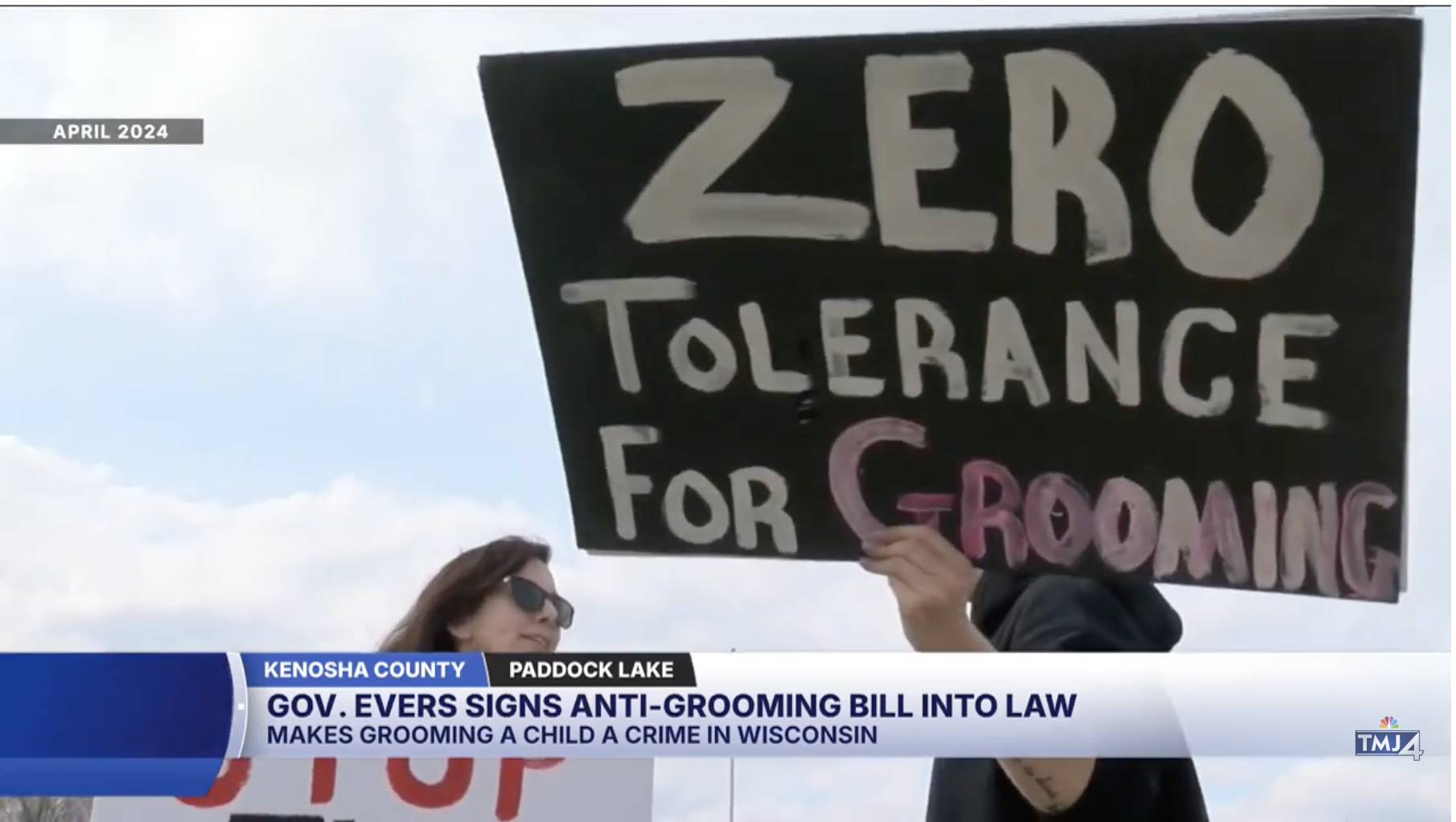
Wisconsin has become the latest state to criminalize grooming, passing a bipartisan package that proponents believe will set a national standard for protecting children from sexual predators.
So why did the state’s Democrat governor sign the legislation in behind closed doors? Why did the Badger State’s leading leftist candidate for governor and the head of a local teachers union vote against the bills?
‘A Major Step Forward’
Assembly Bill 677 establishes a criminal definition of child grooming and imposes felony penalties on predators who target children. The new law defines grooming as “a course of conduct, pattern of behavior, or series of acts with the intention to condition, seduce, solicit, lure, or entice a child for the purpose of engaging in sexual intercourse or sexual contact or for the purpose of producing, distributing, or possessing depictions of the child engaged in sexually explicit conduct.”
Senate Bill 673 requires all Wisconsin schools to create clear anti-grooming policies and training “governing appropriate communication between staff and students.”
“After nearly two years of working to strengthen protections for children in Wisconsin, I’m grateful to see these two important bills signed into law,” Rep. Amanda Nedweski, a southeast Wisconsin Republican and co-author of the legislation, said in a statement. “This is a major step forward in protecting kids, supporting victims, and ensuring that those who prey on children are held accountable.”
‘Our Young Girl’s Life Was Profoundly Affected’
The bills in large part were in response to the case of Christian Enwright, a former Kenosha public school teacher who in April pleaded guilty to 15 counts of disorderly conduct after prosecutors said he engaged in a “sexually charged,” two-year social media relationship with a female student, beginning when she was 12. The investigation found that Enwright had sent hundreds of Snapchat messages to the student. He at first claimed he was merely trying to build up the girl’s confidence. Enwright was sentenced in July to 450 days in the Kenosha County Jail and three years of probation.
Despite overwhelming evidence of sexually inappropriate conduct, prosecutors could not charge Enwright with anything stronger than misdemeanor disorderly conduct because Wisconsin had no law against or definition for grooming, Nedweski testified during a legislative hearing.
“Our young girl’s life was profoundly affected by the actions of someone she should’ve been able to trust,” the victim’s father said, according to Fox6 in Milwaukee. “A teacher is meant to guide, protect and inspire – not manipulate.”
In another case, Chippewa Falls police said a man in his 70s used a big bag of lollipops to earn the trust of children. Despite telling law enforcement officials he was sexually attracted to pre-teen boys and would commit sexual assault if left alone with a child, prosecutors couldn’t charge the man.
State Sen. Jesse James has investigated several grooming-related cases over his law enforcement career. As the only active law enforcement officer in the legislature, he helped drive the legislative package.
“I have numerous cases throughout my career where if grooming was in statute at the time we would have been able to address it and actually added more charges to the cases,” James, co-author of the bills, told me Friday on the Dan O’Donnell Show in Milwaukee. “Sadly, I’ve lost cases in jury trials when it comes to this type of activity, sexual assault of children.”
Moving forward, convicted groomers will have to register with the state as sexual offenders.
“I think we will set a standard for other states to follow with our legislative language that we’ve incorporated into this bill with the help of the Chippewa Falls Police Department, because, really, it was their case that [spurred] this action.”
‘They Need to Change’
Wisconsin has joined 13 other states that criminalize grooming as a felony, according to Enough Abuse, a nonprofit child sexual abuse prevention organization. An anti-grooming bill is pending in the Kentucky legislature. And Iowa is looking to strengthen its current anti-grooming law to include offenders who attempt to groom a minor — even if the child turns out to be an undercover officer.
Fifteen states now have laws defining grooming as a process of manipulating a child in an effort to gain the child’s trust and sexually abuse him or her, according to Enough Abuse.
An investigative series by the Cap Times cast a huge spotlight on the dark issue of grooming in Wisconsin’s public schools. The series uncovered the state Department of Public Instruction had quietly investigated more than 200 teachers, aides, substitutes and administrators accused of sexual misconduct or grooming of children from 2018 to 2023. Those investigations were kept hidden from the public eye.
“They need to change. That’s insufficient. That’s not going to keep kids safe,” Charol Shakeshaft, author of one of the most comprehensive reviews of teacher sexual misconduct for the U.S. Department of Education, told the Madison publication.
‘Immoral Conduct’
Tony Evers, the Democrat who would be elected governor in late 2018, was superintendent of Public Instruction at the time. He had been in the leadership position for nearly a decade.
Perhaps that’s why Evers, who has decided not to seek a third term as governor, decided to quietly sign the bipartisan anti-grooming legislation into law. No ceremony. No press. No lawmakers present.
Just a press release, insisting that the former education chief is “glad the Legislature took this seriously this session and passed bipartisan legislation to get this done.” Nedweski said she learned the bills had been signed through a 9:46 a.m. email from Amanda Butterfield, Evers’ Legislative Affairs assistant, rather than through advance notice from the governor’s office.
“Unfortunately, the decision to quietly release news of the bill signing as part of a Friday news dump limited the opportunity to make the public aware of this important step forward in protecting Wisconsin’s children,” the lawmaker said. “Under Act 88, predators can now get up to 25 years in jail for grooming a child for sexual activity. These strong deterrents will keep kids safe and put predators behind bars.”
Evers may not have wanted to remind Wisconsin voters that the education agency he long lead — and the powerful teachers unions so generous to his political campaigns — kept sexual abuse offenses against Wisconsin’s most vulnerable on the down-low.
DPI Superintendent Jill Underly, another union stooge like her predecessor, has argued that long-standing statute on “immoral conduct” did not include language on grooming, making it difficult for DPI to revoke teacher licenses for what was clearly “immoral conduct.”
The bipartisan bills were supported by all but a half-dozen Democrats, including state Rep. Francesca Hong, the far-left Democratic Party frontrunner in this year’s governor’s race, and Rep. Angelina Cruz, president of Racine’s public school teachers union.
The Republican Party of Wisconsin was quick to alert voters to Hong’s “no” vote.
“Francesca Hong voted against protecting YOUR children. From pushing the Dems further left and leaving children behind, she can’t be trusted to govern,” the GOP wrote on X.
Matt Kittle is a senior elections correspondent for The Federalist. An award-winning investigative reporter and 30-year veteran of print, broadcast, and online journalism, Kittle previously served as the executive director of Empower Wisconsin.