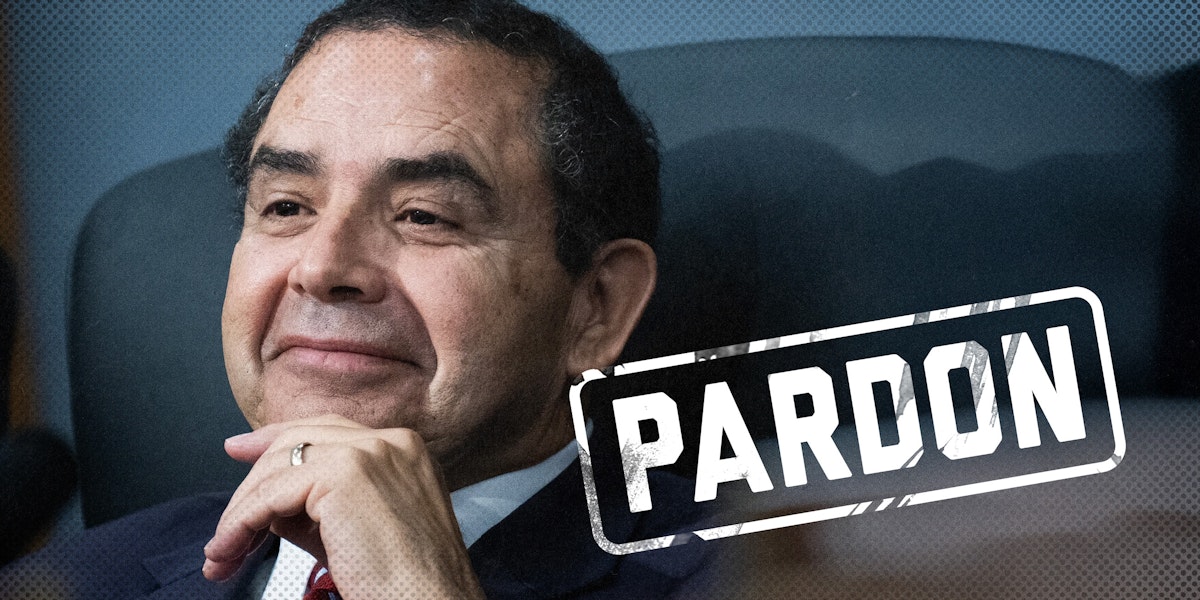
President Donald Trump’s decision to pardon Democrat Representative Henry Cuellar has stunned a lot of people — especially those of us who have followed Cuellar’s corruption for years. I was involved in uncovering key pieces of Cuellar’s misconduct during his indictment by the Department of Justice. Earlier this year, I helped expose the foreign bribes he took from Azerbaijan and Mexico, and I documented the disturbing irregularities in his 2024 congressional race against Republican Jay Furman. Cuellar’s record is not misunderstood. It is not exaggerated. It is exactly what it looks like: the record of a profoundly corrupt politician.
That is why Trump’s pardon feels, on the surface, almost impossible to justify. But politics is rarely clean, and in this case, it is clear to me that — uncomfortable as it is — Trump made the right strategic call.
The charges against Cuellar remain some of the most serious ever brought against a sitting member of Congress. According to the federal indictment, Cuellar and his wife accepted nearly $600,000 in bribes from Azerbaijan’s state-owned oil company, SOCAR, and from Mexico’s Banco Azteca. The money was funneled through shell companies owned by Cuellar’s wife and disguised as consulting fees. Prosecutors say she performed “little or no work” for those massive payments.
The scheme began around 2013, after the Cuellars traveled to Turkey and Azerbaijan on a trip funded by a Houston nonprofit. What looked like routine travel quickly evolved into a years-long exchange of influence, cash, and policy favors. Prosecutors detailed direct communications between Cuellar and Elin Suleymanov, Azerbaijan’s ambassador to the United States, including discussions about contracts and legislation that would benefit the Azerbaijani government.
One of the “contracts” alone provided $20,000 per month to Cuellar’s wife’s companies until 2019.
Cuellar’s work for Mexican interests was no cleaner. Banco Azteca agreed to pay Cuellar’s wife $12,000 per month, plus potential bonuses of up to $500,000, in return for Cuellar’s help in weakening U.S. regulations. He allegedly pushed to soften anti-money-laundering language, offered insider updates to bank executives, and even texted them seeking input on legislation before it moved through Congress.
To hide the operation, Cuellar used intermediaries who later pleaded guilty to money laundering — including longtime associate Florencio “Lencho” Rendon and former chief of staff Colin Strother. And when the FBI raided Cuellar’s home in Laredo in 2022, the depth of the scheme became unavoidable.
Corruption does not get much clearer than this. And yet President Trump issued a full pardon.
So why would he do it?
Because Henry Cuellar is not a typical Democrat. He is one of the last remaining moderates in his party — pro-border security, critical of the far left, and increasingly isolated within the Democrat caucus. Trump understands political realignment better than any figure in American politics today. South Texas has already been shifting toward the Republican Party. A figure like Cuellar, who has until Monday to change his party registration for the next election cycle, could accelerate that shift dramatically.
If Trump can flip even a single Democrat of Cuellar’s stature — or simply secure his open support — it sends a national message: the realignment is growing, and the Democrat coalition is cracking from within.
I don’t like seeing Henry Cuellar walk away from accountability. Based on everything I’ve seen firsthand — his dealings with foreign governments, the money laundering, the election inconsistencies — he deserves consequences, not clemency.
However, the pardon was needed for a broader strategy. In the balance of power in Congress, South Texas, and the broader political landscape, President Trump made a difficult but ultimately correct calculation.
Sometimes leadership requires choosing the move that feels wrong but strengthens the country’s future. Trump’s pardon of Henry Cuellar is one of those moments.