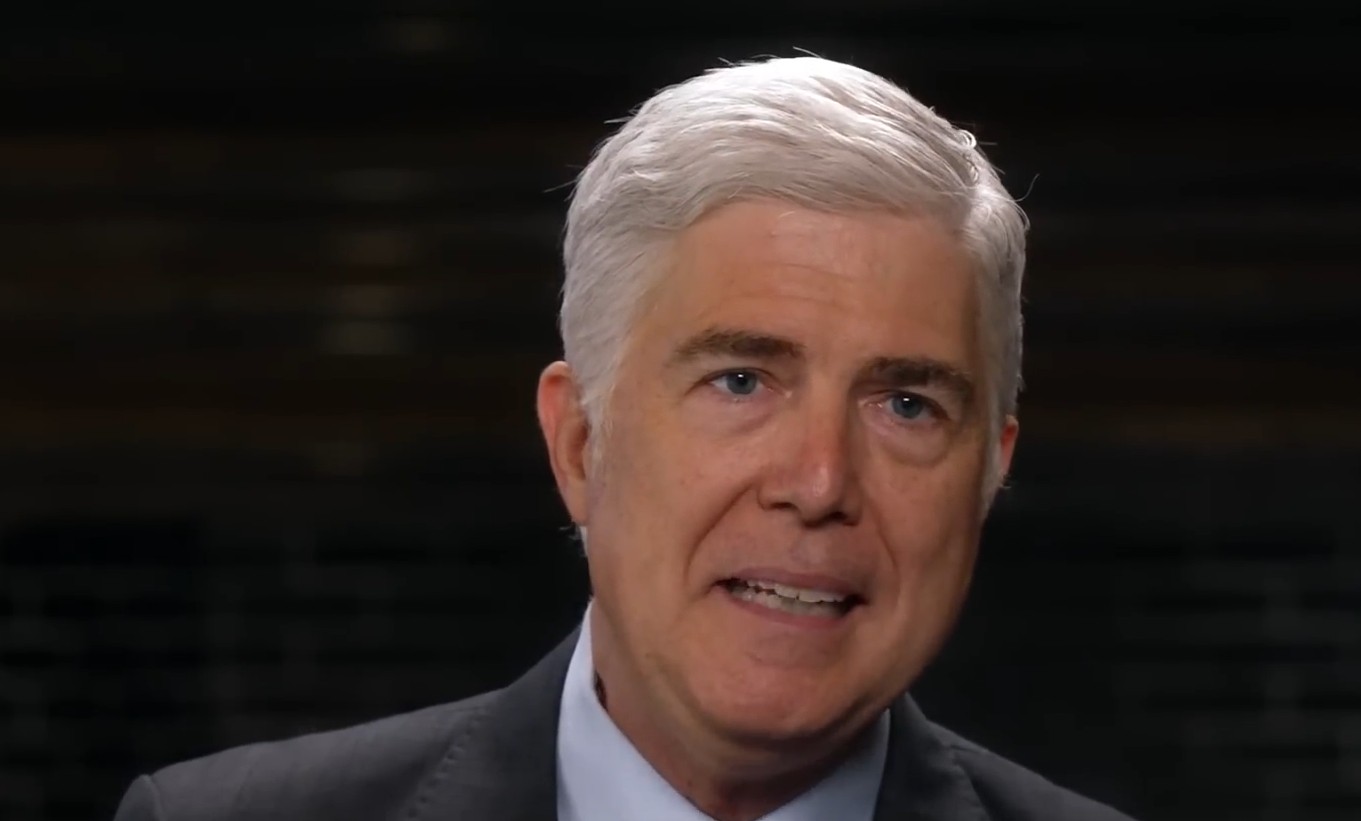
Justices Neil Gorsuch and Amy Coney Barrett, both appointees of President Donald Trump, appeared to be buying into “transgender” ideology during oral arguments for a case regarding men playing in women’s sports.
Gorsuch’s major contribution to the Tuesday oral arguments thus far was relatively early on, when he suggested that people identifying as “transgender” should be considered a “discrete” group “given the history of de jure discrimination against transgender individuals in this country.” The justice essentially asked whether those who claim to be “transgender” should be a legally protected class.
This really comes as no surprise for Gorsuch, who authored Bostock v. Clayton County, which essentially invented a protected class for those claiming to be “transgender” with regard to Title VII workplace discrimination.
However, in Bostock, he danced around the issue in an extremely strained and convoluted way by claiming that “transgender” discrimination was “sex” discrimination, since one would have to know the true sex of an individual in the first place in order to discriminate against a trans-identifying person.
The Biden administration used that case to expand “transgender” identity into every part of its policy and enforce radical gender ideology across the federal government and in states and localities that received federal funding. Many conservatives consider Bostock to be the worst decision since Roe v. Wade.
Idaho Solicitor General Alan Hurst replied to Gorsuch on Tuesday that while there has been some discrimination, the reality is that a protected class needs to have encountered discrimination that mirrors the “discrimination that … people have faced on the basis of race or sex in this country.”
The Supreme Court dealt with this issue to some degree in United States v. Skrmetti, which allowed states to ban the use of chemical castration drugs and genital mutilation surgeries for children claiming to be a sex or gender that conflicts with their biology.
In Skrmetti Barrett actually wrote a separate opinion, joined by Justice Clarence Thomas, explaining why “transgender” identity is not a separate protected class.
“We have held that the mentally disabled, the elderly, and the poor are not suspect classes,” she wrote, adding:
The Sixth Circuit held that transgender individuals do not constitute a suspect class, and it was right to do so. To begin, transgender status is not marked by the same sort of “‘obvious, immutable, or distinguishing characteristics’” as race or sex. In particular, it is not defined by a trait that is “‘definitively ascertainable at the moment of birth.’” The plaintiffs here, for instance, began to experience gender dysphoria at varying ages — some from a young age, others not until the onset of puberty. Meanwhile, the plaintiffs acknowledge that some transgender individuals “detransition” later in life — in other words, they begin to identify again with the gender that corresponds to their biological sex. Accordingly, transgender status does not turn on an “immutable . . . characteristi[c].”
Nor is the transgender population a “discrete group,” as our cases require. Instead, like classes we have declined to recognize as suspect, the category of transgender individuals is “large, diverse, and amorphous.”
However, despite Barrett’s writing on the issue, in Tuesday’s oral argument, she consistently referred to boys claiming to be “transgender” as “trans girls” and the like.
While it is expected that the three left-wing justices will play word games like this — particularly Ketanji Brown Jackson, who famously claims to have no idea what a woman is despite being a woman herself — having a conservative justice give linguistic legitimacy to the idea that men can become women or that there are people who are truly “transgender” is unacceptable.
Barrett also suggested that prepubescent boys have no physical advantage over prepubescent girls, which Hurst quickly dispelled, pointing to medical evidence that boys do have advantages over girls even at such a young age.
While the current Supreme Court majority ruled in favor of allowing state bans on the medical industry side of the “transgender” debate, the issue of sports and Title IX could end differently. After all, the fact that Gorsuch wrote the pro-“transgender” majority opinion in Bostock and Chief Justice John Roberts joined in that opinion sets up the potential for a 5-4 decision in favor of men in women’s sports.
Breccan F. Thies is the White House correspondent for The Federalist. He previously covered education and culture issues for the Washington Examiner and Breitbart News. He holds a degree from the University of Virginia and is a 2022 Claremont Institute Publius Fellow. You can follow him on X: @BreccanFThies.