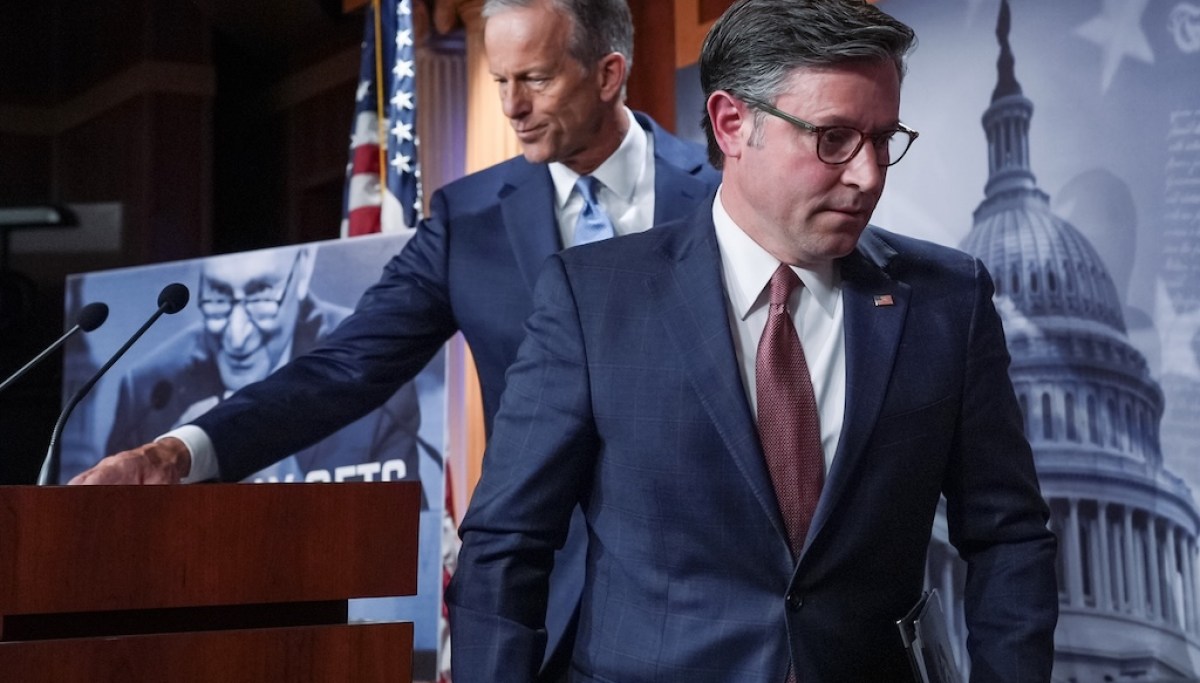
Congressional Republicans are revisiting the same intraparty tensions that turned passage of last year’s “big, beautiful bill” into a drawn-out and politically damaging saga.
Republicans in the House and Senate have begun discussing what might get included in another attempt at reconciliation, the party-line budget process they used to pass President Donald Trump’s tax law. At the top of the list is money for the war in Iran and immigration enforcement. Republicans are also contemplating ways to pass a watered-down version of the SAVE America Act, their flagship election bill.
They are moving ahead despite a heavy dose of skepticism that a GOP-only bill, even a relatively narrow one, can get through the House, where Republicans have a threadbare, one-vote majority — and despite the infighting they endured last summer, when months of disagreement over Medicaid reform threatened to derail the first reconciliation bill.
Senate Republicans nonetheless see reconciliation as an escape hatch to Trump’s fuming over the filibuster, which is allowing Democrats to block the SAVE America Act and funding for Immigration and Customs Enforcement. Democrats have also signaled opposition to funding the war with Iran.
Sen. Lindsey Graham (R-SC), the Senate Budget Committee chairman, launched the reconciliation push on Wednesday with the blessing of Trump and Senate Majority Leader John Thune (R-SD). And in a sign of early coordination, Graham met with his House counterpart, Budget Chairman Jodey Arrington (R-TX), the same day for what he called a “great” initial conversation.
Yet Republicans are hardly on the same page about what should go into a reconciliation bill, and even the legislation’s core pillars have become controversial among congressional Republicans.
House rebels view the attempt to squeeze the SAVE America Act into reconciliation, a restrictive budget process that requires all language to have a direct fiscal impact, as capitulation and want to see the entire bill, including its mandates on voter ID and proof of citizenship, signed into law.
On Iran, Republicans have stood behind Trump as the conflict drags into a second month, but at least one House conservative, Rep. Nancy Mace (R-SC), has threatened to oppose funding if the president sends ground troops into combat.
The White House has not yet requested funding for Iran, though the Pentagon is apparently asking for an eyebrow-raising $200 billion.
The headache of muscling a bill through the Senate, a chamber with its own unique set of rules and senator privileges, was enough to keep Thune from pursuing reconciliation until this week. In the House, top Republicans openly described it as wishful thinking due to their slim margins.
But the climate of congressional gridlock has quickly changed that calculus, and Republicans have decided it’s better to risk GOP division than bank on Democratic cooperation. In terms of the filibuster, which requires 60 votes for most legislation, Thune announced earlier this month that there wasn’t enough Republican support to weaken or sidestep it, leaving reconciliation as one of the only off-ramps to advancing Trump’s second-year agenda.
The push is unfolding against the backdrop of a monthlong shutdown at the Department of Homeland Security that now has House and Senate Republicans at each other’s throats. Thune reached a deal with Senate Democrats to leave ICE unfunded, betting that the agency will receive money under reconciliation. House Republicans rejected that piecemeal approach, with Speaker Mike Johnson (R-LA) describing it as a “joke.”
Tempering expectations
Senate Republicans are trying not to overpromise when it comes to what will make it into a reconciliation bill, and explicitly want to avoid a repeat of last year, when lawmakers stuffed all of Trump’s priorities, from tax cuts to defense to permitting reform, into a single piece of legislation.
“It won’t be the one big, beautiful bill — it’s going to be focused on protecting our homeland and helping our troops,” said Graham.
But House Republicans have other ideas for the legislation and have long seen it as a vehicle for policies that were left on the cutting room floor. Johnson, in particular, floated the legislation as a way to tackle healthcare reform, while the Republican Study Committee, the largest caucus of House conservatives, released a framework in January that detailed proposals on housing and energy costs, on top of those addressing healthcare affordability.
“I’m glad to know the Senate is interested in reconciliation 2.0,” Johnson told reporters on Wednesday. “We need to do that. It’s an important legislative tool.”
At a policy conference for House Republicans in Doral, Florida, earlier this month, Johnson quipped that “it will not be as big, but it can be just as beautiful.”
In terms of election language, Graham has pitched reconciliation as a “down payment” on the SAVE America Act and gave it only a passing mention in his Wednesday statement announcing the latest budget push.
To comply with budget reconciliation rules, Republicans are expected to attach strings to the federal funds states use to administer elections, incentivizing photo ID and other voting requirements.
Thune had called the idea “very, very difficult,” but changed tack when Trump began demanding that the SAVE America Act be attached to DHS funding, a nonstarter for Democrats who claim the bill is an attempt at voter suppression.
Welfare reform 2.0
At the outset, both Graham and Arrington are eyeing pay-fors that could include language to clamp down on welfare fraud, suggesting Republicans believe they will need to offset the legislation’s price tag to bring fiscal hawks on board.
“It’s the first thing we discussed – let’s pay for this,” said Sen. Ron Johnson (R-WI), a member of the Senate Budget Committee.
Still, any attempt to rein in entitlement spending could create another rift between those fiscal hawks and more centrist members of the party, as it did when Republicans contemplated a menu of Medicaid changes to keep the cost of Trump’s tax law in check.
The party ultimately united behind relatively modest reforms, including new work requirements and eligibility checks, but the offsets became such a hang-up that Thune had to negotiate specific carveouts for Alaska, the home state of centrist Sen. Lisa Murkowski (R-AK), before the bill could pass the Senate.
Arrington named illegal immigrant access to low-income housing tax credits as one area for savings in a Friday interview on CNBC. Republicans have also emphasized the reports of mass welfare fraud in Minnesota and other states to argue for reform.
Change of heart
For months, Johnson has been a cheerleader for reconciliation and, on Thursday afternoon, met with some of the House Republicans whose votes could prove decisive in any floor vote.
But Thune has been slow to embrace the process, in part because it is viewed as so cumbersome. He joked to reporters that Republicans will need a map to keep track of all the possible votes Democrats could force in overnight voting sessions known as “vote-a-ramas.”
Last year, Republicans also had to deal with days of trading paper with the parliamentarian, a nonpartisan referee of Senate rules who gets to decide whether language complies with budget reconciliation.
That veto power has drawn the ire of House Republicans and even Trump himself, leading to calls for her firing. On Tuesday, Thune said that he expected Republicans would respect her rulings on a second reconciliation bill.
“I would expect that’s an iterative process and a back-and-forth, sometimes trading back different ideas to see what works,” Thune said at his weekly press conference. “But obviously, the parliamentarian has a role to play in that process. And in the past, we have respected it. And I would expect we would do that.”
In terms of its scope, Thune is urging Republicans to stay “realistic” about what can be accomplished through reconciliation and on Wednesday warned against expansive legislation.
“I think to succeed, it’d have to be pretty narrowly focused,” Thune said.
Trump, for his part, has previously dismissed the need for another party-line bill, arguing that his tax law encapsulated all of his priorities.
“In theory, we’ve gotten everything passed that we need,” Trump said in February. “Now we just need to manage it. But we’ve gotten everything passed that we need for four years.”
TRUMP SIDES WITH JOHNSON IN SENATE-HOUSE BROWL TO END DHS SHUTDOWN
More recently, Trump has fixated on the SAVE America Act, which cleared the House last month, and has repeatedly called on Senate Republicans to “terminate” the filibuster to pass it. He’s kept an open mind to Thune’s use of reconciliation as a middle ground, but has frequently vented about its limitations.
“I think he’s willing to try all strategies,” White House press secretary Karoline Leavitt said on Wednesday. “I spoke with him about this yesterday, and he said if we can make it work through reconciliation, let’s absolutely do that.”