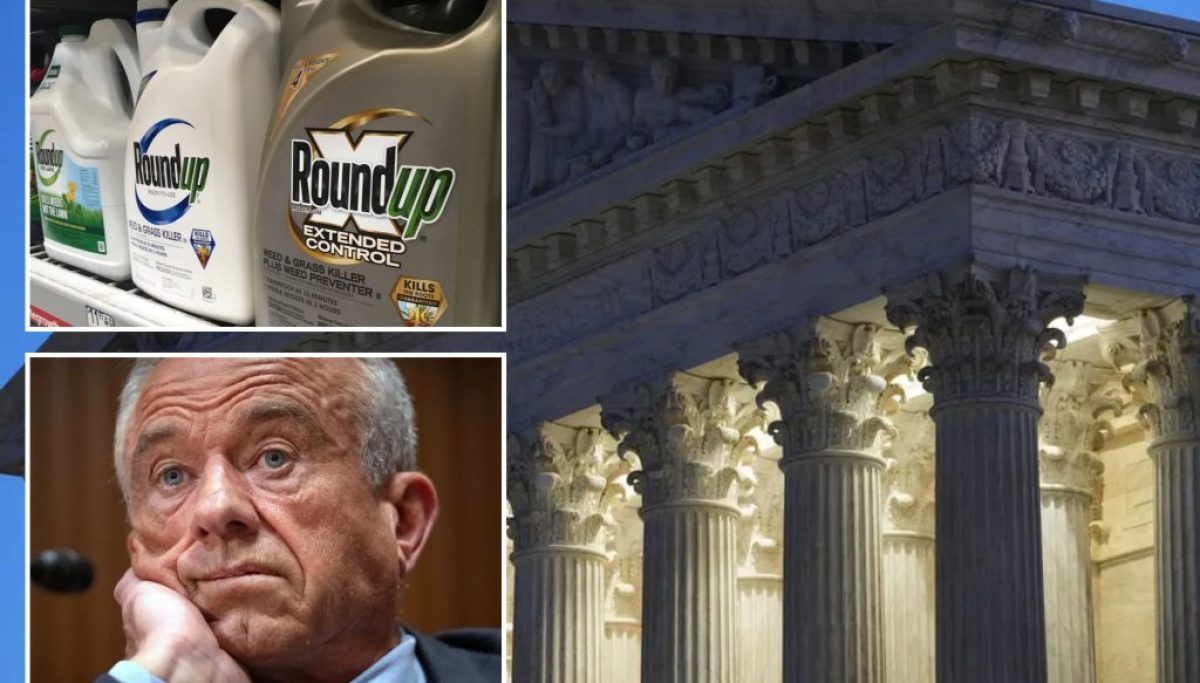
The world’s most common herbicide is driving a wedge between Make America Healthy Again activists and their champions in the Trump administration.
Tensions within the MAHA coalition are straining because of how President Donald Trump, his cabinet, and the Republican Party have seemingly embraced protecting the makers of the chemical herbicide glyphosate, the main ingredient in RoundUp.
Glyphosate has been at the center of hundreds of thousands of lawsuits over the claim that the household weed killer and agricultural tool causes non-Hodgkin’s lymphoma, a form of cancer that attacks the immune system.
During Supreme Court oral arguments on April 27, the Justice Department will support Bayer, a German biotechnology company that purchased Monsanto and its product RoundUp in 2018. The case, Monsanto Company v. Durnell, hinges on whether Bayer should be held responsible for failing to warn consumers of a possible cancer risk despite following labeling restrictions set by the Environmental Protection Agency. The Trump administration says no.
Trump also gave Bayer a leg up in February with an executive order that invoked national security protections to shield the company from liability. The order also calls on the company to produce more glyphosate domestically to protect the integrity of the food supply.
MAHA hardliners feel betrayed by Health and Human Services Secretary Robert F. Kennedy Jr., the former environmental lawyer who litigated against Monsanto, for his apparent flip-flop in supporting the executive order and his lack of involvement in the looming Supreme Court case.
Jennifer Galardi, senior policy analyst for the Heritage Foundation’s Restoring American Wellness program, told the Washington Examiner that glyphosate is the “elephant in the room right now” that threatens the stability of the MAHA movement, but she remains optimistic.
“I anticipate that it’s going to be a bumpy road. I don’t think you’re going to satisfy everybody,” said Galardi.
Here is everything to know about the glyphosate conflict between MAHA and the GOP.
What to know about glyphosate
Glyphosate works by binding to weeds and preventing them from making the proteins necessary to sustain life and continue growing.
Roughly 280 million pounds of glyphosate are sprayed on nearly 300 million acres of United States farmland each year, according to the EPA. The chemical is not only sprayed on crops as a weedkiller but also in a process called crop desiccation, in which farmers spray glyphosate on wheat, barley, and other grains to make harvesting easier.
Scientists are still struggling to determine how much glyphosate exposure is dangerous, and much of the disagreement comes from how much weight to give to different types of evidence.
Laboratory studies of human cells and animal research suggest that glyphosate can damage DNA and alter gene expression, which is linked to increased inflammation, as well as liver and kidney damage in animals.
But conducting studies on glyphosate’s effects on the whole human body is challenging because the chemical’s half-life, or how long it survives in the body, is roughly five to 10 hours. That means it is hard to measure glyphosate exposure over long periods to capture long-term effects. While there are small-scale laboratory studies that show glyphosate causes chronic conditions such as cancer, endocrine disruption, and oxidative stress in cells, extrapolating those results to population levels is difficult.
Regulatory bodies around the world disagree on what evidence to consider when determining whether glyphosate is safe.
The International Agency for Research on Cancer, a body of the World Health Organization, first classified glyphosate as “probably carcinogenic” in 2015, a classification that is frequently cited in litigation against Bayer-Monsanto.
But the EPA in 2016 concluded that glyphosate is “not likely to be carcinogenic to humans” and poses “no other meaningful risks to human health” if used as directed. The United Nations’ Food and Agriculture Organization came to the same conclusion in 2016, as did the National Cancer Institute in 2018.
Supreme Court and Trump’s executive order
The Trump administration’s argument in the pending Supreme Court case and Trump’s February executive order both protect Bayer from civil liability claims related to glyphosate, which has riled up MAHA advocates for similar reasons.
Monsanto Co. v. Durnell, which the court has said will be decided by the end of this term in June, centers on whether federal rules that product labels follow EPA science override state laws mandating that companies have a duty to inform their consumers of possible health concerns.
Bayer advocates say the company is in an impossible position, arguing that it ought not be held liable in civil cases at the state level if it is following the federal EPA’s determination that glyphosate does not cause cancer.
Bayer has already paid billions for this catch-22. Since the first case against RoundUp was litigated by Kennedy and his colleagues in 2018, Bayer and Monsanto have paid more than $11 billion in collective damages. In late February, the company agreed to pay an additional $7.25 billion to be distributed to claimants regardless of how the Supreme Court rules in the case.
In early March, Trump DOJ officials filed the administration’s third brief to the Supreme Court in support of Bayer and the supremacy of federal regulation over state duty-to-inform laws.
Rep. Thomas Masse (R-KY) has opposed the Trump administration’s approach to the case, arguing that the Constitution protects the right to trial by jury.
Environmental advocates opposed to the Trump administration also argue that the company knew glyphosate could cause cancer years before litigation began, did not inform their users, and shielded Bayer from liability that would only cause further harm.
Trump’s February executive order had a similar effect of shielding Bayer from civil claims by mandating that it increase production of glyphosate and elemental phosphorus under the Defense Production Act. The order argued these chemicals are critical to maintaining the nation’s food supply.
Despite his years of advocacy against glyphosate, Kennedy has not only remained publicly silent about the Supreme Court case, but he has also come out in support of Trump’s executive order.
Kennedy said on X several days after the order was signed that herbicides and pesticides are “toxic by design” and “put Americans at risk,” but eliminating them overnight “would be disastrous.”
“President Trump did not build our current system — he inherited it,” Kennedy said, adding that Trump’s action “protects our defense readiness and our food supply” in the near term while researchers and policy experts expand access to regenerative agriculture and new technologies to diminish long-term dependence on glyphosate.
Galardi said an upside of Trump’s directive to onshore more glyphosate manufacturing is a better opportunity for tighter regulation than importing it from China, the largest producer of the chemical.
“These products are produced in China, so that’s not good,” Galardi said. “You kind of have to take baby steps to this thing.”
The MAHA fallout and the long-term strategy
Although most MAHA activists concede the food system as it exists right now depends on glyphosate and other chemicals, they have lambasted Kennedy and the Trump administration for shielding Bayer from liability.
Anna Matson, a MAHA-aligned independent journalist, responded to Kennedy’s defense of the executive order by saying that a gradual transition away from glyphosate is understandable, but granting Bayer legal protections is not.
“Farmers can use glyphosate, but they should at least be warned that it could kill them and those that live nearby and eat their food,” Maston replied to Kennedy.
Activist Vani Hari, who also goes by the pseudonym “the food babe,” responded to the executive order by saying on X it is a mistake to give “the most evil corporation in the world immunity.”
“Bayer is working for immunity in state bills, the federal farm bill, in Supreme Court decisions and EOs to get away with murder,” Hari said.
Galardi told the Washington Examiner that she believes Kennedy’s “heart is in the right place” and that sustainable reform takes time.
“It took us a long time to get to this point of epidemic levels of chronic disease; it’s going to take a long time to get out of it,” Galardi said. “It’s going to take patience and endurance and perseverance, and you’ve got to keep fighting.”
Calley Means, a longtime nutritional health activist and senior adviser to Kennedy at HHS, told MAHA supporters at an event in February following the executive order that Kennedy was “disappointed” with the decision.
Means said Kennedy has been in contact with venture capitalists and National Institutes of Health Director Jay Bhattacharya to spur research on alternatives to glyphosate and improve regenerative agricultural practices.
“We are going to research a bridge off these toxic chemicals that our farmers are unfortunately dependent on,” Means said.
Implications for 2026 midterm elections
Although MAHA activists have railed against the Trump administration for its policy decisions on glyphosate, the majority of voters heading into the 2026 midterm elections do not see pesticides and herbicides as a priority, even for nutritional health.
Republican pollster and strategist Adam Geller surveyed voters last year and found that only 9% of Americans say that government regulation of farmers’ use of pesticides should be a priority for federal officials.
Nearly half of the survey participants, 46%, agreed that “American farmers need pesticides to grow enough food for the country,” and that pesticides are essential to “reducing the trade deficit and protecting our national security.” Another six in 10 voters said that farmers’ ability to control weeds, disease, and pests keeps food prices affordable.
Galardi said that the war with Iran and affordability have taken center stage for voters, likely above most MAHA-related concerns.
“For most people, the fact that we’re at war, and there [are] still these economic bread-and-butter table issues that people are dealing with financially, I think that’s going to drive more people,” Galardi said.