Seven states seceded from the Union before James Buchanan left office in 1861, and within months of Lincoln’s inauguration, the forces of slavocracy directly threatened the capital with the Confederate victory at Bull Run. Whatever one thinks of American democracy in 2025, it is not under any more dire threat than the one contained in the telegram Lincoln received informing him of that rout, just 30 miles west of the White House: “The day is lost. Save Washington and the remnants of this army.”
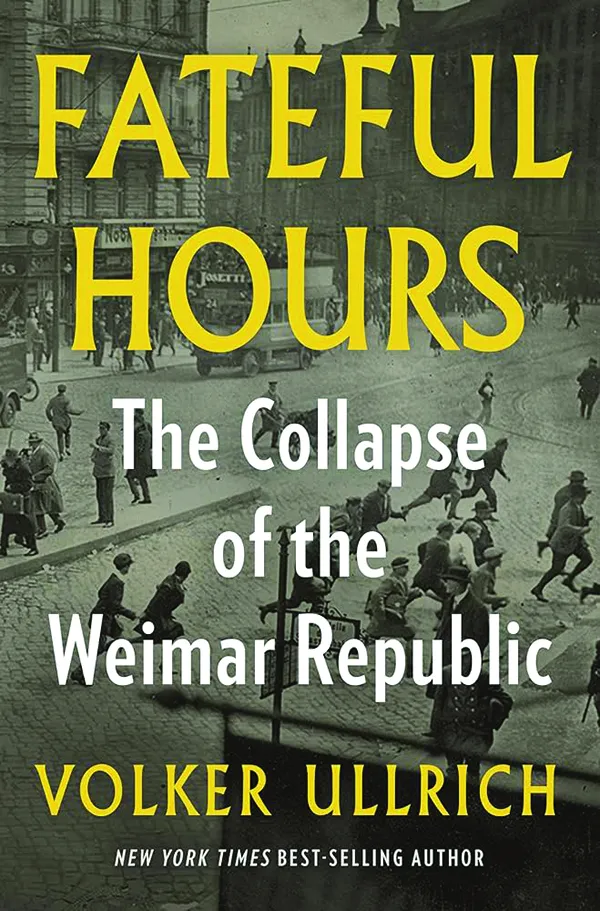
Nevertheless, in the preface to German historian Volker Ullrich’s new history, Fateful Hours: The Collapse of the Weimar Republic, we hear that because “Democracies are fragile” and “can flip into dictatorships,” we should assess that “The future of American democracy has never been so uncertain since the declaration of independence almost 250 years ago.” Claims like this, which surround most of the last decade of discourse about Weimar Germany, named for the city where the post-World War I German constitution was established in 1919, have become a common refrain among European and some American liberals since the first election of Donald Trump. The clever panicmonger of course cannot claim that America is presently living under something comparable to Nazism, so drawing parallels between present-day America and the period immediately preceding Hitler serves to give a veneer of historicity to what is effectively nothing more than the expression of an unprovable prediction about the future, or a hyperbolic expression of personal disapproval that is not even meant to be read as literally true.
For a historian as eminent as Ullrich, also the author of two Hitler biographies from 2013 and 2020, it is disappointing to see him put his subject area expertise in service of current political exigency. But it’s a relief to find, then, that Ullrich’s brief analysis of 21st-century politics is merely a hook for his riveting account of the politics of Germany from the November Revolution of 1918 to Adolf Hitler’s ascent to the chancellorship in 1933. Yes, this is well-trod ground, but Fateful Hours does two things to approach the story from a fresh angle. The first is that this is not, primarily, an account of the rise of Adolf Hitler, though the question hanging over the book is, of course, that of when the rise of Nazism became inevitable. Relatedly, the second approach is to treat the Weimar Republic as a flawed but real effort at democratic self-rule, one that need not have produced the Führer, blitzkrieg, and Auschwitz.
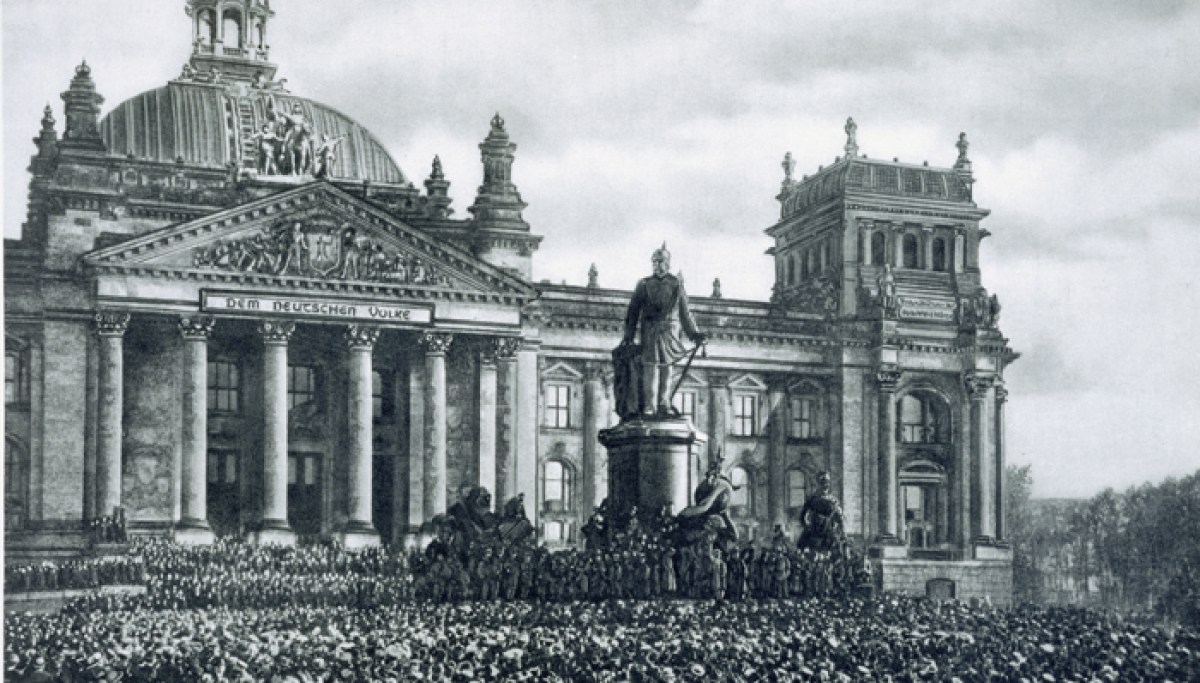
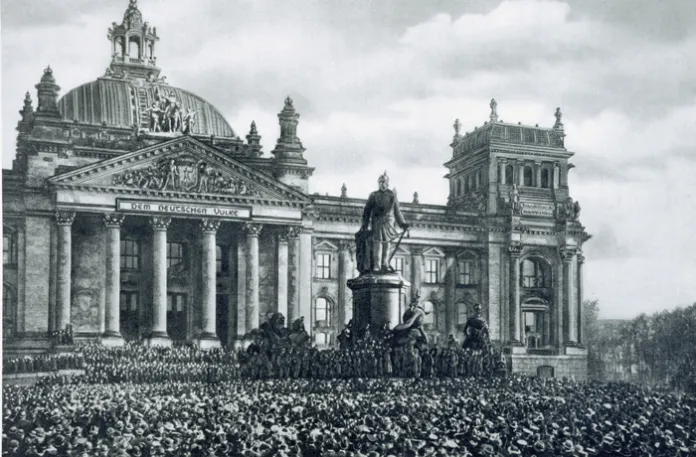
If actually holding plebiscites is anything to measure it by, the Germans thoroughly embraced democracy after World War I, running three presidential elections and another eight federal elections for the constituent assembly and the Reichstag between 1919 and the Nazi seizure of power in 1933. It is difficult, however, to come away from Fateful Hours without concluding that Weimar Germany had ceased to be a meaningful democracy long before Paul von Hindenburg appointed Hitler as chancellor in 1933 — even if, as Ullrich shows, the appointment itself could have been stopped and remained uncertain up to the moment that Hitler took office. Political violence in the form of extrajudicial killings by government forces and murder and intimidation from left- and right-wing paramilitaries was commonplace throughout the Weimar period, which was further punctuated by rebellions and attempted putsches from fascists, communists, and within the Reichswehr.
That Weimar was a rump democracy that would give way to a new totalitarian dictatorship was a view that the right-wing German nationalists shared with the communist KPD. They adhered to the line of the Stalinist Sixth International, holding that the Social Democrats were the “main enemy” of communism, “the last reserve of the bourgeoisie,” and had “many points of intersection with the ideology of fascism.”
Ullrich disagrees with the conclusion of the socialist historian Arthur Rosenberg that “in 1930, the bourgeois republic in Germany perished,” because, Ullrich writes, “there was no direct path from 1930 to January 30, 1933,” when Hitler was appointed chancellor. “The situation was fluid, and the crisis of state could have been overcome in various ways.” But after the 1930 elections, the government coalition could not form a majority, given the success of the Nazis and the communists, and so it dissolved the parliament and began ruling by decree with Hindenburg’s blessing and his authority under Article 48 of the Weimar constitution.
From at least that point onward in Ullrich’s narrative, there is a tension between the claim that Hitler could have been stopped and the idea that what it would have taken to do so would have still represented “democracy.” In 1932, for example, Chancellor Heinrich Bruning ordered a ban on the Nazi’s paramilitary organizations, the SA and the SS, in order to “safeguard the authority of the state.” Hindenburg, who signed the ban, then pressed for action against the Reich Banner Black-Red-Gold, a pro-republic paramilitary formed by members of the Social Democrats. “It speaks volumes,” Ullrich writes, “that the Reich president made no distinction between the paramilitary units of the National Socialists, who wanted to destroy the Weimar Republic, and the Reich Banner, a Social Democratic militia founded in 1924 to actively defend the republic.”
Does it? We know how this story ends, so it seems virtually unlimited political violence would have been justified to prevent Hitler and the Nazis from coming to power. But that does not make the idea of an extralegal paramilitary force any less antithetical to regular democratic order. Yet, Weimar did not have regular democratic order, other than a nascent run of elections, and from 1930 onwards, those elections did not return majorities for parties that supported democracy.
It’s this time period, after Weimar democracy had essentially failed, that I suspect attracts the attention of people who believe that democracy is failing in the West today in ways that echo Weimar. But the comparison between this period and our own cannot survive basic scrutiny, partly because, as anyone who has done high school Social Studies homework knows, you need to compare and contrast to test the strength of an analogy. Joining an anti-fascist street fighting group might have been an honorable option in, say, Thuringia after the 1929 state elections, when the Nazis gained control of the local interior and education ministries. Joining an antifa street-fighting group in Portland, Oregon, in 2025 makes substantially less sense except as live-action role-playing.
And anyway, the contemporary lessons that the American commentariat sometimes draws from Weimar’s failure and the Nazi era tend to be the ones that are most self-flattering, such as calling itself “the resistance,” while papering over some of the most disastrous errors of Weimar. If America today were really trying to learn the lessons of Weimar Germany to avoid the same fate, here are some of the lessons it should take to heart that often go unmentioned by the people most apt to tout the comparison: First, any party that truly believes that the country is verging toward fascism should be reluctant to put its faith in octogenarians. After all, in the 1932 presidential elections, the Social Democrats backed the 84-year-old Hindenburg, declaring, “Liberate the German people from the fascist threat with this one blow! Defeat Hitler! Vote for Hindenburg!” (He died in 1934.) Second, runaway inflation is a disaster that can only be downplayed as “transitory” or “temporary” at great electoral peril.
Except in its preface and afterword, Fateful Hours wisely avoids any such contemporary allusions, which also allows the narrative to cover a decade-and-a-half of German politics in a brisk 291 pages. Ullrich’s focus is on politics, which are specific to a time and a place and a people. These sometimes make for surprising cultural asides that point to the profound social convulsions that gripped Germany between the world wars. In 1922, for example, right-wing ultranationalists assassinated Germany’s Foreign Minister Walter Rathenau, a Jewish industrialist. His funeral march, from Wagner’s Götterdämmerung, prompted spontaneous tears among the hundreds of thousands of onlookers. “The head of one of the largest capitalist companies in the world had been killed, and communist workers wept at his grave and cursed the murderers,” the editor of Vorwärts wrote.
A little over a decade later, just after Hitler was appointed chancellor, Ullrich notes that the editors of the Jewish newspaper Jüdische Rundschau continued to believe that “forces within the German people are still awake that will oppose barbaric anti-Jewish policies.” They were not, and how Germany succumbed to that barbarism is rightly one of the great questions of world history. Ideally, the time will soon return when such profound questions of history and the urgent moral and political questions of our own times are reliably kept separate.
Andrew Bernard is a correspondent for the Jewish News Syndicate.