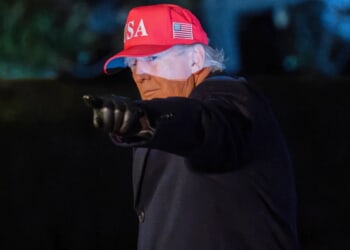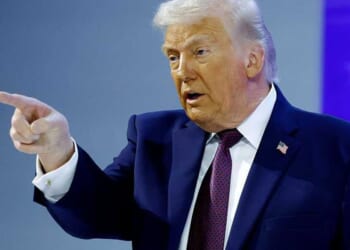
IN SEARCH OF AN OFF RAMP: Facing another week of rising gas prices and a falling stock market, President Donald Trump made a surprising announcement Monday morning as there were only hours left before the deadline for his threat to “obliterate Iran’s various POWER PLANTS,” if Iran didn’t “FULLY OPEN, WITHOUT THREAT, the Strait of Hormuz.”
Iran — having called Trump’s bluff and raised the stakes by threatening to hit energy and desalination plants in the region in retaliation — didn’t blink, and Trump needed a way to back off his threat to attack civilian energy infrastructure, which would have been a war crime and risked widening the war even more.
Based on what Trump said, there were two days of “very good and productive” talks, which he said would continue this week. He was postponing “any and all military strikes against Iranian power plants and energy infrastructure for five days,” that is, until after the markets close on Friday.
“Let’s all just say wow. Are we allowed to have some good news for at least one minute?” retired Adm. James Stavridis said on CNN. “It’s going to be a rollercoaster, but I think this is good news.”
The good news lasted about a minute before Iran began throwing cold water on the secret talks that nobody seemed to know about, especially the Iranians.
“There is no negotiation whatsoever between Tehran and Washington. The statements of the President of the United States are within the framework of an attempt to lower energy prices and buy time for the implementation of his military plans,” Iran’s Foreign Ministry said in a statement.
NETANYAHU VOICES SUPPORT FOR TRUMP’S POTENTIAL IRAN DEAL
“VERY STRONG TALKS … WENT, I WOULD SAY, PERFECTLY”: Speaking to reporters as he departed Florida for Memphis, Trump brushed aside the Iranian denials. “Well, they’re going to have to get themselves better public relations people,” Trump said, suggesting that perhaps the unnamed Iranian had not “conveyed” the 15 “major points of agreement,” to Tehran. “The communication, as you know, has been blown to pieces. They’re unable to talk to each other.”
“We are dealing with a man that I believe is the most respected, not the supreme leader, we have not heard from him,” Trump said, noting Mojtaba Khamenei has yet to show his face in public. “We don’t know if he’s living.”
Trump said his Middle East envoy Steve Witkoff and son-in-law Jared Kushner had “very, very strong talks,” with “a top person,” and that the discussions took place Sunday and went into the evening. “They went, I would say, perfectly,” Trump said. “If this happens,” he said. “It’s everything that we want,” including Iran giving up its 1,000 pounds of 60% enriched uranium, which he called “nuclear dust.”
“It’s very easy. If we have a deal with them, we’re going down, and we’ll take it ourselves,” Trump said, referring to the complex task of extricating canisters of uranium believed buried under rubble at Iran’s Isfahan site.
An Israeli official told Axios that Witkoff and Kushner had been in touch with the speaker of the Iranian parliament, Mohammad Bagher Ghalibaf, but Axios’ Barak Ravid reported that Ghalibaf denied that any “negotiations” had taken place.
Ravid said a source told him that Egypt, Pakistan, and Turkey passed messages between the U.S. and Iran on Sunday and were attempting to set up a call on Monday “between Ghalibaf and Trump’s team.”
“We’re doing a five-day period. We’ll see how that goes, and if it goes well, we’re going to end up with settling this,” Trump said. “Otherwise, we’ll keep bombing our little hearts out.”
OPINION: TRUMP RISKS ENCOURAGING IRANIAN ESCALATION
SKEPTICISM ABOUNDS: In a statement Iran’s Foreign Ministry called the alleged 15 points of agreement “nothing but a trick to lower Iran’s level of alertness.”
“Contrary to what Trump claims, there are no ongoing negotiations between Iran and the United States. Indirect messages have reached Iran, but they do not include any proposals of value or worthy of consideration,” the ministry said in a statement. “Iran will continue the war until it achieves its objectives.”
“The Strait of Hormuz will remain closed.”
Sen. Chris Van Hollen (D-MD) accused President Trump of having what he called a “track record of lying” about the Iran war. “He told the American people during the campaign that he was going to keep us out of war in the Middle East. He broke that promise.”
“He lied about Iran being an imminent threat to the United States … He lied about Iran being on the precipice of getting a nuclear weapon. We know that because Tulsi Gabbard just testified just the opposite recently,” Van Hollen said in an appearance on CNN. “And yes, we know he’s lying when he says that the Iranians are talking with us and they’re about to give Donald Trump everything he wants. Yes, that’s a lie.”
HOW DOES ISRAEL FIT IN THE US-IRAN TALKS?
Good Tuesday morning and welcome to Jamie McIntyre’s Daily on Defense, written and compiled by Washington Examiner National Security Senior Writer Jamie McIntyre (@jamiejmcintyre) and edited by Christopher Tremoglie. Email here with tips, suggestions, calendar items, and anything else. Sign up or read current and back issues at DailyonDefense.com. If signing up doesn’t work, shoot us an email and we’ll add you to our list. And be sure to follow me on Threads and/or on X @jamiejmcintyre.
CLICK HERE TO SIGN UP OR READ BACK ISSUES OF DAILY ON DEFENSE
REPORTERS NON GRATA: Well, that didn’t go the way the judge intended.
In a ruling Friday, U.S. District Judge Paul Friedman found that the Pentagon’s policy, which effectively bars reporters from asking for information not specifically authorized for release, is an unconditional infringement of the First Amendment protection guarantee of freedom of the press.
The case centered around the Pentagon’s issuance of what’s known as a PFAC card, or “Pentagon Facilities Alternate Credential.” The cards are not technically press credentials; they are building access cards that allow non-DOD employees, including vendors and service workers, access to the building, but not any classified spaces.
For eight decades, reporters have been provided access cards and workspaces and have been allowed to freely interact with military and civilian officials in the building.
After Friday’s ruling — in which the Pentagon was ordered to restore access cards for reporters who refused to sign on the restrictions on “solicitation” of “unauthorized” information — the Pentagon moved to make the PFAC cards essentially useless, by issuing the cards, but then banning all reporters from the building, claiming they pose a security risk if they can ask questions of anyone about anything, with no government oversight.
“The court removed every provision that allowed the Department to screen press credential holders for security risks and every provision that allowed the Department to deny, revoke, or suspend a press credential based on security considerations,” Chief Pentagon Spokesman Sean Parnell said in a statement. “The Department determined that unescorted access to the Pentagon cannot be responsibly maintained without the ability to screen credential holders for security risks. Effective immediately, the Correspondents’ Corridor is closed.”
“A new and improved press workspace will be established in an annex facility outside the Pentagon, but still on Pentagon grounds, and will be available when ready,” Parnell said, but all reporters must have a government escort at all times. “Credential holders will continue to have access to the Pentagon for scheduled press briefings, press conferences, and interviews arranged through public affairs offices.”
A CLEAR VIOLATION OF THE LETTER AND SPIRIT: In a statement, the Pentagon Press Association called the Pentagon punitive reaction “a clear violation of the letter and spirit of last week’s ruling.”
“At such a critical time, we ask why the Pentagon is choosing to restrict vital press freedoms that help inform all Americans,” the statement said.
In ruling in favor of the New York Times and against the Pentagon, which brought the legal action against War Secretary Pete Hegseth, Judge Friedman said the evidence shows the Pentagon is engaging in “viewpoint discrimination, full stop.”
“In sum, the undisputed evidence reflects the Policy’s true purpose and practical effect: to weed out disfavored journalists — those who were not, in the Department’s view, ‘on board and willing to serve — and replace them with news entities that are.”
PENTAGON ANNOUNCES NEW PRESS RESTRICTIONS AFTER JUDGE REVOKES PRESS BAN
THE RUNDOWN:
Washington Examiner: How does Israel fit in the US-Iran talks?
Washington Examiner: Netanyahu voices support for Trump’s potential Iran deal
Washington Examiner: US still hasn’t seen or heard from Mojtaba Khamenei, Trump says
Washington Examiner: Russia has been an early beneficiary of the US-Iran war in the Middle East
Washington Examiner: IAEA says no radiation leaked from Natanz after Iran claims facility was struck
Washington Examiner: Opinion: Trump risks encouraging Iranian escalation
Washington Examiner: Starmer focuses on economic threats after Iranian missiles fail to reach British base on Diego Garcia
Washington Examiner: London police investigating Iran ties to Jewish ambulance arson after terrorist group claims responsibility
Washington Examiner: Trump says National Guard members patrolling US cities will get active-duty benefits
Washington Examiner: ICE to maintain ‘presence’ at 13 airports and help with crowd control
Washington Examiner: Trump asks ICE officers not to wear masks while deployed to airports
Washington Examiner: Pentagon announces new press restrictions after judge revokes press ban
Washington Examiner: Trump rejects Senate GOP proposal to punt ICE funding
Washington Examiner: Pope calls for ban on airstrikes, says no one should fear ‘death and destruction’ from above
Washington Examiner: Opinion: Congress must demand Iran war answers from Trump administration
Washington Examiner: Opinion: Trump needs a short war
Wall Street Journal: Europe Is Quietly Playing a Crucial Role in the Iran War
Axios: Press groups denounce Pentagon’s new media rules
New York Times: A Choice of Deadly Drones Is Only a Few Clicks Away for Ukrainian Troops
Defense One: KC-135 Crash in Iraq Spurs Calls for Communications Upgrades
DefenseScoop: How TRANSCOM Is Handling Medical Evacuations and Planning for Operation Epic Fury
Air & Space Forces Magazine: Look Inside Anduril’s New Factory as Collaborative Combat Aircraft Production Begins
Air & Space Forces Magazine: Drones Incursions Over B-52 Base Spark Concern
Defense News: Poland Eyes Benefits of Joining GCAP Sixth-Generation Fighter Project
Air & Space Forces Magazine: More Launches, More Cyber Threats: Space Force Stands Up Units to Defend Ranges
Defense Daily: Next SDA Tranche 1 Launches Likely in May or June, Director Says
Air & Space Forces Magazine: Testing Shows Progress on Key Air Force Missiles and Bombs
Breaking Defense: Space Force Anticipates First Kronos C2 Contracts in April
Task & Purpose: French Sailor Goes Running, Reveals Flagship’s Location via Fitness App
THE CALENDAR:
TUESDAY | MARCH 24
8 a.m. 1700 Richmond Hwy., Arlington, Va. — Pentagon Office of Information Operations Policy and the Federal Business Council Phoenix Challenge conference: “Information Operations: Evolving for Strategic Dominance,” with Benjamin Jensen, professor, strategic studies at the School of Advanced Warfighting and scholar-in-residence at American University School of International Service https://www.fbcinc.com/e/phxchall26/attendeereg.aspx
10 a.m. — Atlantic Council virtual discussion: “The Future of Iran’s Axis of Resistance,” with Renad Mansour, senior research fellow, Chatham House Middle East and North Africa Program; Allison Minor, director, Middle East programs at the Atlantic Council; and Nick Blanford, nonresident senior fellow, Atlantic Council’s Middle East Security Initiative https://www.atlanticcouncil.org/event/the-future-of-irans-axis-of-resistance/
11 a.m. G-50 Dirksen — Senate Armed Services Committee hearing: “Low-Cost Munitions,” with testimony from Brig. Gen. Robert Lyons, portfolio acquisition executive for weapons and director of the Air Force Life Cycle Management Center Armament Directorate; Lt. Gen. Frank Lozano, portfolio acquisition executive fires at the Army; Vice Adm. Elizabeth Okano, principal military deputy assistant secretary of the Navy for research, development and acquisition; and Space Force Lt. Gen. Steven Whitney, director of force structure, resources and assessment at the Joint Staff http://www.armed-services.senate.gov
11 a.m. — Middle East Institute virtual discussion: “Testing the Shield: Air and Missile Defense Capabilities in the Iran War,” with Shira Efron, RAND Corporation chair for Israel policy; Kelly Grieco, senior fellow, Stimson Center’s Reimagining U.S. Grand Strategy Program; Michael O’Hanlon, director, Brookings Institution’s Foreign Policy Program; and Jason Campbell, MEI senior fellow https://us02web.zoom.us/webinar/register
11 a.m. Carnegie Endowment for International Peace virtual discussion: “Did Biden Get China Right? Lessons Learned and What Comes Next,” with Julian Gerwitz, senior research scholar at Columbia University’s School of International and Public Affairs; Rush Doshi, director, Council on Foreign Relations’ China Strategy Initiative; Laura Rosenberger, former National Security Council senior director for China and Taiwan; and Christopher Chivvis, director, CEIP American Statecraft Program https://carnegieendowment.org/events/2026/03/did-biden-get-china-right
1 p.m. — Arms Control Association virtual briefing: “Multilateral Arms Control after New START: Involving China and Other Nuclear-Armed States,” with Mallory Stewart, CEO of the Council on Strategic Risks; Tong Zhao, senior fellow, Carnegie Endowment for International Peace; Thomas Countryman, chair, board of directors of the Arms Control Association; and Daryl Kimball, executive director, Arms Control Association https://us02web.zoom.us/webinar/register/WN_U2tvcnIKTFeR_PFY40B2aw#/registration
2 p.m. — Defense One virtual discussion: “State of the Navy and Marine Corps” https://events.defenseone.com/state-of-defense-2026
2 p.m. 1775 Massachusetts Ave. NW — Brookings Institution discussion: “U.S. strategy in a turbulent world,” with Mara Karlin, former assistant secretary of defense for strategy, plans and capabilities, and visiting fellow of the Brookings Foreign Policy Program and Brookings Strobe Talbott Center for Security, Strategy and Technology; Lawrence Freedman, emeritus professor, war studies at King’s College London; Mara Karlin; Joshua Rovner, visiting fellow of the Brookings Foreign Policy Program and the Brookings Strobe Talbott Center for Security, Strategy and Technology; and Michael O’Hanlon, director, research for the Brookings Foreign Policy Program and director, Brookings Strobe Talbott Center for Security, Strategy and Technology https://www.brookings.edu/events/us-strategy-in-a-turbulent-world/
2:30 p.m. 232-A Russell — Senate Armed Services Cybersecurity Subcommittee hearing: “Enterprise security and information technology operations of Department of Defense networks and systems,” with testimony from Defense CIO Kirsten Davies; and Lt. Gen. Paul Stanton, director, of the Defense Information Systems Agency and commander of the Defense Department Cyber Defense Command http://www.armed-services.senate.gov
3:15 p.m. 805 21st St. NW — George Washington University Elliott School of International Affairs discussion with first lady of Ukraine Olena Zelenska with Alyssa Ayres, dean, GWU Elliott School of International Affairs https://calendar.gwu.edu/event/a-conversation-with-olena-zelenska
4 p.m. — Center for Strategic and International Studies virtual discussion: “International Cooperation for Resilient Subsea Cable Infrastructure,” with Rep. Earl “Buddy” Carter (R-GA); Adam Chan, director, FCC Council on National Security; Yasuyuki Okazaki, minister at the Embassy of Japan’s Economic Section; and Tatsuya Kurosaka, professor at Keio University https://www.csis.org/events/international-cooperation-resilient-subsea-cable-infrastructure
6 p.m. Cambridge, Massachusetts — Harvard University Kennedy Institute of Politics discussion: “The state of international affairs, and the many challenges facing the nation and the world,” with former Secretary of State Antony Blinken; and David Sanger, correspondent covering national security and the White House at the New York Times t https://www.youtube.com/@HarvardIOP/streams
WEDNESDAY | MARCH 25
8 a.m. — George Washington University Project for Media and National Security Defense Writers Group Zoom discussion with Sen. Jack Reed (D-RI), ranking member, Senate Armed Services Committee [email protected]
8:30 a.m. 1211 Connecticut Ave. NW — Henry L. Stimson Center discussion: “Next Steps for U.S.-Japan Military Shipbuilding, Repair, and Maintenance,” with Yuki Sekiguchi, vice president of Cognitive Research Labs Inc.; Brent Sadler, Heritage Foundation senior research fellow; Monica Dus, associate professor, University of Michigan; Kelly Greico, Stimson senior fellow; and Andrew Oros, director, Stimson Japan Program https://www.stimson.org/event/next-steps-for-u-s-japan-military-shipbuilding-repair-and-maintenance
8:45 a.m. 1735 New York Ave. NW — Defense Strategies Institute FutureG For Defense and Warfare Summit: “Empowering the Warfighter with Next Generation Network Capabilities,” with Thomas Rondeau, principal director for FutureG at the Office of the Defense Undersecretary for Research and Engineering https://futureg.dsigroup.org/
1 p.m. — Center for a New American Security virtual book discussion: Project Maven: A Marine Colonel, His Team, and the Dawn of AI Warfare, with author Katrina Manson, Bloomberg reporter; and Paul Scharre, CNAS executive vice president https://www.cnas.org/events/project-mave
2 p.m. — Defense One virtual discussion: “State of the Air Force and Space Force,” with Sen. Deb Fischer (R-NE), and Lt. Gen. Gregory Gagnon, commander, U.S. Space Force Combat Forces Command https://events.defenseone.com/state-of-defense-2026
2 p.m. 2255 Rayburn — Tom Lantos Human Rights Commission hearing: “Ukraine: Abducted Children and Mechanisms for Accountability,” with Rep. Jim McGovern (D-MA), co-chair, Tom Lantos Human Rights Commission; Rep. Chris Smith (R-NJ) co-chair, Tom Lantos Human Rights Commission; Katya Pavlevych, policy advisor for Razom for Ukraine, American Coalition for Ukraine; David Crane, founding chief prosecutor for the UN Special Court for Sierra Leone and founder, Global Accountability Network; David Scheffer, former U.S. war crimes ambassador in the State Department; and Inna Liniova, director, Ukraine Bar Association Human Rights Center https://humanrightscommission.house.gov/
THURSDAY | MARCH 26
8:45 a.m. 1735 New York Ave. NW — Defense Strategies Institute FutureG For Defense and Warfare Summit: “Empowering the Warfighter with Next Generation Network Capabilities,” with Joshua Weaver, director, spectrum initiatives and analysis in the Office of the Undersecretary of Defense for Research and Engineering https://futureg.dsigroup.org/
2 p.m. — Defense One virtual discussion: “State of the Army,” with Maj. Gen. John Cogbill, commanding general, 11th Airborne https://events.defenseone.com/state-of-defense-2026
3 p.m. 1616 Rhode Island Ave. NW — Center for Strategic and International Studies discussion: “The Future of U.S.-Europe Relations,” with Lawrence Freedman, professor, war studies at King’s College London; Eliot Cohen, CSIS chair in strategy; and Heather Williams, director, CSIS Project on Nuclear Issues https://www.csis.org/events/future-us-europe-relations
3:30 p.m. 37th and O Sts. NW — Georgetown University Center for Security Studies, GU Center for German and European Studies, and the GU Center for Eurasian, Russian and East European Studies discussion: “NATO’s Northern Flank and Baltic Security,” with Swedish Armed Forces Supreme Commander Gen. Michael Claesson https://events.georgetown.edu/event/39038-natos-northern-flank
FRIDAY | MARCH 27
8:30 a.m. 11493 Sunset Hills Rd., Reston, Virginia — Government Executive Media Group forum: “Securing the Supply Chain and Managing Modern Cyber Threats,” with Defense CIO Kirsten Davieshttps://events.washingtontechnology.com/cmmc-supply-chain/register