Order Michael Finch’s new book, A Time to Stand: HERE. Prof. Jason Hill calls it “an aesthetic and political tour de force.”
In February 2006, I published a book called While Europe Slept: How Radical Islam Is Destroying the West from Within. That same month – exactly a week later, to be specific – Claire Berlinski came out with Menace in Europe: Why the Continent’s Crisis Is America’s, Too. We were just part of what would turn out to be a wave of warnings between hard covers. September 2006 brought Mark Steyn’s America Alone: The End of the World as We Know It. In 2007 came Walter Laqueur’s The Last Days of Europe: Epitaph for an Old Continent. And in 2009 Christopher Caldwell published Reflections on the Revolution in Europe: Immigration, Islam, and the West.
Most writers are irked when they find their books competing with other titles on the same topic. I wasn’t. The more the merrier. Why? Because the main arguments leveled against While Europe Slept were as follows: I was a hysteric who was dramatically overstating the problem. I was a bigot, a racist, an Islamophobe. Much of my evidence was anecdotal, and hence without value. I wasn’t a credentialed expert in Islam. My book didn’t have footnotes. (Actually, it had had footnotes, but the publisher decided to yank them at the last minute.)
The best way of demonstrating to these critics that I wasn’t peddling sheer fantasies was to point to the authors of those other books. I’d never met or communicated with any of them, and I don’t think any of them had ever met or communicated with each other. Also, we had a wide range of backgrounds and educations and professional résumés: I was born in New York City, earned a Ph.D. in English at Stony Brook, and went on to live in the Netherlands and Norway; Berlinski was born in California, earned a doctorate in International Relations at Oxford, and went on to live in Paris and Istanbul; Laqueur (who died in 2018) was born in Wroclaw, Poland, spent a year at the Hebrew University of Jerusalem, and became a distinguished historian of modern Europe and a professor at several American universities; Caldwell, born in Lynn, Massachusetts, is a Harvard-educated political journalist who became an editor of the Weekly Standard; Steyn is a Toronto-born high-school dropout who became a TV and radio host in both the U.S. and U.K.
In short, several very different people with very different perspectives. But we had all taken a long, hard look at Western Europe and had all seen exactly the same thing – and had all been worried enough to sit down and write books that we knew would land us in hot water with the Western cultural and political establishment.
Of course, not all of us saw eye-to-eye on every detail. Berlinski devoted the fourth chapter of her book to France’s second largest city, which is a major Mediterranean port and a traditional melting pot. Berlinski’s take on the city was made clear by the chapter’s title: “The Hope of Marseille.” It began as follows:
Compared with those of other European countries, French policy has in one way been a success. It has been a full ten years since the last wave of Islamic terrorism on French soil, a circumstance in large measure owed to the sheer ruthlessness of French antiterrorism prosecutors and investigators, who are Europe’s most draconian….So far, these policies have worked.
Well, that was 2006. In 2012 three soldiers, three schoolchildren, and a rabbi would be shot to death by a jihadist in Toulouse and Montauban. In January 2015 came the Charlie Hebdo massacre, which took 17 lives. In November of that year came the attacks on the Bataclan theater and other targets in and near Paris, in which 131 people were killed. On Bastille Day 2016, 86 victims were mowed down on the Promenade des Anglais in Nice. That year the Centre for Geopolitics & Security in Realism Studies posted an article entitled “Why always France? The logic behind the surge of Islamist terrorist attacks on its territory and possible policy implications.” France as an antiterrorism success story? The very idea was now ancient history.
To be sure, Berlinski had been quick, in the opening of her fourth chapter, to acknowledge that while France had been spared major acts of terrorism, Muslim immigrants were no more successfully assimilated in the French Republic than in other Western European countries. The exception, she maintained, was Marseille. In that city, a wave of antisemitic attacks in 2001-2 had been succeeded by calm: “the animus,” as Berlinski put it, “has fizzled out.” While Muslim leaders in other French cities stayed mum on antisemitic violence, their counterparts in Marseille condemned it.
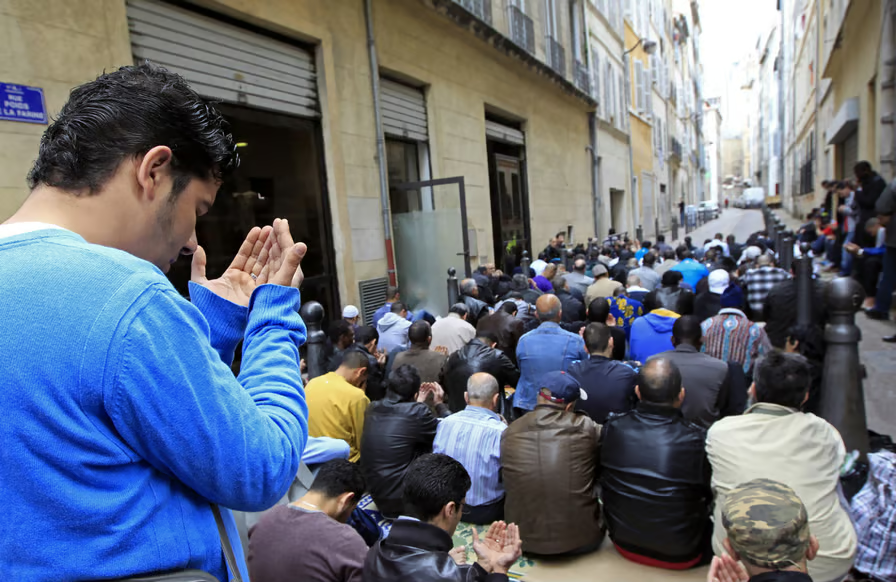
Why the difference? Berlinski went to Marseille to find out. Her cabdriver told her: “I’m a Jew, my neighbors, they’re Arabs, we understand each other fine….It’s not like the rest of France; we’re cosmopolitan here, everyone understands everyone else.” One reason for Marseille’s exceptionalism, Berlinski decided, was that immigrants were not “shunted off into suburban slums,” as in other large French cities. Another reason was that Muslims were afforded “representation as a group in city politics,” which made possible certain trade-offs: while the city provided Muslim cemeteries and abattoirs for halal slaughter, Islamic leaders, in return, promised to “keep the extremists in their community in check.”
If Marseille worked, concluded Berlinski, it was largely “because its constituent ethnicities, particularly its Arab immigrants, [we]re recognized, organized, courted, and given voice in a formal system,” and because moderate Muslims, “who have been co-opted into the system,” were used effectively to contain their “violent and immoderate” coreligionists.
Berlinski wasn’t alone in considering Marseille a noble – and promising – exception to the rule when it came to the peaceful incorporation of Muslims into Western Europe. Six years after Menace in Europe, a researcher named Françoise Lorcerie contended in the New York Times that the reason why Christians and Muslims seemed to get along better in Marseille than in other French cities was that its residents had forged for themselves “a kind of creole identity, a bit like another port city, New Orleans. In Marseille a collective identity has arisen from a history of hardships and from shared strong aspirations to a better life.”
By 2015, however, the bloom seemed to be off the rose. A reporton PBS, of all places, admitted that the number of Muslims in Marseille had grown, that the Muslims had become increasingly radicalized, and that the radicals were more and more inclined to be violent. Both Muslims and non-Muslims testified that the situation was getting “worse and worse.”
On 1 October 2017, in a crime later classified by Europol as a terrorist act, an illegal Tunisian immigrant stabbed two young women to death at a train station in Marseille. In May of last year Éric Zemmour, the former presidential candidate, said in an interview that Marseille was “no longer really a French city” but was, instead, the site of “a war of civilizations, a daily jihad.” In September of this year, after another Tunisian stabbed five people in Marseille, Zemmour told an interviewer: “I am very sad when I see Marseille transforming steadily. It is no longer the city I knew in the 1980s. It has fallen into the hands of the North Africans….It is no longer truly a French city, and there is no longer a French social life.”
Is any of this a surprise?
Now, I’ve never been to Marseille. I’ve spent a week in Cannes, 100 miles down the coast, but not Marseille. But I didn’t need to have visited Marseille to shake my head when, 19 years ago, I read the fourth chapter of Menace in Europe. My observations of Islam in Europe had already made it clear to me that Muslims were not like other immigrant groups, that settling them in city centers instead of suburbs would not make any difference in the long run, that relying on “moderate” Muslims to restrain their immoderate brothers was a pipe dream, and that interfaith “understanding” was a crock. It was already clear to me that as a city’s population of Muslims grew, those Muslims would flex their muscles with increasing aggressiveness, causing the illusion of integration to fade steadily.
Claire Berlinski, while seeing a lot of things about Islam in Europe very clearly, nonetheless felt driven to embrace the notion of Marseille as a beacon of hope and a role model for other European cities whose native populations dreamed of coexistence with their Muslim neighbors. After all, wrote Berlinski, “[i]f immigrants cannot be assimilated and they cannot be sent back – and they can’t – Europe must find some way to make its peace with them.” In her desperation to cling to this hope for peace, alas, Berlinski apparently forgot momentarily that for Muslims the words peace and submission are synonymous.
As for her statement that unassimilated immigrants “cannot be sent back” – why not? Like many Americans today who are fiercely hostile toward ICE, Berlinski seemed, at least in 2006, to regard the very idea of rounding up enemies within as distasteful. Well, perhaps. But better to carry out a distasteful mass expulsion, and thereby save one’s civilization, than to commit civilizational suicide for the sake of sensitivity. In 2025, to contemplate Marseille is to reflect sadly upon the once vibrant but now quickly dying dream of a Europe defined by a multicultural harmony that – as more and more of us now realize – never could have been.