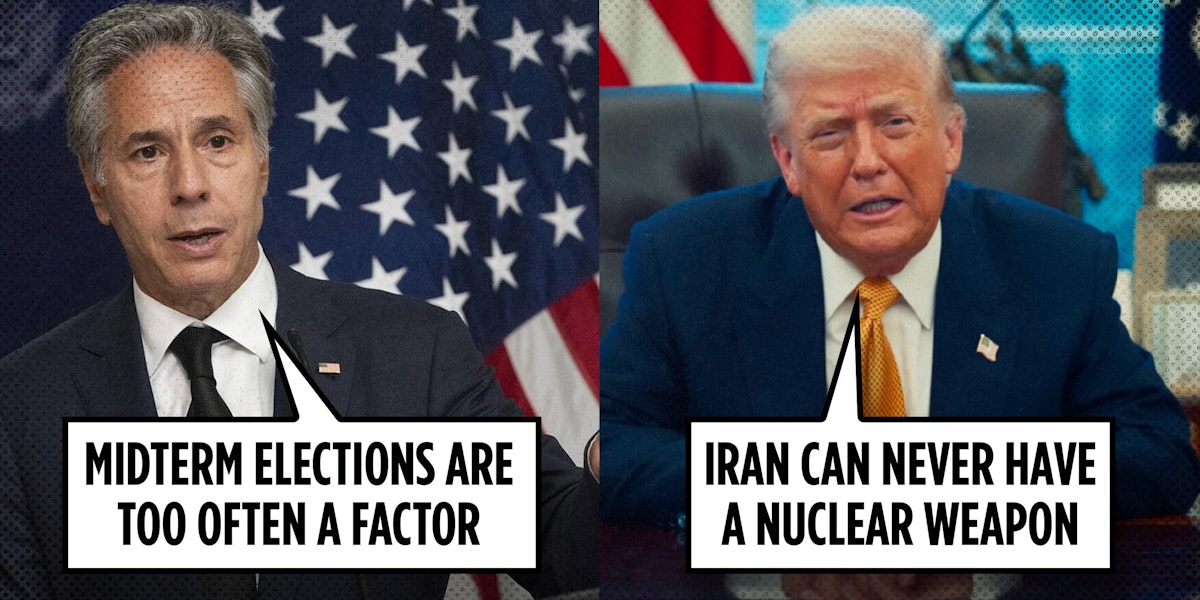
“You have midterm elections. It shouldn’t be, but it is too often a factor. … Sometimes politics gets in the way.”
So said Joe Biden’s secretary of state, Antony Blinken, to The New York Times’s David Sanger at a Harvard forum last Tuesday.
To be clear, politics should never get in the way of our national security, but it did with the Biden administration, and the Obama administration, and every American presidential administration that kicked the Iranian nuclear can down the road during the past 47 years.
Yesterday, in a rare primetime address to the nation, President Donald Trump told the American people that the fight in Iran is winding down — that we’ve made great progress and are near to completing all of our military objectives, but that we’re not there yet. “Shortly, very shortly,” he said.
“They were right at the doorstep,” Trump said. “For years, everyone has said that Iran cannot have nuclear weapons. But in the end, those are just words if you’re not willing to take action when the time comes.”
The time did come, and Donald Trump did take action. And here we are.
The president’s 20-minute speech was short on military specifics, but that makes sense, since he wanted to reassure the American people while at the same time keeping what’s left of the Iranian regime guessing. He did say, however, that more very serious pain is headed Iran’s way if a ceasefire deal can’t be reached with those who purport to be in charge of what’s left of the regime.
He also, once again, called out his predecessors in the White House, especially Barack Hussein Obama, for having paid mere lip service to the longstanding U.S. policy that Iran can never have a nuclear bomb.
Perhaps the most interesting point that he made was that the United States doesn’t need a drop of oil from the Strait of Hormuz, and he called on those who rely on oil shipped through those Straits to either buy oil from the U.S. or “build up some delayed courage” and secure that vital international waterway themselves. This in itself is a radical and welcome departure from the so-called Pottery Barn Rule — You break it, you own it — coined by The New York Times’s Thomas Friedman and adopted by former George W. Bush Secretary of State Colin Powell in the days leading up to the Iraq War.
Trump refrained from criticizing our erstwhile NATO “partners” directly, and he said in an interview yesterday that withdrawing from the NATO alliance was “beyond reconsideration.” Ultimately, though, it will likely require a coalition naval effort to keep the Strait of Hormuz open and safe for transit of oil tankers and other shipping.
It’s one thing not to help, but another thing not to even allow our planes flyover permission. Unforgivable, in my humble opinion. Article 13 exit, anyone?
Why are our NATO allies behaving like such cheese-eating surrender monkeys? No doubt because, as our Mark Alexander noted at the onset of the conflict, “The UK and France have allowed so many Islamic extremists into their country that they fear any participation will result in domestic terror attacks.”
The big open question is whether victory can be declared at this point, or whether we need to secure and remove Iran’s nuclear stockpile. The president hinted at the former, saying that we’ve hit their nuclear sites hard, that we’ve got them under satellite surveillance, and that “if we see them make a move, even a move for it, we’ll hit them with missiles, very hard.”
“They were the bully of the Middle East,” said Trump, “but they’re the bully no longer.”
It’s Holy Week, by the way, and what better time to remind ourselves why it was that Donald Trump attacked Iran: namely, because the posture of prior American presidents toward Iran was wholly weak.
Oh, every American president of the past 47 years talked a good game. “Iran can never have a nuclear weapon,” they all announced, one right after another after another. But talk is cheap, and the mullahs knew it. And so, they kept on working, kept on enriching, kept on progressing toward a nuclear bomb.
Until Donald Trump said: No more. We’re done.
When push came to shove, only Trump dared to shove back. Indeed, he did more than shove back. He knocked Iran into next week — or was it the Stone Age?
Meanwhile, a spokesperson for the Islamic Revolutionary Guard Corps said, somewhat comically, that they will “fight until your eventual surrender.”
Trump paid tribute to our 13 fallen warriors, adding, “We must honor them by completing the mission.” Trump said that our Middle East allies have been great, and that what Iran is doing now in the Strait of Hormuz is just more proof that it can never be allowed to have a nuclear bomb.
Ultimately, this was a speech for many audiences, including the vast majority of the American people — those who aren’t following this war as closely as some of us, and haven’t considered too carefully what was really at stake.
In his private diary, then-President Harry S. Truman said this about the fearsome new weapon that our brilliant team at Los Alamos had developed:
We have discovered the most terrible bomb in the history of the world. It may be the fire destruction prophesied in the Euphrates Valley Era, after Noah and his fabulous Ark. Anyway, we “think” we have found a way to cause the disintegration of atom. An experiment in the New Mexican desert was startling — to put it mildly.
To put it mildly.
Of course, President Truman wasn’t there on July 16, 1945, at the Trinity blast site on a remote part of Alamogordo Air Base, 120 miles south of Albuquerque. But Robert Oppenheimer was there. Some 20 years later, Oppenheimer recalled the moment of the explosion in an NBC News documentary:
A few people laughed; a few people cried; most people were silent. I remembered the line from the Hindu scripture, the Bhagavad Gita. … ‘Now I am become death, the destroyer of worlds.’ I suppose we all thought that one way or another.
For around a decade now, Donald Trump has been saying that the Iranian regime can’t have a nuclear weapon. Just like all the presidents before him had been saying. The only difference is that Trump meant what he said, and he backed it up with force.
And we should all be grateful for it — higher gas prices and November midterms be damned.
You might not like him, you whiny, sniveling Democrats. And you might not have the onions to admit it, but you want him on that wall. You need him on that wall.