Order Michael Finch’s new book, A Time to Stand: HERE. Prof. Jason Hill calls it “an aesthetic and political tour de force.”
From the beginning of citizen rule in Ancient Athens, the problem of controlling the state’s fisc has been a perennial anti-democracy argument. As early as 423 B.C., Euripides produced The Suppliant Women, in which one of the earliest criticisms of democracy appears. In response to the Athenian Theseus’s panegyric of Athens’ democracy that empowers the uneducated poor, the Theban herald mocked the notion of allowing the poor and uneducated to participate in governing.
The 6th century poet and aristocrat Theognis in one poem memorialized what such men would use that power for. Enflamed by a demagogue in Megara, the poor took power and burned to death the wealthy, seized their property and banished the rich.
This and other civil violence directed at the wealthy was featured two millennia later among the Framers of the Constitution. Delegate James Madison, who wrote Federalist 10, was cognizant of this evidence from antiquity of humanity’s destructive passions “sown in the nature of man.” His concern was with “factions”–– “a number of citizens, whether amounting to a majority or minority of the whole, who are united or actuated by some impulse of passion, or interest, adverse to the rights of other citizens.”
Moreover, Madison wrote, “The most common and durable source of factions, has been the various and unequal distribution of property [wealth]. Those who hold, and those who are without property, have ever formed distinct interest in societies.”
Pure democracies are unleavened by counter-balancing powers to prevent the tyranny of the majority. Without that division of powers, as we have seen in our history since the rise of progressivism a century ago, the demagogues who in ancient Greece pandered to the citizens, are now in our age found in the technocratic agencies and their political bosses who redistribute money to their party’s clients. As the Wall Street Journal’s Kimberley Strassel writes about the malign consequences of government social welfare agencies distributing incontinent largess: “The long-term dependency and loss of dignity. The discouragement of work. The damage to family structure. We’ve had many rounds of this discussion: from fallout over the New Deal and Great Society to ‘welfare queens’ in the 1990s. Today’s vast outlays and falling labor-force participation rates are proof that the failure is becoming deeper. According to the Center for Immigration Studies, the share of U.S.-born working-age men not in the labor force was about 11% in 1960. It is now 22%.”
Another danger of government hand-outs is the fraud found by the DOGE agency in President Trump’s administration. Just recently we saw exposed in Minnesota massive theft in programs fecklessly distributing money to fraudsters––$1 billion (California scammed $50 billion) in federal money. Hard on that news came a Government Accountability Office undercover sting that exposed widespread fraud in Obamacare subsidies. As Strassel writes, this is a story “of a federal government that shovels more than $1 trillion annually into more than 80 major ‘antipoverty’ programs (and countless minor ones)—a system too complex to ensure even basic integrity. And of a state that preened as a model of social welfare, its own lavish benefits drawing many immigrants, and invited a plundering.”
As much as President Trump has pushed back on feckless government hand-outs and corruption, we are still in dangerous waters teeming with debt and the cost of serving the debt’s interest––an amount greater than what we spend on our military. Here, too, ancient Athens provides a warning.
“In the end more than they wanted freedom, they wanted security,” writes Edward Gibbons of Athens’ decline. “When the Athenians finally wanted not to give to society but for society to give to them, when the freedom they wished for was freedom from responsibility, then Athens ceased to be free.”
The instrument of that catastrophe was Phillip II of Macedon, whose conquest of Athens in 338 had been long predictable to the Athenians. Yet Athens kept spending money on festivals and payment for attending the Assembly, rather than preparing for Phillip’s looming aggression. Earlier, the comic poet Aristophanes in his political satire the Knights, had one character say, “If two politicians were making proposals to the Assembly, one to build triremes [war ships], one to spend the same on state-pay for attending festivals, the pay man would walk all over the trireme man.”
After Athens’ defeat at Chaeronea, the historian Theopompus wrote that the defeat was the consequence of the politician Eubulus who convinced the Athenians to transfer all surplus revenue into the theoric fund that financed state pay, which paid for festivals, rather than in the military fund. That decision made the Athenians “less courageous and more lax” by giving them the theoric dole upon which the Athenian people “thoroughly squandered their state revenues,” spending “more on the public festivals and sacrifices than on the management of the war.”
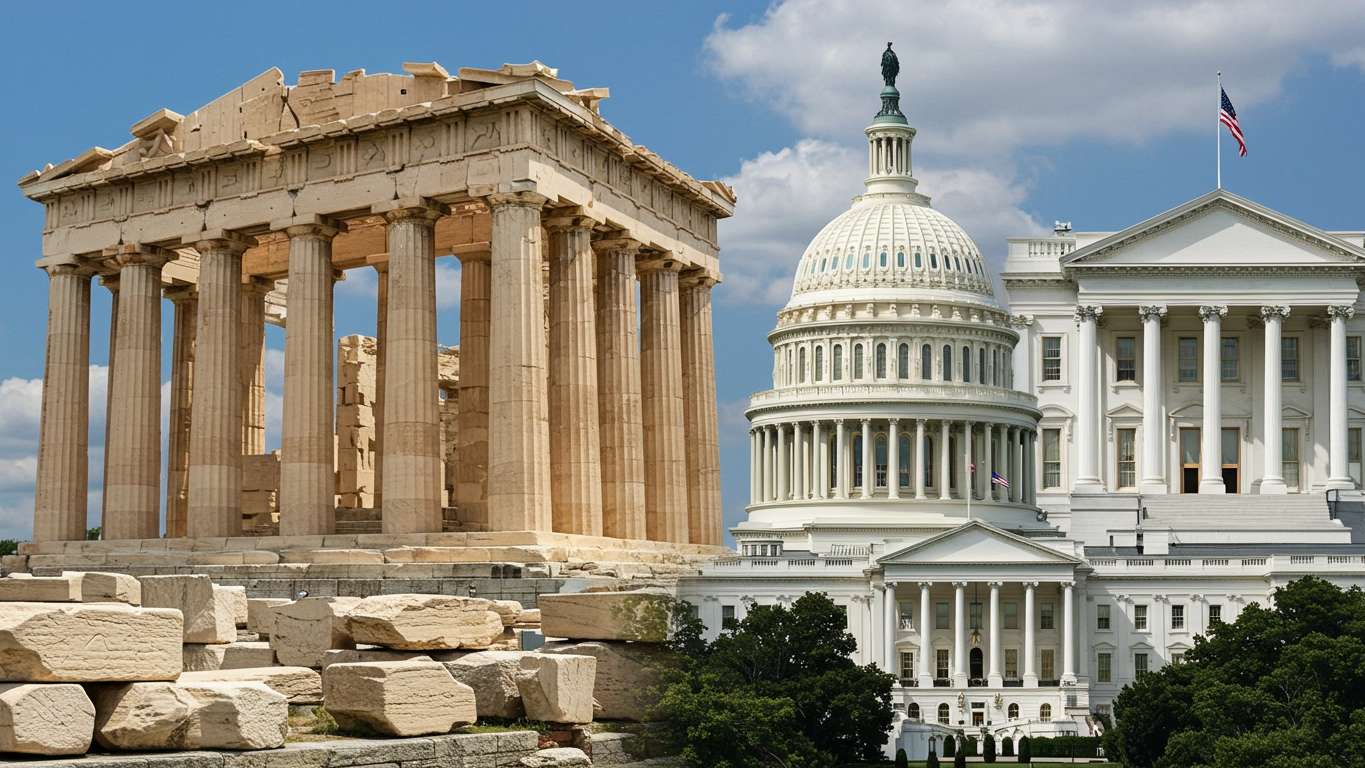
It’s easy to see the feckless behavior of Athens that cost them their freedom for centuries, resembles the fiscal carelessness of our government’s long habit of redistributing taxpayer money to fund entitlements for political clients, and printing or borrowing more funds, creating the massive debt that our children and grandchildren will have to pay. For nearly a century, we’ve ignored the example of ancient Athens, which illustrates the dire wages of ignoring common sense.
President Trump has done much to rein in our fiscal malfeasance, and his efforts will be helped by the Supreme Court if its judges correctly rule on the Trump v. Slaughter case in this year’s session. As David Harsanyi writes, “It’s about time an unaccountable fourth branch of the state was decimated. Trump v. Slaughter revolves around the president’s ability to fire executive branch officials without cause at ‘independent’ agencies. For one thing, nowhere does the Constitution empower Congress to create ‘independent’ anything. The notion is a concoction of our worst former president, Woodrow Wilson, and it was codified nearly a century ago in Humphrey’s Executor v. United States, when the court ruled that the Federal Trade Commission was a quasilegislative, executive and judicial agency.”
Ever since the rise of the Progressives, the obstacle to their desire to “fundamentally transform the United States,” as Barack Obama said, was the Constitution that divided power and acknowledged unalienable rights that blocked their technocratic dreams of concentrate power wielded by “experts” who could move the country to the collective utopia.
Since the Humphrey’s decision, federal agencies have been the instruments of this transformation by weakening the Constitution’s principles of divided, balanced, and checked powers. Just as the Framers feared would happen without those guardrails, the result has been tyrannical changes and policies unaccountable “to we the people.”
The right decision on Trump v. Slaughter will help Trump’s administration avoid the temptations for power and pelf that cost Athens its freedom.