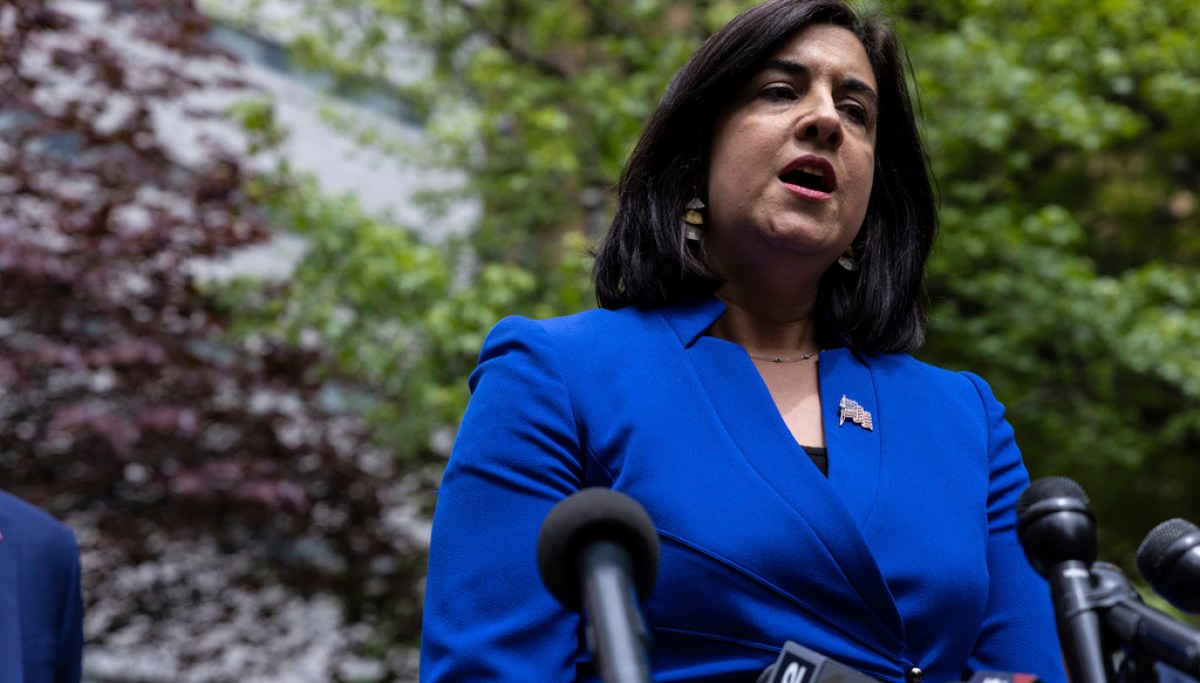
A bipartisan effort to establish a Smithsonian American Women’s History Museum on the National Mall is at risk of becoming the next casualty of America’s culture war over a partisan clash on the definition of a woman.
The legislation, led by Rep. Nicole Malliotakis (R-NY), gained the most momentum it’s seen in over four years when it was brought up for a vote in the House Administration Committee earlier this week. The momentum unraveled after Republicans amended the bill to ensure only biological women would be exhibited and to give the president discretion over the museum’s location.
The bill passed the panel along party lines, a shift that makes bipartisan support unlikely in either the House or Senate, where at least seven Democrats would need to join all 53 Republicans to get it across the finish line.
Rep. Norma Torres (D-CA), a House Administration Committee member, said that Republicans “broke” a bipartisan agreement that “unraveled years of good faith,” told the Washington Examiner in a statement.
“Republicans chose to play politics over principle,” Torres said.
Rep. Julie Johnson (D-TX), also on the panel, said she was excited for the museum and planned to support it before the amendment, sponsored by Rep. Mary Miller (R-IL), “took away the whole tenor and point” of the bill.
“Why in the world would Representative Miller hijack another representative’s bill that they have been working on really hard, and had a really great bill that got strong, broad bipartisan agreement,” Johnson said in an interview. “The fact that she was allowed to do that, and the fact that she trampled on her colleague’s bill, is outrageous.”
Malliotakis said the results of the vote were unfortunate and made passage more difficult, saying she believes it was “not a controversial amendment.”
“The fact is, we have so many women to highlight that we don’t need to have — we don’t need to go outside of highlighting biological women,” Malliotakis told the Washington Examiner on Friday. “I mean, so anybody who would not vote for this, over that, is ridiculous.”
Frustration with both sides of the aisle
Malliotakis’ bill is the kind of bipartisan measure that would pass easily without controversy, but has faced major obstacles, even before the latest amendment upended its appeal across the aisle.
The bill, which was reintroduced last February, authorizes land on the National Mall to be used to build the Smithsonian American Women’s History Museum. The museum’s existence was first approved in a bipartisan fashion and signed into law by President Donald Trump as part of a 2020 appropriations package.
Yet, the Smithsonian could not start construction until federal land was transferred for the project. Several factors stalled that transferring, such as disputes over the museum’s physical location.
Malliotakis said the current plan is to place the museum at the “South Monument” site, which is across from the African American History Museum on the National Mall. Under the congresswoman’s bill, Trump would have the authority to override that site within 140 days if a problem arose.
At the end of 2025, Malliotakis said she was a good example of how rank-and-file members felt “disgruntled” with House GOP leadership for not pushing her seemingly harmless bill through committee, much less bringing the bill to the floor for a vote.
“A lot of the committees don’t move bills unless the speaker gives them the nod,” Malliotakis told the Washington Examiner at the time. “The president even indicated, during Women’s History Month, that he supports the legislation. And so, why is it still sitting in committee? Why am I having such a hard time getting a floor vote on something that will pass on suspension?”
But that was back in December, when her museum bill was all but assured to pass under suspension of House rules. Parliamentary procedure is used for noncontroversial, bipartisan bills that can easily meet the two-thirds majority threshold in the House.
“Obviously, the dynamics have changed now,” Malliotakis said Friday. “This was, you know, a minor hiccup with our friends on the other side of the aisle.”
But the “minor hiccup” could turn into a significant roadblock. A lack of Democratic support means the bill will no longer go directly to the floor for a vote; instead, it will head to the Rules Committee for consideration. If it clears the committee, it could then head to the floor for a simple majority vote.
Getting the museum bill through a final passage vote along party lines is not assured, given the House GOP’s razor-thin, one-seat majority.
Despite the hurdles, Malliotakis is still pushing for a floor vote.
“If the Democrats all want to vote against it, which I would find shocking, that there wouldn’t be one Democrat that would support construction of a women’s history museum, because there’s a line in there that says it needs to only include biological women,” the congresswoman said. “I mean, to me, that seems very ridiculous that none of them would support it.”
“I still think, I still hope, that it would pass with bipartisan support when it comes to the floor,” Malliotakis added.
When could the women’s history museum bill get a vote?
A floor vote on the bill remains unclear, as House leadership has not set a timeline, the Washington Examiner confirmed.
But as House Republicans push a “common sense vs. crazy” message ahead of the 2026 midterm elections, the bill’s shift from bipartisan to partisan could make it more politically useful for Republicans by putting Democrats on record opposing it over the biological women provision.
Malliotakis initially hoped the bill would come up during the March recognition of Women’s History Month, but is now just hoping that it gets a vote before the end of the year.
TRUMP RE-ENDORSES JEFF HURD AFTER YANKING SUPPORT OVER TARIFF REPEAL VOTE
If Democrats take the House majority in 2026, the legislation would likely stall or be rewritten to remove the disputed language.
“We’ve seen what he’s done to the White House,” said Johnson. “We’ve seen what he’s planning on doing with the Kennedy Center, and we want the Smithsonian institution to have the discretion to determine the content, to determine the placement, to determine the design, and have it be done in a very non-partisan way.”