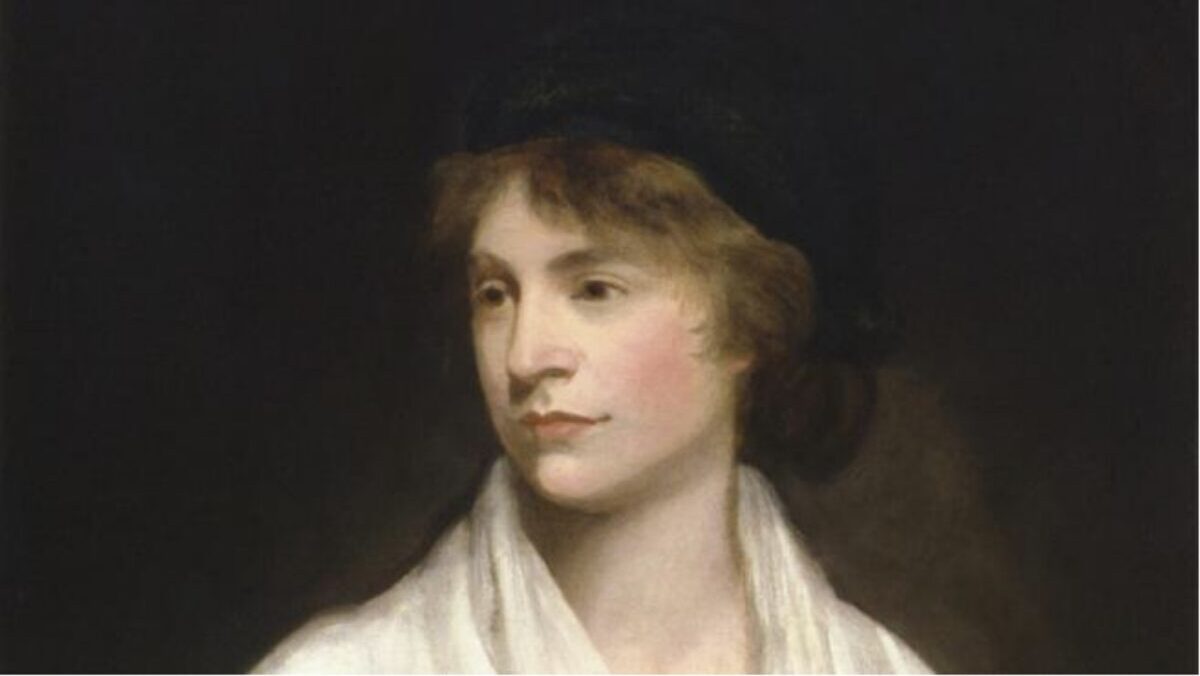
Over the last few years, I have come to know the work of Mary Wollstonecraft intimately. Though hardly a household name, she has assumed a primary place in the conversation about Christian womanhood today. My latest books, The End of Woman (Regnery, 2023) and Something Wicked (Sophia Institute Press, 2026) engage her in varying degrees. While every author expects to deal with disagreement and criticism, the pushback against these books has been monotonously uniform. Aside from the recent criticism I received for being “too reasonable,” most every other negative review has criticized me for not heralding Wollstonecraft as an intellectual heroine for Christian women, as has Erika Bachiochi in The Rights of Women (2021) and Emily Dumler-Winckler in Modern Virtue (2022).
The negative reviews have been legion and from overlapping sources: See Elizabeth Grace Matthew’s “The Lives of Feminists” at Law & Liberty and Nina Power’s “Sexual Politics on the American Right” at Fairer Disputations. Public Discourse has four: Rachel Lu’s “The End of Feminism,” Nathan Schlueter’s “When Anti-Feminism Isn’t Enough,” Claire Swinarski’s “Cultivating a Holistic Feminism,” and Beatrice Scudeler’s “Loving Both Mother and Child: Mary Wollstonecraft and the Case for a Maternal, Pro-Life Feminism.”
The basic arguments made by most was that I erroneously read the history of feminism because I am unfamiliar with, or do not engage the research of, Bachiochi and Dumler-Winckler on Wollstonecraft. For example, Matthew contrasts what she sees as my weakness with Bachiochi’s point of view: “In The Rights of Women (2021), legal scholar Erika Bachiochi offers a rich understanding of the early women’s movement that draws on Wollstonecraft’s writing and that of her like-minded intellectual heirs. Bachiochi shows that nascent feminism was far from a monolith.”
I took seriously these erroneous reviews and wrote responses to several, including “Threading the Feminist Needle” at Law & Liberty, “The End of Feminism: A Response to Rachel Lu” at Public Discourse, and “Which Mary Should Catholic Women Follow?” at National Catholic Register. (There is not space to adequately outline each review and argument, but the links are provided for those who want to go deeper.)
In the midst of this, Bachiochi and I were invited to write side by side articles for and against Wollstonecraft’s use of virtue. Bachiochi readily agreed; I was a bit hesitant because it was going to require me to drop everything and dig deeper into Wollstonecraft’s opaque and uninspiring scholarship, which is a bit like agreeing to a daily root canal. For the sake of scholarship and the truth, however, I got to work; but about a month in Bachiochi inexplicably backed out. Already invested, I continued to slog away, and the fruits of that effort appear in my just released book, Something Wicked.
Philosophical Errors
In Something Wicked, I explain more fully why Wollstonecraft is not an appropriate role model for Christian women. My explanations are not short or ad hominem attacks, as some have claimed, but deeply researched and, uncommon in a non-academic book, generously cited. Not only did I want to ensure my arguments were solid and my conclusions correct, I also wanted to give others the opportunity to easily check my work.
What my research unearthed left no doubt: Wollstonecraft is not the right woman to lead Christian women today. Both Bachiochi and Dumler-Winckler claim to be recovering or seeing for the first time something about Wollstonecraft that has been forgotten or missed for centuries. Bachiochi’s book subtitle is Reclaiming a Lost Vision and Dumler-Winckler’s is Mary Wollstonecraft and a Tradition of Dissent. They both make philosophical errors which undermine their reading of Wollstonecraft. Those errors are generally that they misunderstand how Wollstonecraft’s use of words such as virtue, reason, rationality, tradition, and dissent in the 1790s differs significantly from both ancient and contemporary usage. The simple truth, obvious to anyone with more than a superficial grasp of the history of philosophy, is that critical words have different meanings to different philosophers. For example, Aquinas, Machiavelli, and Hume (Wollstonecraft followed the latter) do not mean the same thing when they use the word virtue.
Doubling down on this fundamental error of language, Dumler-Winckler inaccurately projects modernity’s novel “tradition of dissent” onto the whole of the western philosophical tradition. She also incorporates the most cutting-edge woke concepts into her book, for example, in her definition of feminism: “I use the word ‘feminist’ in the broadest sense to include the anti-racist and anticolonial commitments of Black feminist, womanists, mujeristas, Asian feminist, decolonial feminist, and LGBTQI+, intersectional, and gender theorist, among others. As Flavia Dzodan famously and eloquently put it ‘My feminism will be intersectional or it will be b******t.’”
Only a deep misunderstanding of language and its misapplication can justify Bachiochi and Dumler-Winckler’s readings as having anything to do with the Christian tradition.
Not a Role Model for Christian Women
Here are a few summary reasons why, despite my critic’s continued efforts, I cannot add a pinch of incense at the altar of Wollstonecraft. A fuller treatment of each is in Something Wicked. Wollstonecraft can easily be considered the first leftist woman, a disciple of the first leftist man, Richard Price. Her most famous work, A Vindication of the Rights of Woman, was directed at Edmund Burke, the first thinker on the right, or what is known today as conservatism. She was anti-Catholic and an ardent believer in the French Revolution, even moving to Paris after the bloodshed started and maintaining that the violence was justified because Catholicism had infantilized the French people. That revolution, of course, ushered in the distortions of rationalism and a rejection of Christianity.
Wollstonecraft’s best-known works were written after rejecting mainline Protestantism and adopting, first, Dissent, then its theological cousin Unitarianism, which denies the divinity of Christ and the Trinity. Wollstonecraft’s theological beliefs included the idea that any male meditator between a woman and God — including the male Jesus Christ — was an obstacle to her potential.
Even among contemporaries, Wollstonecraft wasn’t viewed as a conservative model. David McCullough in his book John Adams, describes the former president as vehemently opposed to Wollstonecraft’s work, particularly on the French Revolution: “At times his marginal observations nearly equaled what was printed on the page, as in Mary Wollstonecraft’s French Revolution, which Adams read at least twice and with delight, since he disagreed with nearly everything she said.” McCullough goes on to say that in this book alone, Adams’ hand-written notes amounted to roughly 12,000 words.
Mistaken Criticism
Despite using thousands of different data points from a wide array of sources, primary and secondary, biographies, and commentaries, I’m still being criticized as unserious and making ad hominem attacks on Wollstonecraft.
In January, again at Public Discourse — where I seem to have become Public Enemy Number One despite agreeing with most of their general viewpoint — Angela Franks wrote in her article “Steelman or Strawman? Carrie Gress’s Something Wicked”: “Others have pointed out Gress’s errors concerning the religiosity of the earliest feminists, so I will not rehearse the evidence here. It is worth noting, however, that Mary Wollstonecraft, the author of A Vindication of the Rights of Woman and generally considered the first modern feminist, receives a great deal of undeserved ad hominem treatment in Something Wicked.”
More recently, at Word on Fire, in an article first entitled “Carrie Gress Leaves Readers Unprepared to Evangelize,” then changed to “‘Something Wicked’ Leaves Readers Unprepared to Evangelize,” Leah Libresco Sargeant writes: “Like the New Atheists, Gress is deliberately not engaging with the strongest arguments of her opponents. Her evidence that early feminist and advocate for women’s education Mary Wollstonecraft hated men is a single quote in which Wollstonecraft objects to men holding doors for women. She goes further, saying that Wollstonecraft should be judged not just by her writing but by the ‘bad fruit’ her work bore in her disreputable daughter, Mary Godwin Shelley, who ran away with a married man.” Those who read Something Wicked will see that Sargeant might want to take her own advice to present something even close to her opponent’s argument. What she offers are the slightest thumbnails of the much broader argument against Wollstonecraft spread across several chapters.
I’ve also recently turned down interviews from those who were clearly directing their focus to the question of Bachiochi’s work on Wollstonecraft and the first wave. One podcaster sent me 26 questions, with 24 of them (24! for a 75-minute interview) focused on this issue. There was not a single question about the much broader themes of the book.
The writers and outlets change, but the song is the same: Wollstonecraft good. Gress bad.
Bigger Issues at Stake
What has been lost amid the tempest in a teapot debate about Wollstonecraft is the much bigger project of which The End of Woman and Something Wicked are a part. These are not books focused only on Wollstonecraft (in the first, she only appears in one out of 12 chapters). There is much more at stake today that needs to be addressed in our culture well beyond what was offered centuries ago when women were still powdering their wigs.
Today, many cannot define womanhood, including a current Supreme Court justice. Abortion is destroying the fabric of our culture and leaving women with the incapacity to feel empathy for their children. Mental illness, particularly the Cluster B pathologies, which come from a “deficit of affection,” as Erica Komisar notes, are rampant. The war between the sexes has never been greater. We are living under a new kind of slavery of use and disposal. These are the issues that need and deserve our attention.
And for anyone who continues to dwell on this issue, methinks thou dost protest too much.
Carrie Gress is a scholar at the Institute of Human Ecology at Catholic University of America. A mother of five, she is the author of 11 books, including “The End of Woman: How Smashing the Patriarchy Has Destroyed Us” and “Something Wicked: Why Feminism Can’t Be Fused with Christianity.”