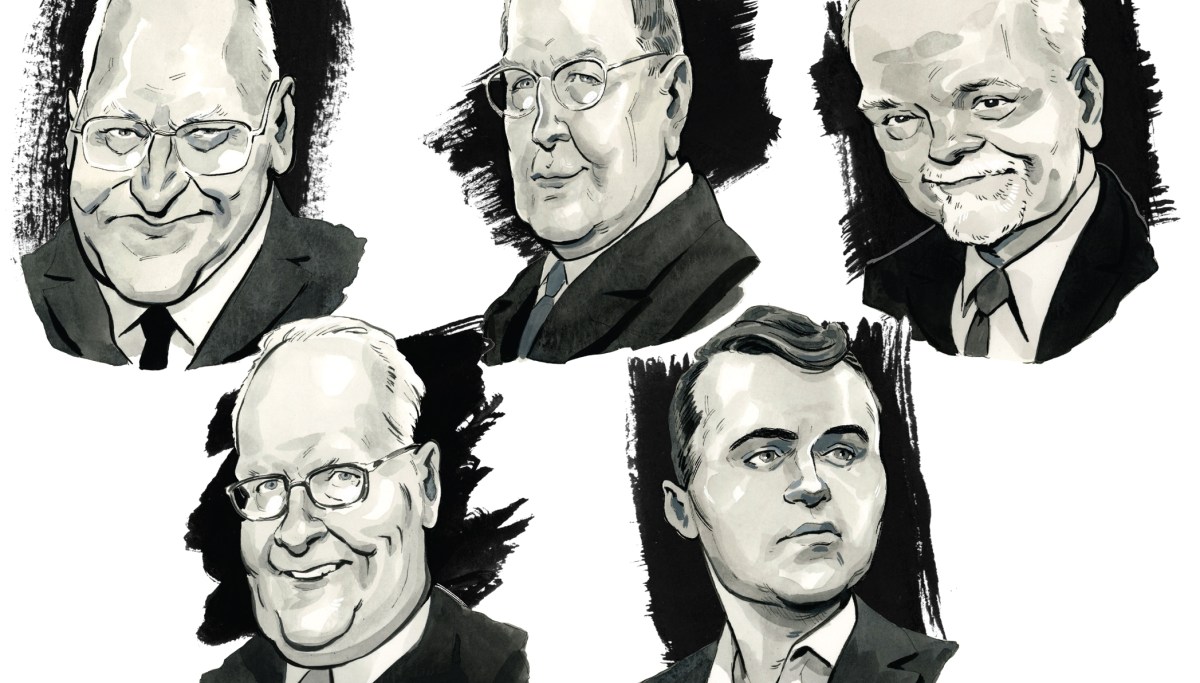
Having been part of the conservative movement for over 35 years, I’ve met a lot of the people who make the movement work. Unfortunately, given this long association, I find myself knowing more and more of the departed conservatives each year. This year was a particularly tough one, as I personally knew 10 of the luminaries who died in 2025.
This year starts with Lee Edwards, who died in late 2024, just after the deadline for last year’s piece. Edwards was a historian, author of 25 books, and chronicler of conservatives and conservative institutions. Edwards himself was also an institution in the conservative world, having helped found Young Americans for Freedom in 1960, working on Sen. Barry Goldwater’s 1964 presidential campaign, and having a half-century relationship with William F. Buckley Jr., the founder of modern conservatism.
Edwards was inspired to join the movement when he was studying in Europe during the 1956 Hungarian Revolution. Excited that communism was about to be defeated, he was then disappointed when Soviet troops brutally crushed the uprising. Typically, he turned his disappointment into resolve, recalling that “right then, I swore I would spend the rest of my life trying to defeat communism and help those fighting for their freedom.” His resolve was revealed in many ways: his books, his relationships with just about everyone in the conservative movement, his self-description as a “Reagan optimist,” and his multidecade effort to build the Victims of Communism Museum. This latter idea came about at an Edwards family gathering in 1990 when they decided the world needed a way to tell the story of communism’s 100 million victims. The museum opened near the White House in 2022.

We lost another eminent conservative when Ed Feulner died in 2025. The legendary founder of the Heritage Foundation in 1973 and its longtime president, he helped create the model for a conservative think tank. As a student at Regis University in Denver, Feulner read Goldwater’s The Conscience of a Conservative and Russell Kirk’s The Conservative Mind, showing the impact that conservative ideas can have on young people.
After earning a master’s degree from the Wharton School of the University of Pennsylvania, Feulner worked on Capitol Hill, where he was disappointed in conservative think tanks such as the American Enterprise Institute that provided too little intellectual ammunition for conservatives for the policy debates of the day. An AEI paper that intentionally came after conservatives had lost a key vote spurred him to create a think tank that could help conservatives win policy disputes in real time. One of the insights that helped make Heritage into what the New York Times called “the Parthenon of the conservative metropolis” was the belief that “personnel is policy.” This concept entailed staffing administrations with talented conservatives as well as hiring and nurturing people at Heritage. As economist Tim Kane recalled of his time at Heritage, “Feulner wanted me to get 100% of the limelight.” It’s a concept that other think tank heads should take to heart, especially today, as Heritage faces serious problems stemming from a president who is, unfortunately, in the limelight far too often.
Another conservative who was motivated by a eureka moment was David Horowitz. Born in New York and educated at Columbia University and the University of California, Berkeley, Horowitz was a “red diaper baby,” Marxist editor at Ramparts, and one-time ally of the Black Panthers until a friend of his was murdered while working for the Panthers. Horrified by both the still unsolved murder, for which he believed, with good reason, that the Panthers were responsible, and the indifference to it on the Panther-coddling Left, Horowitz turned rightward. He and his writing partner, Peter Collier, spent much of the 1970s and 1980s writing well-received books about American dynasties such as the Fords, Kennedys, and Rockefellers. The Kennedy book, in particular, called out the selfishness and depredations of that overrated family. In 1988, Horowitz created the Center for the Study of Popular Culture, later the Freedom Center, and spent the next four decades exposing anti-Americanism on the Left. His whirlwind of efforts included writing more books, but also going to college campuses and debating young leftists.
One of the people inspired by Horowitz’s forays on campus was Charlie Kirk, who was murdered this year while engaging in Horowitz-style face-to-face dialogue. Kirk, 31 at the time of his death, is sadly the youngest person ever profiled in this feature. He founded Turning Point USA at 19 to get young people engaged on the Right. Commentator Ben Shapiro, who met Kirk when he was only 18, recalled saying, “That kid is going to be the head of the Republican National Committee one day.” As Shapiro observed after Kirk’s murder, “Charlie became far more important than that.” Kirk was allied with Shapiro in trying to keep the antisemitic and isolationist forces in the MAGA movement at bay, in reaching out and encouraging anyone who could expand the movement, and in mitigating the ugliness of the antisemitic Right, some of which has surfaced in the aftermath of his death.
Sol Stern was not MAGA, but he would have appreciated Kirk’s support for Israel and stance against antisemitism. Educated at the City College of New York and Berkeley, Stern, like Horowitz, worked at Ramparts for a time. He turned away from the Left over his two big issues, Israel and education reform, both of which he covered extensively for decades at City Journal. As he recalled, “I have fallen into the trap of writing about the two most intractable problems in the world: American education and the Middle East.”
Also taking on tough issues for the conservative cause was healthcare expert Grace-Marie Turner. A former journalist, she worked tirelessly on developing viable conservative healthcare policy solutions. She formed the Consensus Group to hash out healthcare policies among conservative policy experts and created the Galen Institute, a conservative healthcare think tank. Turner traveled in conservative circles for over half a century, even bearing witness to Art Laffer’s legendary drawing of the Laffer Curve on a napkin during a 1974 lunch with Dick Cheney at the Hotel Washington.
Michael Ledeen was a scholar and writer who moved from the Left to the Right, but he also served in government, working for President Ronald Reagan’s National Security Council. A historian with a doctorate from the University of Wisconsin, he was also immersed in the worlds of intelligence and dissent from totalitarian regimes. Ledeen was an expert bridge player, a lover of Italy, and the author of three dozen books. He was a tireless proponent of freedom and opponent of the Iranian theocratic regime.
Long after he left official government employment, Ledeen continued to influence policymakers. Former President George W. Bush told him after his election, “Anytime you have a good idea, tell me.” Ledeen did not have to be told twice. He regularly faxed ideas to Bush aide Karl Rove, and often saw those ideas emerge as Bush policy.
Another important figure in the Reagan White House was Tony Dolan, a folk singer and Pulitzer Prize-winning journalist who was a speechwriter for all eight years. He worked on nine presidential campaigns and six presidential transitions. This cowboy-boot-wearing New Englander was one of the “true believer” speechwriters who fought the so-called “pragmatists” for primacy in the Reagan White House. According to the political scientist Paul Kengor, Dolan served on and led “one of the best presidential speechwriting teams in American history.”
Dolan wrote Reagan’s famous “ash heap of history” and “evil empire” lines but was also an indispensable facilitator of the famous Peter Robinson-penned “Mr. Gorbachev, tear down this wall” line in Reagan’s 1987 Berlin Wall speech. According to Robinson, the line “was a Tony Dolan production” because Dolan protected Robinson from bureaucrats, including deputy national security adviser Colin Powell, who objected to the line. When the time for approval came, Dolan took the speech, with its famous line intact, directly to the national security adviser, who took it to Reagan, ending the internal wrangling.
Alas, Dolan was far from the only conservative White House aide we lost in 2025. Marshall Breger was the White House Jewish liaison under Reagan and President George H.W. Bush, then became solicitor of labor. He was a staunch supporter of Israel but also a firm believer in interfaith dialogue, once giving a speech on freedom in Tehran in 2002 — something that would be unimaginable today. Cam Findlay was also in the first Bush White House and then served as deputy labor secretary in the George W. Bush years. He was known as “The Fixer” for his willingness to take on and resolve tough challenges. A clerk for Supreme Court Justice Antonin Scalia and Rhodes Scholar as well, Findlay had one of the best resumes I have ever seen.
Republican White Houses before Reagan were less conservative, but two aides from that earlier era who died in 2025 are worth mentioning. Marina von Neumann Whitman was the first female member of the White House Council of Economic Advisers. The daughter of the Manhattan Project’s John von Neumann, she worked on liberalizing trade and reforming the international monetary system. Typically, the media seemed more interested in her gender than her economic contributions. As she recalled, reports of her pioneering role “caused the journalistic world to go into an eruption of talk about what I looked like and that my eye shadow matched my dress.”
Ron Nessen served as White House press secretary under President Gerald Ford. A journalist-turned-political aide, Nessen was not that conservative, but he was very funny. Playing off of Ford’s famous line, “I am a Ford, not a Lincoln,” he told reporters, “I’m a Ron, not a Ziegler,” referring to President Richard Nixon’s obstructionist press secretary, Ron Ziegler. Nessen guest-hosted Saturday Night Live, then called NBC’s Saturday Night, in a failed effort to blunt the mockery from Chevy Chase’s portrayal of Ford as a hopeless klutz. On the show, Nessen joked that his job was to “Explain what the president said, what the president meant, what the president bumped his head on, and what the president mispronounced.”
Working with Nessen in the Ford White House was Dick Cheney, a deputy chief of staff and then chief of staff to Ford before becoming a congressman, defense secretary, and eventually vice president to George W. Bush. Cheney is clearly the best-known of the conservatives mentioned here and the subject of many obituaries, but it’s worth mentioning his important role for decades in engaging with conservative thinkers, books, and the world of conservative ideas. He brought in people such as Irving Kristol to advise the Ford White House, was a reader of conservative books himself, and hosted many conservative thinkers as vice president during the Bush years.
Other conservative politicians who died in 2025 included the anticommunist Cuban Rep. Lincoln Diaz-Balart, who once said, “I’m friends with anyone who’s fighting Castro” and Missouri Gov. and Sen. Christopher “Kit” Bond, who chided the IRS for saying that a fan who caught Cardinal slugger Mark McGwire’s 1998 record home run ball would owe the government a gift tax payment. According to Bond, “If the IRS wants to know why they are the most hated federal agency in America, they need look no further than this.” Wyoming Sen. Alan Simpson was a noted wit, once noting that “Over the last 40 years, I have had my size-15 feet in my mouth a time or two.” He was a staunch defender of Justice Clarence Thomas during Thomas’s contentious Supreme Court hearing and was a close friend of George H.W. Bush. At Bush’s funeral, he broke up the audience by saying, “Those who travel the high road of humility in Washington, D.C., are not bothered by heavy traffic.”
One person who helped get many conservatives elected was James Dobson, who founded Focus on the Family and helped bring evangelicals into the conservative movement. A licensed psychologist, Dobson wrote 70 books, including 1970’s Dare to Discipline, which set up a stark contrast between himself and liberal parenting guru Benjamin Spock. After taking on psychology, Dobson then brought his conservative message to the culture and to our politics, becoming a close adviser to the Reagan White House. His friend and colleague, Gary Bauer, with whom he co-founded the Family Research Council, called him “a man of deep conviction whose voice shaped the way generations view faith, family, and culture.”
WILLIAM F. BUCKLEY JR. AT 100: THE IRREPLACEABLE POLICEMAN OF THE RIGHT
This difficult year ended as it started, with another great loss, that of Norman Podhoretz, the author of 12 books and editor of Commentary magazine for 35 years. He brought Commentary from Left to Right as part of his own neoconservative evolution and in the process made it an indispensable magazine of ideas, politics, and culture. He was a towering figure in the American intellectual firmament who succeeded in making what he described as “the longest journey in the world,” from a humble immigrant background in Brooklyn to “the peak of Manhattan’s intellectual aristocracy.”
Others worth remembering as 2025 comes to a close include James Swanson, a Reagan appointee who wrote the terrific book Manhunt: The 12-Day Chase for Lincoln’s Killer; Peruvian Nobel laureate Mario Vargas Llosa, a free market conservative and author of The Time of the Hero, Conversation in the Cathedral and The Feast of the Goat; and Judge William Webster, the only person who headed both the FBI and the CIA. We can only hope for a shorter list after 2026 comes to a close.
Washington Examiner contributor Tevi Troy is a senior fellow at the Ronald Reagan Institute, a senior scholar at Yeshiva University’s Straus Center, and the author of five books on the presidency. He has been writing this annual tribute to conservatives who died for the Washington Examiner since 2020.