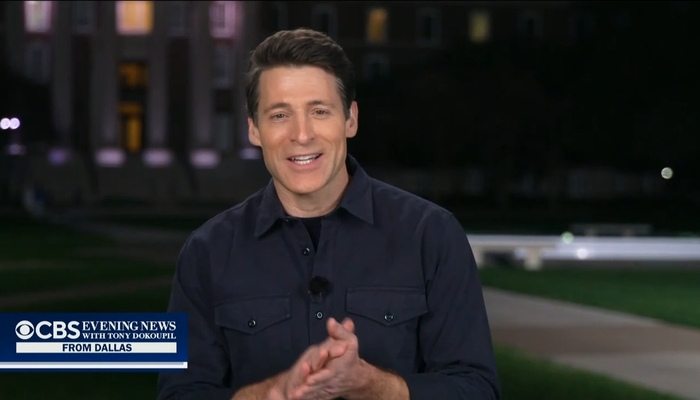
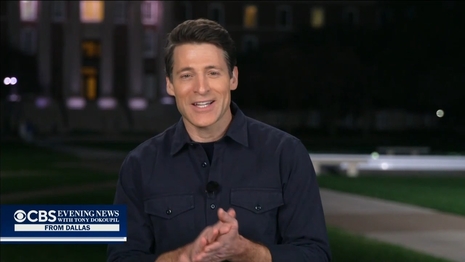
 Columbia Journalism Review provided its contribution Tuesday to the seemingly never-ending liberal, elite media pile-on against CBS News editor-in-chief Bari Weiss and CBS Evening News anchor Tony Dokoupil. This time, it focused on Dokoupil with a nearly 4,000-word story filled with anonymous, petty smears, lame attempts at media analysis, and a general disgust with the stated promise of Dokoupil that he sees, values, and wants to work for all Americans.
In other words, Dokoupil (and Weiss) have promised to build a newscast and network that believes Trump voters have value and should feel seen even though their peers find them detestable and icky.
CJR staff writer Amos Barshad tipped his hand with the headline and subhead: “What’s Up with Tony? How Tony Dokoupil went from being a hair model to a print journalist to the anchor of CBS Evening News, guided by the principle ‘We love America.’”
Barshad began with Dokoupil’s soft launch on January 3 and his interview with Secretary of War Hegseth as unacceptably soft because Dokoupil “did not question the legality of the [Venezuela] raid.”
Translation? As we’ll see with his analysis of Dokoupil’s January 13 Trump interview, the implication is Dokoupil allowing people the left finds repugnant to talk is unforgivable.
Barshad then ran through how Weiss came to run CBS News, the sale of The Free Press, Dokoupil’s brief monologue on social media liberal journalists mocked, and the CBS Evening News’s five guiding principles, including the one the left hate ever so much: “We love America.”
Unsurprisingly, he heavily implied to viewers the only thing that got Dokoupil the top job (being a Jew) and offering disgust with how Dokoupil wasn’t run out of town for his now-infamous interview of a leftist sacred cow, Ta-Nehisi Coates (click “expand”):
Dokoupil has other powers of apparent interest to Weiss. One is his familiarity with a subject about which she and the Ellisons care deeply: Israel. Dokoupil’s ex-wife and their two children live in Israel; the Ellisons have donated millions to the Israeli military, and Larry is reportedly close friends with Benjamin Netanyahu, the Israeli prime minister; for Weiss, American Zionism is a signature. Before being promoted, Dokoupil was a cohost of CBS This Morning, for which he flew to Israel in October of 2023 to cover the country’s reaction to the Hamas-led attacks of that month and the military response. A year later, in October of 2024, he interviewed Ta-Nehisi Coates on This Morning and described his latest book, The Message—in which Coates characterizes Israel as an apartheid state—as something that “would not be out of place in the backpack of an extremist.” The segment catalyzed a significant response inside the network, resulting in a review of CBS reporting; Dokoupil’s coverage of Israel, including the Coates interview, raised repeated concerns about falling short of editorial standards, and he was summoned to a meeting with members of the CBS News standards and practices team and the in-house Race and Culture Unit.
Then came the leaks and absurdist attempt at media analysis that, once again, could be boiled down to a virulent hatred for half of the country that Dokoupil and Weiss have advertised as being worth of hearing out instead of browbeaten into submission.
Also, take notice of the leaks whining “cocky” Dokoupil’s criticism of legacy media is “talk[ing] shit” (click “expand”):
In the anchor seat, Dokoupil has since covered the war in Iran by opining that the “iron-fisted theocracy” of the Islamic Republic may be near its demise; when officials confirmed the death of Ayatollah Ali Khamenei, he said, “Even as Iran retaliates tonight, that era of repression may be ending.” Dokoupil has cited Immigration and Customs Enforcement on the percentage of arrestees with criminal histories, which “wildly distorted CBS News’ own reporting,” as Media Matters put it. Dokoupil covered the five-year anniversary of the deadly insurrection of January 6, 2021, by briefly noting that Trump “accused Democrats of failing to prevent the attack on the Capitol, while House Democratic Leader Hakeem Jeffries accused the president of, quote, ‘whitewashing’ it.” In an interview with Trump, Dokoupil pressed him on concerns from his base that his attention was “drifting” overseas but failed to push back on the president’s claim that he’d ended eight wars. Trump told him that if Kamala Harris had been elected, “you wouldn’t have this job.” During a commercial break in Dokoupil’s Venezuela raid interview, Hegseth said to someone off camera that he was sitting down with CBS for “my first mainstream press interview yet at Bari’s request and because CBS News did something right.”
Some journalists at CBS are wincing. A staffer who was not authorized to speak described colleagues feeling irked by Dokoupil’s attempt to position himself to audiences as a critic of mainstream media’s way of doing things: “You are the media,” the staffer said. “Now you got a promotion and you’re gonna talk shit?”
(….)
Another CBS staffer..told me that Dokoupil has generally been perceived as “professional and smart, if a little cocky and looking to climb,” which is “not unusual for a correspondent.” Since Dokoupil took over as anchor, the staffer said, “people actually feel badly for him.”
Tom Bettag…was a CBS News producer for more than twenty years. From speaking with friends who still work at CBS, Bettag has heard that Dokoupil is “smart,” a “hard worker,” and a “pleasure to work with.” Watching the broadcast, however, Bettag is less impressed—and blames Dokoupil for pulling punches in his interviews with Hegseth and Trump.
The next portion consisted of Dokoupil’s early professional background, which some may or may not know was in print, specifically Newsweek, and NBCNews.com.
Barshad tapped more leaks of colleagues from these stops. The Ringer editor-at-large Bryan Curtis said Dokoupil anchoring a major newscast “was not something that ever crossed my mind” and was unsurprised he’s “nod[ding] at Bari Weiss’s preferred politics,” but another anonymously said Dokoupil’s Evening News tenure “has been so baffling” that he’d forgo any sort of “integrity” to become “a mouthpiece for the state.”
“The most charitable explanation I can think of is that he has a lot of admiration for the classic anchors. The uncharitable explanation is that he’s very ambitious,” the person added.
Yet another anonymous former coworker huffed: “I am surprised that he is pretending to be, if not MAGA-aligned, then somehow sympathetic with that worldview. There was no hint of that whatsoever at NBC.”
Scoffing at Dokoupil’s “admirable willingness to turn his life into copy” that included interviewing his mom for a January 27 closing segment about grandparenting, Barshad played the greatest hits that Oliver Darcy et al have been losing their noodle over from his first few weeks.
Hilariously, Barshad tucked in here a single sentence acknowledging “any given night of the show may look like any bit of generic network television news.” Once again, it sure seems like the so-called media reporters do not, in fact, consistently watch the people they’re writing about (click “expand”):
This last instance quickly became an entry into the annals of coverage Dokoupil has generated about himself. (One representative social media comment from an Evening News viewer: “Jesus Christ this is a clown show.”) Other examples include the time he cheered Marco Rubio, the secretary of state: “Marco Rubio, we salute you,” he said. “You’re the ultimate Florida man.” The White House shared the clip on X. There was the time when he cried during an on-air interview with a local CBS affiliate in Miami while reminiscing about his childhood. When he argued on social media that he would be more transparent than Walter Cronkite. When he defended his height.
Some of this is the stuff of an understandably awkward transition from morning show personality to nightly news anchor. And because his rise has come in the wake of Paramount’s takeover of CBS and Weiss’s arrival, Dokoupil is operating under unique scrutiny. In truth, any given night of the show may look like any bit of generic network television news. Some of his work, such as an interview with Tom Homan, Trump’s so-called border czar, has been well received. Even so, the collective impression does not appear to have won over audiences. Months into Dokoupil’s debut, CBS Evening News has averaged 4.3 million viewers a night..But recently, the weekly average fell below four million viewers[.]
Granting the point that network evening news ratings are influenced by where each of their local affiliates stand versus competitors, Barshad pivoted to one last attempt at media analysis by looking at Dokoupil’s coverage from the Middle East in the early days of the U.S. and Israeli war against Iran.
Specifically, he zeroed in on Dokoupil’s sit-down with Israeli President Isaac Herzog and whined the CBS anchor didn’t pursue a slew of far-left narratives about Israel and the Middle East (click “expand”):
But Dokoupil did not ask Herzog about the [power he has to] pardon [Netanyahu]. He did not ask about the tens of thousands of civilians the Israeli military has killed during its war in Gaza, or about the hundreds more civilians who have been killed so far in the strikes against Iran, or about the million people it has displaced in Lebanon since the latest round of air strikes. At one point, Herzog said that Israel has been “protecting Europe, protecting the free world, for quite some time.” Dokoupil accepted the statement without comment.
A majority of Americans, according to polls, disapprove of the United States’ involvement in the military strikes against Iran…Public approval for this conflict is lower than the support for other recent American military action at this stage. Yet those views were not foregrounded in the Evening News coverage produced in the Middle East, and in general, there’s been a feeling that a connection to the public interest is not being made: Weiss “just keeps saying ‘America’ and ‘people,’” one of the CBS staffers told me. “But what people in America?”
During the Herzog interview, Dokoupil made his closest approximation to an acknowledgment of that dynamic just before wrapping up….“What do you think this war does to the US-Israeli relationship going forward? And I ask because it’s not a popular war in America.” Herzog countered that Americans don’t understand the “intricacies” of the war and its potential to “bring real change in the Middle East for the future.” Dokoupil thanked him, and moved on.
Dokoupil’s newscast and CBS writ large still have a long way to go. On many nights, their shows are indistinguishable from past anchors and sets of leadership. But here we see America’s most esteemed journalism arbiters telling the public that the mere promise to regain the trust of Americans who’ve abandoned legacy media is a bridge too far and thus must be condemned.