Order Jamie Glazov’s new book, ‘United in Hate: The Left’s Romance with Tyranny, Terror, and Hamas’: HERE.
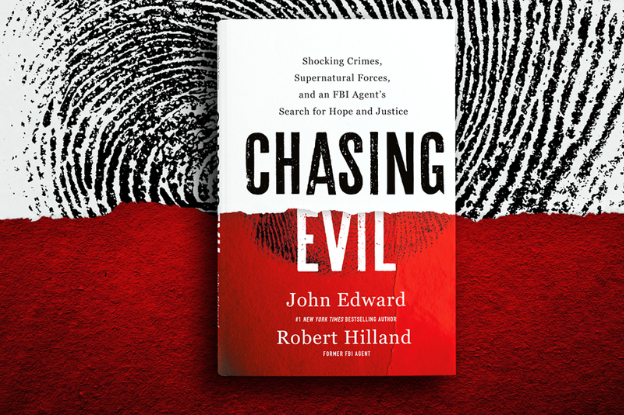
Chasing Evil: Shocking Crimes, Supernatural Forces, and an FBI Agent’s Search for Hope and Justice was released on September 2, 2025 by St. Martin’s Essentials. It is 353 pages long. The book recounts the quarter-century partnership between Robert Hilland, a thirty-year law enforcement veteran and FBI Special Agent, and John Edward, one of the most famous psychic mediums in the world. Hilland and Edward worked together on chilling cases of organized crime, serial killing, and missing children. Their partnership lead to the location of long-lost corpses and contributed to convictions of evildoers. Their work probably also contributed to the breakup of one of their marriages. Both Hilland and Edward have, apart from each other, appeared in media, but this book exposes their partnership to the world for the first time. Award-winning journalist Natasha Stoynoff is the duo’s co-author.
Chasing Evil is one of the best books I’ve ever read. It became an immediate bestseller for good reasons. In over 2,000 reviews, Amazon readers give the book an average of 4.7 out of a possible 5 stars. The writing is superb: smooth, direct, fast-paced. Hilland is the flesh-and-blood equivalent of a fictional noir hero. It’s easy to imagine him in a fedora and trench coat, in the cone of a lamp’s yellow light on a sidewalk enshrouded in mist. He is a “just the facts, ma’am,” character. He behaves with cool expertise in face-to-face encounters with a slippery serial killer he despises and promises to entrap, and the filthy-trailer-dwelling heroin-addict mother of a lost five-year-old boy.
Through Hilland’s vivid recreations of his police work, the reader gains deep understanding of how FBI agents operate, within what parameters, and propelled by what motivations. The book’s descriptions of Hilland’s pursuit of justice are suspenseful and also deeply moving. Hilland works with ugly, frightening criminals and crimes. He inhabits an netherworld most of us are barely aware of. Lonely, antisocial, irrational and destructive people populate his workday. In spite of the evil into which he, metaphorically, plunges his workman’s hand, Hilland is an exemplar of the best law enforcement has to offer. He prays the prayer to St. Michael the Archangel. Hilland himself is a shining example of the ideals in that prayer. Hilland “defends us in battle”; he bravely marches through a fallen world stamping out dark forces “who prowl about the world seeking the ruin of souls.”
In Chasing Evil, John Edward is most often a telephone contact or occasional in-person resource for Hilland. Edward’s contributions to the narrative also educate the reader in how this particular psychic medium works. His guides reveal to Edward material he may, in a daydream-type state, mentally see, hear, smell, feel, or taste. Edward may or may not immediately know the import of these revelations. In one case, he told Hilland to remain alert for a soccer ball. At the time, neither he nor Hilland had any idea what the soccer ball signified. Hilland would indeed encounter a significant soccer ball in this particular case. In other cases, Hilland and Edward spoke via telephone as he, Hilland, searched for a corpse. In two cases, Edward, though not present and never having visited the location Hilland was investigating, was able to describe where Hilland was and where to seek the body.
Obviously, Edward’s profession will be a stumbling block to many readers. Many religious people, including many Christians, believe that mediumship violates Biblical commandments, for example, “Thou shalt not suffer a witch to live” (Exodus 22:18). See also Leviticus 19:31, Deuteronomy 18:10-13, and the Catechism of the Catholic Church, CCC 2116.
On the other hand, the New Testament book of Luke honors Anna, a prophetess who, accessing her supernatural gift, recognized infant Jesus’ status as the Messiah (Luke 2:36-38). Joseph protected Jesus and Mary on the basis of a prophetic dream. Matthew honors the Magi, wise men who used astrology to predict the date and location of the birth of a great king. In Matthew 7: 15-20, Jesus advises his followers to judge prophets by the outcome of their actions. “Judge a tree by its fruit,” Jesus advises. “A good tree cannot bear bad fruit, nor can a bad tree bear good fruit.” Edward’s work has born good fruit, his fans insist.
John Edward was raised Catholic and has promoted the rosary as a beneficial prayer. Edward has, as he puts it, “evolved” over the years and his religious worldview has moved away from strict Catholicism, but he still honors his Catholic upbringing. Psychic mediums George Anderson and Theresa Caputo are practicing Catholics. Anderson believes that Catholic saints actively guide his work. Caputo attends mass and says, “I know my gift comes from God.”
Religious people who dare to open this book will discover a John Edward who is able to provide accurate information that leads to the apprehension of evildoers. Cops wear down shoe leather, burn up brain cells, follow leads, shoot guns and throw fists to solve crimes. We thank them for that. In this book, Edward uses his skills to work toward the same end of keeping the public safe. It’s unclear how anyone could dub what Edward does here as “satanic.”
Materialists are another group who reject truth claims for mediumship. They believe that there is no reality beyond which humans can contact with their five senses. If you can’t see it, feel it, taste it, hear it, or smell it, it doesn’t exist. Given that the human body provides the only possible vessel for the human experience, once a person dies, that’s it. There is no consciousness, no self, and no communication beyond physical death of the body.
Most people in most places have not been strict materialists. Over 100,000 years ago, Neanderthals and Homo sapiens buried their dead in a ritualistic manner, suggesting belief in an afterlife. Ancient folklore from cultures around the world contains mentions of psychic experiences, shamanic healing, dark forces, and of what sound very like near-death experiences. It’s remarkable that, given how many thousands of cultures humanity has produced, all, as far as we know, have some conception of a reality beyond the material.
Tim Whitmarsh, author of Battling the Gods: Atheism in the Ancient World, an exploration of atheists living in ancient Mediterranean societies that, otherwise, did have conceptions of a reality beyond the material, says that “Early atheists were making what seem to be universal objections about the paradoxical nature of religion – the fact that it asks you to accept things that aren’t intuitively there in your world.” One might want to point out to Whitmarsh that the believers in a reality beyond the material who have lived across the face of the earth and as far back in time as the Neanderthals are not being asked to “accept things that aren’t intuitively there in your world.” Rather, it is the atheists who are insisting that “things that are intuitively there in our world” don’t exist at all. People believe what they believe for a variety of reasons. It’s clear that a critical mass of humans have had experiences that cause them to believe in a reality beyond the material for the same reason they believe in the existence of trees or grass, cats or dogs. Their senses inform them that they have experienced cats and dogs; their senses inform them that they have experienced a non-material reality.
Personal anecdotes are all well and good, but when it comes to psychic mediums, we cannot rely on them. There are too many shysters out there. There are also too many desperate people who will jump at any bit of data to confirm their pre-existing beliefs. And there are too many people unschooled in methods to test truth claims. What separates a John Edward from a fake storefront psychic? John Edward has been giving public readings for decades. His accuracy is available for public inspection on YouTube and at his events. Further, he has been investigated. In 1999, Dr. Gary Schwartz subjected Edward to examination at the University of Arizona’s Human Energy Systems Laboratory. Schwartz holds an undergrad degree from Cornell, where he majored in psychology and minored in chemistry as part of his pre-med program. His Harvard PhD is in psychology. Schwartz went on to teach at Yale before he moved on to Arizona. As part of Schwartz’s experimentation, Edward “read,” that is provided information about, subjects he could not see or hear. Edward’s ability to provide accurate information exceeded mere chance.
In Chasing Evil, materialists will be confronted with one account after another of a psychic providing accurate, helpful information. Perhaps the only argument they could offer is that none of this actually happened; author Hilland invented every account to gain money or fame. But Hilland devoted his life, and repeatedly risked his life, in service to truth. And Hilland is a retired FBI agent, benefitting from a pension. He’s a workaholic. He’s now training newbie crime stoppers in various government agencies, including at Quantico. He doesn’t need money, nor does he need fame. He’s already been on TV talking about his work. In fact, the cases Hilland worked were so hair-raising and so full of darkly titillating details that a psychic-free account of his career would still make for a true-crime bestseller. Further, the FBI vetted Hilland and Edward’s book for nine months before allowing it to go to press. In short, the materialist objections to Chasing Evil are implausible.
Chasing Evil, like many true crime books or fictional whodunits, opens in media res. In the tradition of a professional investigator’s scrupulous note-taking, Hilland opens his accounts with dates, places, and names. Thus the prologue begins, “Little Noah. Dublin, Virginia. March 25th, 2015.” Hilland was on a steep hillside behind a filthy trailer inhabited by two heroin-addict parents. It was nighttime. Hilland was seeking a missing five-year-old boy. Hilland received a phone call. The caller was John Edward. “Bob, you walked right over him! Bob, stop where you are right now. Turn around. Go black in the direction you came … Look for that Star Wars toy. The X-wing fighter plane.” Edward was calling from hundreds of miles away. He had never been to the location Hilland was searching. Neither Edward nor Hilland had yet seen a Star Wars toy.
Before revealing the conclusion of the search for Noah, the book next addresses Hilland’s lengthy efforts to find the corpses left behind by serial killer John Smith and to bring Smith to justice. Hilland was only a 23-year-old patrolman when, in 1991, in a New Jersey police station, he first saw Smith. He immediately recognized evil. “I was seeing something difficult to comprehend – an evil spirit hiding in a human body daring me to expose it.” Smith posed a special challenge. He was highly intelligent and a brilliant engineer. He could move around the country and get high-paying jobs, in spite of his repulsive personality and his scrambled work and personal history.
Hilland says his background and his body prepared him for his work. Hilland is 6′ 8″ tall. He pumped iron and played sports. He protected his four younger siblings, as well as kids victimized by bullies. He had no use for psychics. “I was brought up a [Lutheran] churchgoer and did not subscribe to superstition, hocus-pocus, or the supernatural.” Hilland describes himself as a bit obsessive-compulsive. When not solving cold cases, he solves Rubik’s cubes. His workaholism did not benefit his marriage. “The life of a cop’s wife is thankless.” His kids, though, inspired him. They were “points of light in a dark world.” At other times, Hilland resorted to bourbon to deal with the darkness he had to wrestle as part of his job.
The book then offers background on John Edward. Edward’s last name is McGee. He doesn’t use it because his police officer father disdained his psychic work. He thought his son would “besmirch the family name.” John’s father ordered Edward never to work with law enforcement. At first Edward treated mediumship as a sideline. He studied for a degree in healthcare. In 1995, he quit doing healthcare work and turned to mediumship full-time.
Edward’s and Hilland’s paths crossed in 1998, after Hilland began hearing Edward’s appearances on a New York radio station. Callers would receive on-air readings from Edward. Hilland believed the callers to be paid actors. There was no other way, Hilland believed, that Edward’s readings could be as accurate as they were. Hilland was then working on the cold case of the disappearance of Janice Hartman and Betty Fran Gladden, two of John Smith’s missing former wives.
Hilland describes in detail the painstaking police work required to revive the Smith case. Hilland didn’t even know where John Smith was. Hilland had to wade through very disturbing material, including sickening accounts of Smith’s behavior as reported by a drug addict and prostitute who used to live with him. Hilland investigated the murders of a couple of dozen prostitutes, murders that may be connected to Smith. The bloodied corpses of these murder victims spoke of a man who hated women with a violent rage, but was still obsessed with them. “There are one million John Smiths living in the United States, and I’ve gone through paperwork for half of them … After a day of butchered bodies and lost souls” his children’s “sweetness and innocence helped erase some of the torture I’d seen.”
During another commute, Hilland heard Edward again. He, again, cursed Edward as a fraud. But then he picked up the phone. Edward’s assistant told Hilland that Edward did not do police work; nevertheless, she said she would pass his message on. Edward agreed to a meeting. Hilland brought items belonging to Fran, the missing Smith wife whose body had never been found. Hilland also brought control items that had no connection to the case.
Edward opened their meeting by saying that if he did end up helping Hilland, there was to be no publicity, or even records in official paperwork. Edward then began the reading. He immediately put aside all of the control items that had not belonged to Fran. “These have nothing to do with why you are here.” Edward then proceeded to tell Hilland details about the case. Hilland “shivered. This was unreal … not only was John confirming details we already knew, he was giving information we didn’t know, details that made sense, information that rang true that we could follow up on.” Edward revealed disturbing details about Smith. Edward said that Smith had killed many more than Hilland realized, and that Smith sexually violated corpses. Hilland would later learn details reinforcing Edward’s statements. “Your guy is pure evil … This is a fight between Good and Evil,” Edward said. “He will kill again unless he’s stopped.”
Edward then read Hilland. “You’re a man of extremes … You will make it your mission to get this guy at all costs. That could mean your personal life, your family, your status at work.” Edward provided details about Hilland, including details about his family history unknown to Hilland but that he later confirmed through conversations with his parents. Edward’s reading shattered Hilland’s skepticism.
Hilland met with a woman who had had an affair with Smith. She said that he made her insert ice-soaked cloths into her private parts, lie on her stomach, and stop breathing while he penetrated her. She hadn’t realized it at the time, but Hilland pointed out to the woman that that sounded like Smith asking her to play dead while he had sex with her chilled and inert form. Smith’s perverse proclivity for corpses had been mentioned by John Edward.
Hilland met with one of Smith’s former employers, who praised Smith’s skills as an engineer. “He had no interpersonal skills,” though, and he sometimes wore women’s clothes to work. Another former boss said that Smith was so obnoxious that his fellow workers wanted to “kick the s— out of him.” Smith was a pathological liar. A woman who had socialized with Smith said, “He was the center of the universe, the hero in all the stories he told, and we were supporting characters.”
One night Hilland was at home. Alex, his wife, was updating him about their children. Both were sick. As Alex spoke to Hilland about his kids’ illnesses, Hilland received a call on his work phone. He took it. Afterward, Alex said, “You can’t pay attention to me for five minutes! I’m talking to you about our kids and our family’s welfare, and you couldn’t care less. But the minute work calls, everything stops and they have your full attention. I wish for one minute you cared about us half as much as you did that damn job!”
Hilland mentions what inspires recruits to join the FBI. “They wanted to make a difference. They wanted to stand up for people who couldn’t stand up on their own. They wanted to be part of something bigger than themselves.” In addition to high ideals, the FBI included lots of office politics. “The FBI was known as a land of egos, power plays, and careerists.” Hilland had to work hard not just at finding information, but also at getting permission from his superiors to pursue the Smith cold case.
Edward predicted that Hilland would risk his job to bring Smith to justice, and that turns out to be true, over and over. Hilland’s superiors tell him to stop his investigation, but he can’t stop. Hilland was dogged. He continued working on the case even though eventually he was not getting paid for it.
Edward had said that Smith would be found in California. He was. Smith was intelligent and slippery. How to get him to say something incriminating? Hilland devised a strategy. Agents would be placed in five different US states where Smith had contacts, including family members. All of these contacts would be simultaneously interrogated by agents. Hilland would interrogate Smith in a hotel room, and would use input received from his colleagues who were interrogating Smith’s contacts. The information Hilland gathered thereby would immediately be plugged into his session with Smith. This access to information would intimidate Smith and also make it harder for him to lie.
Smith was apprehended at his new workplace in California. Hilland provides a fascinating and detailed account of the methods used during interrogation. The session lasted for hours. Just when it seemed that Smith might incriminate himself, he shut down, and had to be set free.
I won’t provide any more details about the Smith case. If you google his name and “serial killer” you will immediately learn the final outcome, which is mixed, with some victories and some goals yet to be achieved. Hilland and Stoynoff tell this story so expertly that even after Google reveals all, the book’s account of the Smith case is a page-turner.
Roughly the second half of the book covers Hilland and Edward working together on other cases. One involved Officer Charles Bernoski, shot to death in Rahway, NJ, in 1958. Edward provided information he received psychically to protect President Bush from a would-be assassin.
In spite of their successes, Edward became seriously depressed. He wasn’t sure why. One day, to accompany his wife, Edward entered the World Trade Center. He got the sense that the building was spiraling around him. He ordered his wife not to return there, in spite of a work contract that required her to be there.
Shortly thereafter, Hilland was driving into Manhattan, and he saw a plane hit the WTC. Hilland proceeded toward the towers. He witnessed victims ending their own lives through falls, rather than through fire. He assumed he’d die soon, too, and he prayed for his family. “For the next year … I lived and worked at Ground Zero. I put my search for Fran” – Smith’s second missing wife – “on hold.” As Hilland sought human body parts in the rubble, “I felt nothing. I couldn’t let myself. A job needed to be done and there was no time for feelings. I had to compartmentalize.”
In spite of his professional focus, though, Hilland did feel something so profound he asked for a tweak to his responsibilities. He had to ask loved ones related to 9-11 victims for DNA samples from the deceased person’s toothbrush or hairbrush. “I was sent to an address in New Jersey. A young mother answered the door, holding a baby. She glanced at my credentials, and then, joyously, looked past me … she must have thought I had her husband with me … as I asked for her husband’s toothbrush, the look of despair on her face was more than I could bear.” Hilland begged his superiors, “Put me back in the morgue … don’t send me to any more families.” He says they never found any remains belonging to the husband of that woman and the father of those two children.
Hilland began saying every morning the prayer to St. Michael the Archangel, that is, “St. Michael the Archangel, defend us in battle. Be our defense against the wickedness and snares of the Devil. May God rebuke him, we humbly pray, and do thou, O Prince of the heavenly hosts, by the power of God, thrust into hell Satan, and all the evil spirits, who prowl about the world seeking the ruin of souls.”
Though Hilland struggled to stuff his philosophical questions in a place where he could not access them, so as to be stoic and strong for his demanding work, the questions bled through to his conscious mind. “The battle between Good and Evil that John had mentioned … What made one person choose to hate, and another person choose to love?” Hilland witnessed great heroism at Ground Zero, especially from the police and firefighters who risked their lives, and sacrificed their lives, to be of service to their fellow man. But he also witnessed looters, “among the fresh graves of thousands of victims.” This enraged him. Evil “can thrive in your own backyard.” “We all have free will,” John Edward reminded Hilland.
A year after 9-11, Hilland became a polygraph examiner. He worked on the murder case of Florida husband and wife Christopher Benedetto and Janette Piro. Edward was able to provide information that supplemented Hilland’s old-fashioned police work. That work contributed to a conviction. Next Hilland turned to the 2005 disappearance of cruise passenger George A. Smith IV. That case has not lead to a conviction and, unusual for Hilland, the scrupulous cop and scrupulous storyteller, for legal reasons, he must blur some details in his account. It’s clear, though, who Hilland thinks is guilty.
Even while working other cases, Hilland could not let go of his search for Fran’s body. John Edward’s guides stopped providing him with new information. Hilland conferred with another psychic, Jonathan Louis. The three of them were still frustrated, and Edward told Hilland to “ask for a sign.” What happened next was so outlandish I will leave it to you to read about it. If it were coming from someone other than a rock solid character like Hilland, I would not be able to believe it, even though I know other people, including, those who claim to be orthodox materialists, who can tell similar outlandish stories when, in desperation, they asked for a sign, and something beyond their ken happened. Another sign occurred and Hilland methodically researched it, by reporting to a perfume counter at a department store. He discovered that that sign was beyond chance.
A less uplifting and more domestic sign: Hilland wanted to discuss the event with his wife, Alex, but felt he couldn’t. They were drifting apart, and his work, and his workaholism, steadily shoved a wedge between them.
Hilland reports on his overseas work, often involving situations where he or the people he must interrogate are at risk of death by both governmental and non-governmental forces. Women who look like supermodels surrounded him and his men. “Go straight to your room and put the chain on your doors!” Hilland ordered his men. These accounts are nail-biters. Edward’s all too earthbound advice to Hilland in some of these situations was “Don’t trust anyone.” As seems inevitable in accounts of Westerners doing demanding work in exotic locales, Hilland was invited to eat a local delicacy he’d rather not eat, a goat’s eyeball.
Hilland met a fellow agent who was as passionate about catching mob boss Whitey Bulger as Hilland was about catching John Smith. Hilland and Edward pitched in. Before their first group meeting, Hilland did not tell Edward whom they were seeking. When Edward met with Hilland’s colleagues in a hotel room, he immediately drew Hilland out into the hall. “Can we trust these guys?” Edward asked. He sensed that the case involved betrayal and a “bad cop,” and indeed it did. Various government employees had protected Bulger for years. Edward, not knowing who he was reading or why, selected, from some of Bulger’s belongings, an implement of torture, and was horrified. He quickly dropped the knife when he understood how Bulger used it.
Hilland worked on the Michael Vick dog abuse case. Edward advised Hilland on key strategies he could use in the interrogation. Hilland used them and they worked. Vick served prison time. As if Hilland had not been through enough to wreck the nervous system of any man, he next worked in Afghanistan, investigating double agent activity. It was a grueling experience. Hilland reports one bright light. “I visited an impoverished family who lived in an adobe mud hut.” The family patriarch shared the only food he had with Hilland, almonds and prunes, though “They were starving.” “There exists only two kinds of people in this world – Good and Bad. You can find evil where you least expect it, but you can find beauty and love where you never imagine.”
Hilland recorded in his Afghan diary, “Being away from Alex and the kids was terrible … God has blessed me with a beautiful family … They mean more to me than anything else. I would be lost without them … Please forgive me for the times I could not be with you.” Unfortunately, the marriage did not last.
Annie Marie Le was a 24-year-old Yale doctoral student. She was only 4′ 11″ and 90 pounds. She was seen on surveillance video entering a Yale building, but never seen exiting. Hilland sought her remains, and Edward helped via telephone. Noah Thomas was a missing five-year-old boy in Dublin, Virginia. Edward helped locate his remains, as well. In both cases, suspects went to prison.
The book ends with Hilland’s retirement from the FBI, and his letting go of his obsessive search for Fran’s body. Edward assured Hilland that the earthly justice system is nothing compared to one to be found in another dimension entered after physical death. In that eternal justice system, Smith will encounter consequences for all of his crimes, not just the ones for which law enforcement officers were able to find evidence.
Danusha V. Goska is the author of God through Binoculars: A Hitchhiker at a Monastery