 During the Easter edition of CBS News Sunday Morning, the not-so right-wing network dedicated four minutes and four seconds to the war in Iran. But despite the United States pulling off a daring rescue of an airman from Iranian territory the day prior, only 43 seconds, less than a quarter of the of the airtime was about the successful operation. Instead, they chose to interview a former Obama advisor, bash President Trump, and suggest the United States was committing war crimes for the remainder of the segment.
It was obvious that CBS was trying to salvage a pre-recorded segment that was designed to bash Trump because all mentions of rescue operation appeared to be grafted onto the front.
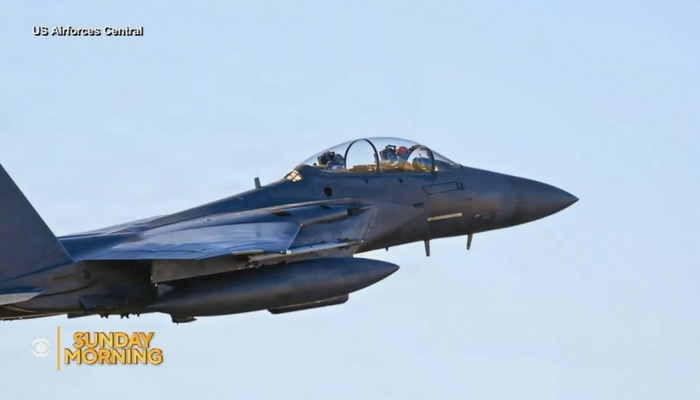
A voice over of host Jane Pauley giving a general run down of the operation preceded a soundbite of Pentagon correspondent David Martin simply describing a video of aircraft participating in the search:
PAULEY (voice over): As we’ve told you, the missing American airman injured when his F-15E was shot down over Iran, on Friday, has been found. In a social media post, President Trump said the aviator is expected to be just fine. The two-day rescue involved U.S. Special Operations Forces and travel deep into hostile territory. We’re also told the CIA was heavily involved.
(On screen] Once again this morning, we turn to David Martin, with a look at events in Iran.
[Cuts to video]
MARTIN: American aircraft flying low and slow over Iran, searching for a downed aviator and taking fire from the ground.
In all, the successful rescue of an American airman from deep behind enemy lines only garnered 43 seconds, from a segment that was over four minutes long. That’s less than a quarter.
Martin then hard pivoted to whining about Trump talking tough against America’s enemy and clutching his pearls over the destruction of a bridge used by the IRGC (Click “expand”):
MARTIN: The airman was rescued, but the U.S. is being drawn deeper in and the commander in chief is posting strike videos and sounding more bellicose than ever.
TRUMP: We’re going to bring them back to the stone ages, where they belong.
MARTIN: So far, the U.S. has struck mostly military targets, like this ammo depot, which triggered a massive explosion. But it also hit Iran’s biggest bridge, a civilian target, which U.S. officials said was used to transport missiles. The President threatened much worse if Iran does not come to terms by Monday night.
TRUMP: If there is no deal, we are going to hit each and every one of their electric generating plants very hard and probably simultaneously.
In a segment about the war in Iran that lasted 4 minutes and 4 seconds, CBS News Sunday Morning sprinted through an update about the rescued airman (43 seconds) to spend the rest of the time bashing Trump. They didn’t speak to anyone who supported the war, but they did speak with… pic.twitter.com/HOcOTppIUM
— Nicholas Fondacaro (@NickFondacaro) April 6, 2026
The expert Martin cited to suggest America was going to be committing war crimes under Trump? Tess Bridgman, a former advisor to President Obama, the president who drone-striked so many Afghan weddings it became a meme:
BRIDGMAN: Well, electrical generating plants power hospital, they power schools, water sanitation facilities, the things that you need to sustain basic day-to-day living for a civilian population.
MARTIN: [Voice over with picture of Bridgman with President Obama’s hand on her shoulder] Tess Bridgman was a legal advisor to President Obama’s Security Council.
BRIDGEMAN: Obliterating all power plants, threatening coercive actions against the civilian population to try to bring a government to the negotiating table; those kinds of things are flatly illegal.
Martin’s second expert cited against Trump for a former Trump official, Eliot Abrams. He too didn’t like the idea of cutting off power to the IRGC:
MARTIN: Eliot Abrams, who served as special representative to Iran in the first Trump Administration, says punishing the Iranian population would undercut the American cause.
ABRAMS: We want the Iranian people on our side. I’d rather see us go after regime targets, assets they use to repress the American people, not assets Iranians use to live their daily lives.
While CBS was busy trying to claim Trump was going to commit war crimes, they ignored or were ignorant of the fact that the U.S. had weapons that could disrupt power but not destroy the power plants. Weapons such as graphite bombs, which uncoil long filaments of metal wires which as designed to be deployed over power lines and cause them to short circuit. The lines being much easier to replace than an entire power plant.
Of course, the final expert CBS spoke with to suggest Trump was failing in his mission was the president of a think tank who argued that things weren’t gong well since the uranium was yet to be seized (Click “expand”):
MARTIN: It also seems far removed from the reason President Trump went to war.
TRUMP: All I want to do make sure they don’t ever have a nuclear weapon.
MARTIN: Has he done that?
DAVID ALBRIGHT: Unfortunately not.
MARTIN: David Albright is president of the Institute for Science and International Security, and a leading expert on Iran’s nuclear program.
ALBRIGHT: The most important part that remains is the highly enriched uranium. And that has not been destroyed or taken by the United States or Israel.
When asked about the future of Iran’s nuclear weapons program, the doomsayer Albright claimed: “The way things are going now, I don’t think we’re going to see the end of it.”
CBS would rather sprint through an American success story that saw the U.S. military set up an airfield just outside Iran’s second largest city, control their air space and ground traffic for hours so we could land multiple fixed-wing planes, and leave without sustaining an lost personnel, all so they could smear the U.S. and suggest we’re losing.
The transcript is below. Click “expand” to read:
CBS News Sunday Morning
April 5, 2026
9:07:31 a.m. EasternJANE PAULEY (voice over): As we’ve told you, the missing American airman injured when his F-15E was shot down over Iran, on Friday, has been found. In a social media post, President Trump said the aviator is expected to be just fine. The two-day rescue involved U.S. Special Operations Forces and travel deep into hostile territory. We’re also told the CIA was heavily involved.
(On screen] Once again this morning, we turn to David Martin, with a look at events in Iran.
[Cuts to video]
DAVID MARTIN: American aircraft flying low and slow over Iran, searching for a downed aviator and taking fire from the ground. The airman was rescued, but the U.S. is being drawn deeper in and the commander in chief is posting strike videos and sounding more bellicose than ever.
PRESIDENT DONALD TRUMP: We’re going to bring them back to the stone ages, where they belong.
MARTIN: So far, the U.S. has struck mostly military targets, like this ammo depot, which triggered a massive explosion. But it also hit Iran’s biggest bridge, a civilian target, which U.S. officials said was used to transport missiles. The President threatened much worse if Iran does not come to terms by Monday night.
TRUMP: If there is no deal, we are going to hit each and every one of their electric generating plants very hard and probably simultaneously.
TESS BRIDGMAN: Well, electrical generating plants power hospital, they power schools, water sanitation facilities, the things that you need to sustain basic day-to-day living for a civilian population.
MARTIN: [Voice over with picture of Bridgman with President Obama’s hand on her shoulder] Tess Bridgman was a legal advisor to President Obama’s Security Council.
BRIDGEMAN: Obliterating all power plants, threatening coercive actions against the civilian population to try to bring a government to the negotiating table; those kinds of things are flatly illegal.
MARTIN: Eliot Abrams, who served as special representative to Iran in the first Trump Administration, says punishing the Iranian population would undercut the American cause.
ELIOT ABRAMS: We want the Iranian people on our side. I’d rather see us go after regime targets, assets they use to repress the American people, not assets Iranians use to live their daily lives.
MARTIN: It also seems far removed from the reason President Trump went to war.
TRUMP: All I want to do make sure they don’t ever have a nuclear weapon.
MARTIN: Has he done that?
DAVID ALBRIGHT: Unfortunately not.
MARTIN: David Albright is president of the Institute for Science and International Security, and a leading expert on Iran’s nuclear program.
ALBRIGHT: The most important part that remains is the highly enriched uranium. And that has not been destroyed or taken by the United States or Israel.
MARTIN: Does Iran still have a path to a nuclear weapon?
ALBRIGHT: As long as it has this highly enriched uranium, it does have a path.
MARTIN: The path of Iran’s highly enriched uranium is believed buried inside this mountain complex, and President Trump seems willing to leave it there.
TRUMP: We have it under intense satellite surveillance and control. If we see them make a move, even a move, we’ll hit them with missiles very hard again.
MARTIN: The U.S. can bomb the complex to make the uranium even harder to get to, but that is not the entire stockpile.
ALBRIGHT: It’s a big question about where is the rest. Because the rest is enough for at least two or three nuclear weapons
MARTIN: Will this war leave Iran more or less determined to get a bomb.
ABRAMS: I think this leads them to believe that they need a nuclear weapon. I don’t think they’re going to do this tomorrow morning, I think they’ll return to it over time, if the regime survives.
MARTIN: Have we seen the last of Iran’s nuclear program?
ALBRIGHT: The way things are going now, I don’t think we’re going to see the end of it.