In Focus delivers deeper coverage of the political, cultural, and ideological issues shaping America. Published daily by senior writers and experts, these in-depth pieces go beyond the headlines to give readers the full picture. You can find our full list of In Focus pieces here.
California has a wealth of advantages compared to other states. Its gross domestic product would rank fourth on the global stage, behind only the United States, China, and Germany. It has a wealth of natural resources that should make water management and energy production easy.
And yet, California is badly mismanaged.
California is one of seven states that share water from the Colorado River, receiving one-third of its overall water from the river. These states have failed to come to a renewed agreement on how to divvy up that water, leading the Interior Department to get involved. The current deal among the states expires at the end of the year.
BELTWAY CONFIDENTIAL: NEWSOM’S WORST NIGHTMARE, AS ZUCKERBERG LEAVES CALIFORNIA
In 2023, six of the seven states actually did reach an agreement. Those states were Arizona, Colorado, Nevada, New Mexico, Utah, and Wyoming. California did not agree because the Golden State would have seen the biggest cuts under the other states’ plan. California instead proposed a plan that would put the most cuts on its fellow “lower basin” states, Arizona and Nevada, which included California reportedly pitching cutting off Las Vegas and Phoenix from relying on the river.
California is trying to throw its weight around against its water neighbors because it has become reliant on water from outside the state, all because state leaders have refused to harness the water within the state’s borders. Voters approved a bond in 2014 that allocated $2.7 billion for water storage projects. It has been 12 years, and no new storage facilities have been built as of yet.
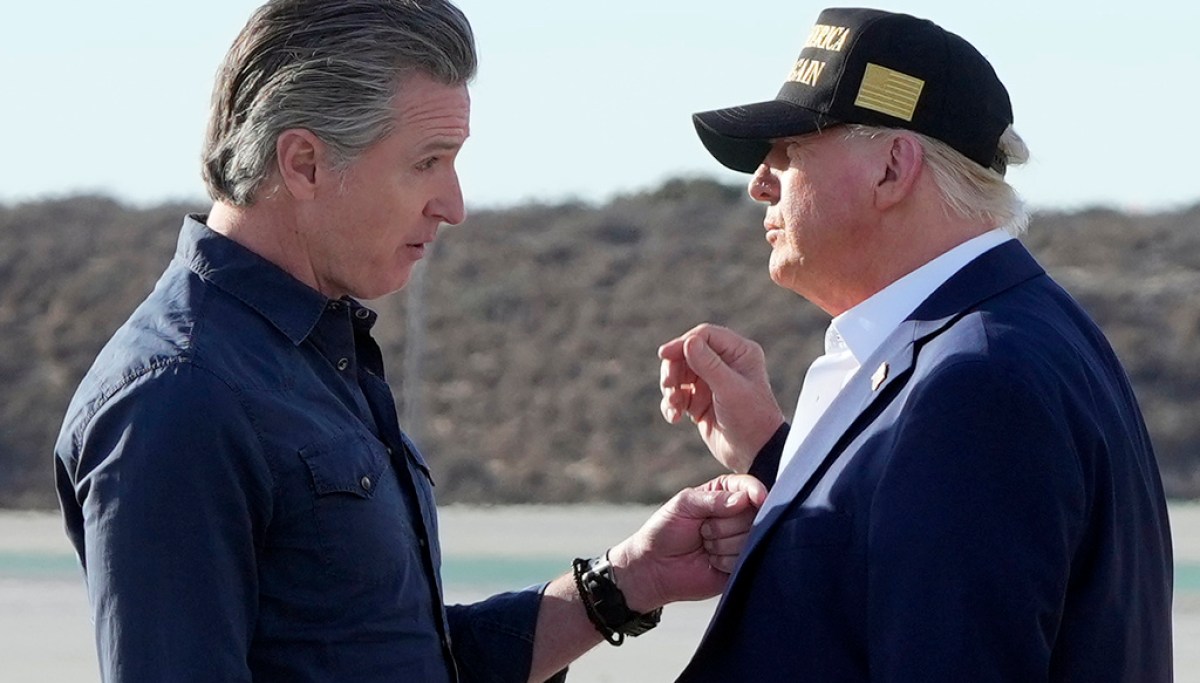
When presented with solutions, California has declined to take them. Gov. Gavin Newsom (D-CA) and his administration determined that $20 billion was too expensive for plans for a tunnel that would direct water from the Sacramento River to water-needy Southern California, even as Newsom has overseen exponential increases in the state’s budget. California has seen record-setting years of rain and snow, only to let the runoff flow into the Pacific Ocean, with no ability — or willingness — to store that water for dry years. California even struggles to keep water in its water-rich north, where activists pressure Democratic leaders to keep water pumps shut off on behalf of dying species of fish, resulting in that water being flushed out to sea.
California has been reduced to a dependent “power,” not just on the issue of water. California’s targeting of the oil industry with heavy regulations has led to refineries shutting down in the state. California is on track to lose a projected 21% of its oil refinery capacity over the next few years. Valero and Phillips 66 have each announced recent refinery closures, which have led Newsom to support reversing a law he signed just three years ago.
Much as it did with water policy, California created this crisis by fitting its oil and gas policy to what environmental activists have demanded. The result is that California, in November 2025, imported more gasoline than it ever has before, despite most of it being produced in the U.S. According to the Institute for Energy Research, “In 2025, the Bahamas supplied 12% of California’s ship-borne gasoline imports, more than it had in the previous nine years combined.” India and South Korea are also heavy importers for California, and the state “will need to depend on imports for at least the next several years.”
This was not inevitable. California had over 40 oil refineries in the 1980s. That number has dropped to a dozen, which are increasingly consolidated under a handful of companies. The best California can hope for to decrease its self-imposed dependency on foreign nations is to increase its dependency on other states through a proposed pipeline that would bring gasoline from Illinois to California.
Just as California is the biggest importer of gasoline among U.S. states, it was also the leading importer of electricity for years. Virginia has since taken that top spot, but California is still reliant on its neighbors for power despite its grand promises of a sustainable “clean energy” grid that would revolutionize the future of the nation. Instead, California’s grid relies on importing 20% to 30% of its electricity in a given year.
This is because, again, California has been weakened by its commitment to environmental activism. The state has tried to erase oil and natural gas from its energy production system, putting increased weight on wind and solar, neither of which is strong or reliable enough to keep the grid running. Aside from making California reliant on energy from other states, this has also led Newsom and his Democratic colleagues to reverse course on those “dirty” forms of energy.
What is more interesting than that reversal is what California has done with regard to nuclear energy. Despite nuclear being a clean form of energy, state Democrats have run every nuclear plant out of service but one, Diablo Canyon. California Democrats signed the death warrant for that plant as well, but the last several years have been defined by those Democrats reversing course to keep the plant open, since it alone provides roughly 9% of the state’s energy.
Despite this war on nuclear energy at home, California also imports energy from Washington and Arizona. In fact, nuclear energy makes up a higher percentage of California’s energy imports — 11% — than Diablo Canyon does of the state’s energy, meaning that the state was happy to force its neighbors to produce nuclear energy for the Golden State’s grid while it was hounding nuclear plants out of its own borders.
That extends to “dirty” energy forms as well. California is working on setting up a regional energy network with neighboring states to trade electricity. It’s a sensible proposal, since it would likely make energy cheaper in California, and the state already exports excess solar energy that it can’t use itself. But such a proposal would mean that California would be entering into an agreement with states that rely on coal, such as New Mexico, Utah, and Wyoming. In 2021, California produced almost no coal energy on its own, but nearly 10% of the state’s energy imports came from coal.
NEWSOM’S ENERGY POLICIES COULD JEOPARDIZE NATIONAL SECURITY, CALIFORNIA CONGRESSMAN WARNS
This stands in contrast with Newsom’s boasting that California is providing federal welfare to other states through its federal tax loads. Newsom is happy to paint other states as whiny dependents who criticize California’s mismanagement while relying on its money (or, more accurately, the money from California residents who pay federal taxes). But he has it backwards. It is California that has become reliant on other states for such basic things as energy, gasoline, and water.
California has the resources, financial and natural, to be independent when it comes to those issues, but it does not have the will or the competence. That has left California as a dependent state, which helps explain why it is floundering.