Order Michael Finch’s new book, A Time to Stand: HERE. Prof. Jason Hill calls it “an aesthetic and political tour de force.”
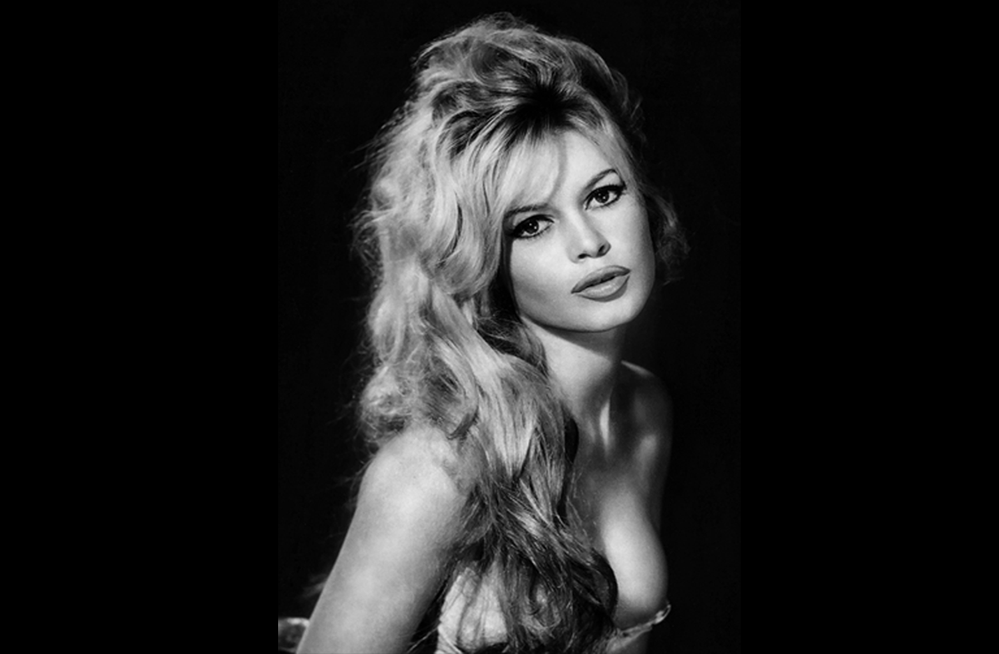
On December 28, 2025, Brigitte Bardot died at age 91. Bardot starred in the groundbreaking 1956 film, And God Created Woman. Bardot was so hot, so different from what one expected from a post-World-War-II French woman onscreen, that she became an international superstar. The very name, “Brigitte Bardot,” became metonymous with sex, pleasure, allure, seduction, and overwhelming sensuous abandon.
Many who heard the name “Brigitte Bardot” might never have seen one of her films. American theater chains tend not to screen foreign films with subtitles, and, of course, the Legion of Decency condemned And God Created Woman. But we saw photographs of her, and even just those photos worked Bardot’s magic on our eyes. I’m a heterosexual woman, and not at all into Bardot’s body type, the petite, heavily made-up blonde, but I’m not blind. One glance at a head shot of Bardot told me all I needed to know.
Brigitte Bardot’s contemporary, Marilyn Monroe, was another blonde bombshell with an alliterative name. In contrast to Bardot, Monroe always seemed vulnerable. In her famous “Monroeisms,” Monroe playacted at the “dumb blonde,” the wide-eyed little girl who had no idea how attractive she was, and what the consequences of her attractiveness might entail. In her affected, childish voice, she would speak double entendres meant to sound innocent but that had a sexual meaning. Monroe practically hung out a sign reading, “Big Bad Wolf, come get me.”
Like And God Created Woman, 1950’s All About Eve was another film whose title referenced the Biblical Eve. All About Eve is one of Monroe’s earliest screen appearances. She’s surrounded by female power players: Bette Davis, Anne Baxter, Celeste Holm, and the waspish George Sanders. Every one of these actors is playing a calculating character whose mind is actively at work at multidimensional chess. Monroe alone plays the vapid, empty-headed “idiot,” as Sanders’ character, Addison DeWitt, dubs her; see here.
Unlike Marilyn Monroe, the onscreen Brigitte Bardot could take care of herself. After an encounter with Bardot, it was the man, not Bardot, left gasping for breath and checking his pockets for his valuables. In my imagination I insert a Bardot character into that All About Eve scene. I think the Bardot character and the Bette Davis character would bond. Game recognizes game. I think my imaginary Bardot character would either take pity on, or simply smack, the Monroe character. Bardot’s characters did smack other characters, and she did get into cat fights onscreen, where she stopped slapping men for a minute and mixed it up with another female; see here and here.
But Brigitte Bardot the real woman had a very different reaction to the real woman Marilyn Monroe. The two screen queens met face to face in a dressing room before meeting the real-life queen, Elizabeth. It’s astounding that so much star power so close together didn’t trigger a cosmic explosion. Bardot was very tender, even maternal, in her description of the meeting. “I felt so inferior to her,” Bardot said. “She was so vulnerable. Like a baby. The people around her destroyed her. No one understood her.” One beneficiary / victim of the sex goddess industry recognized another.
Bardot played characters who swaggered through life, well aware of how hot she was, and expert at strategic deployment of her heat to gain what she wanted. Unlike, say, Vivien Leigh’s Scarlett O’Hara, Bardot didn’t just play a woman who could wrap men around her finger by manipulating their helpless desire for her. Bardot made it obvious that she liked sex, too, on her own terms. Bardot is one actress I can think of who could have done as good a job playing Scarlett O’Hara as did Vivien Leigh. There’s even a picture of Bardot in an antebellum style bonnet; see here.
Was Brigitte Bardot a Bardot character in her private life? Like the characters she played, real life Bardot chose many lovers, sometimes moving on to a new one before the previous one realized he was yesterday’s news. “I always left men before they could leave me,” she said. And, “I have always looked for passion.” She was “packing my suitcase” when “the present was getting lukewarm.”
Bardot’s strict Catholic parents “kept me under lock and key till I was fifteen,” Bardot said. She studied ballet. A governess supervised her. At age fifteen, she met 22-year-old aspiring director Roger Vadim. He was immediately taken. “What struck me about Brigitte when I met her was, to use a dance term, her posture, her bearing, her arched back, her regal head carriage, and her way of seeing. Many people look, but don’t know how to see.” Obedient to her resistant parents, Bardot waited till she was 18 to marry Vadim.
Vadim knew that Bardot cheated on him with her co-star Jean Louis Trintignant. Vadim said, “I knew what was happening and rather expected it. I would always prefer to have that kind of wife, knowing she is unfaithful to me rather than possess a woman who just loved me and no one else … I wanted … a woman with a sense of adventure and sexual curiosity.” Vadim and Bardot continued to work together after their divorce, and always spoke well of each other. Bardot married German millionaire Gunter Sachs. She cheated on him, too, but he said, “A year with Bardot was worth ten with anyone else.”
Behind the scenes Bardot was not always happy with the fate her gorgeousness made almost inevitable. The roles she played took a toll on her mental health. In 1960, when she was 26 years old, Henri-Georges Clouzot’s directed Bardot in the Academy-Award-nominated film La Verite. Bardot played Dominique, a prostitute, murderer, and suicide. “Clouzot convinced me so thoroughly that I was this woman of loose morals, this tragedienne, that I ended up believing it myself. I became Dominique. So much so that months later, I wanted to kill myself.”
She struggled with depression; she attempted suicide more than once; and she was saved, she says, at one point, by a “miracle.” “When you live such intense moments as I have done, there is always a bill to pay … You cannot escape the distress which follows great happiness.”
In a 2012 interview, Bardot said that celebrity almost crushed her. “I tried to make myself as pretty as possible and even then I thought I was ugly. I found it madly difficult to go out, to show myself … I was afraid of not living up to what people expected me to be. Today, at my age, I don’t give a damn. I no longer want to seduce, not anything, not anyone.” After leaving film, she found joy in everyday life, in “Little miracles like the blossoming of a flower, the dance of a bee, the vastness of the sea and of course animals, because of their purity, their courage and their loyalty.”
Roger Vadim directed and co-wrote And God Created Woman as a slap in the face to “Christian” sexual mores. Like the Sexual Revolution itself, Vadim’s worldview was a double-edged sword for women. The film championed a woman who exercises agency over her own sex life. But it advocated for abandoning social customs that protected women, customs that recognized that women are different from men. Like most people, Bardot became more conservative as she aged. In 1986, when she was 51, she told Le Figaro, “My dream would be the solitude of two. I would like to marry for the last time of my life … Right now, the best thing that could happen to me would be to live with a companion for the rest of my days … I just lived through a Christmas of solitude. It was not fun.” In that same interview, she protested against public nudity on St. Tropez’s beaches. “You have to show a certain dignity and respect in life. I am not particularly moralistic. But as there are less and less normal people, I seem maybe old fashioned compared to what is commonly widespread. We are right in the middle of decadence.” In 1992, Bardot married businessman Bernard d’Ormale. “He loves me for myself, not my image,” she said. D’Ormale supported Bardot as her health declined. They remained married until her death.
She knew full well that her looks were her ticket, and that her looks’ marketability would expire as she aged. Bardot left acting before she turned 40. Bardot didn’t attempt to cling to ingenue roles. She appears never to have gotten a face lift; rather, Bardot aged naturally. Her face was a net of wrinkles; her hair gray. To me, she still looked fabulous.
Unlike Monroe and too many other great beauties, Bardot didn’t die a suicide. At least three times, in Streetcar, Ship of Fools, and Roman Spring of Mrs. Stone, Vivien Leigh, another great beauty, played aging coquettes who have lost their looks and have no cards left to play in life’s Darwinian casino. Leigh’s characters in these films are raped, institutionalized, humiliated, and murdered. Leigh herself suffered from bipolar disorder, ended up divorced from her beloved Larry Olivier, and succumbed to tuberculosis at the relatively young age of 53. Unlike Vivien Leigh, Bardot didn’t take on tragic roles in films that punish beautiful women for aging. Bardot didn’t become a recluse, hiding from the camera, as did aging beauties Greta Garbo and Marlene Dietrich. The silent movie “It Girl,” Clara Bow, not only became a recluse, but she was diagnosed with schizophrenia, and died alone at age 60. Ava Gardner, dubbed by her beloved Frank Sinatra as “the most beautiful woman in the world,” drank so much she was banned from the best places for, for example, urinating in the lobby of Madrid’s Hotel Ritz. Gardner’s bad taste in her many lovers included George C. Scott, a fellow alcoholic, who, she said, “beat the s— out of me.” More seriously, Gardner’s cigarette and alcohol addictions caused strokes and contributed to her death at age 67.
It’s not easy to be the most beautiful woman in the room, or in the world. At least two classic novels, Wladyslaw Reymont’s The Peasants, and Nikos Kazantzakis’ Zorba, depict villagers actively destroying the one beautiful woman in their midst. Brigitte Bardot was not just, in her time, crowned as the sexiest woman in the world. She wasn’t just France’s most important animal rights activist. She survived to ninety plus, and she thrived. And, goshdarnit, she was apparently a lifelong smoker.
After leaving stardom, Bardot didn’t just go off into the sunset and luxuriate in her wealth without doing anything for society. Her activism began when she was still a screen goddess, and only 28 years old. Bardot appeared on television on January 5, 1962. In that appearance, she used her fame to arouse compassion for a suffering population people found it easy to ignore – livestock. Exquisite blondes were not supposed to draw attention to cows’ and pigs’ cries of fear and pain in squalid slaughterhouse conditions, but on that 1962 TV appearance, Bardot went there. She was humble, “It’s not entirely my place to be here tonight. I would have preferred someone else to take my place.” But she was determined. “Since no one else is here, it is I who am here to speak to you about this horror that is still happening today.” She was also unflinchingly graphic. “Their throats are cut and the blood flows out, causing death. It sometimes lasts three, four, or five minutes. And during those three, four, or five minutes, the animal is alive and suffering.”
Television journalist Pierre Desgraupes challenged Bardot. “Don’t you find it strange that you, Brigitte Bardot, are dealing with these issues?”
She was not intimidated. “I find it especially strange that no one else is dealing with them.”
Aren’t you just doing this for publicity? Desgraupes asked.
“I’m perhaps one of the few people in the world who doesn’t need publicity,” Bardot replied.
Though she sounded pretty sure of herself in her TV appearance, years later, she would acknowledge, “I was sick with stage fright.” But she carried on, anyway.
Bardot acknowledged that meat consumption is “normal,” but she knew that many meat eaters would want to feel that they were not supporting needless suffering. She advanced an entirely workable solution. She held in her hands a shiny metal captive bolt pistol that could be used to knock animals unconscious before their slaughter. The device, she said, would serve as a kind of anesthetic. To see that frightening looking gun in the hands of a young beauty was great TV. But it was not enough. Later, Bardot, wearing a mannish suit jacket and necktie, met with Interior Minister Roger Frey. On April 16, 1964, Frey passed a decree requiring that animals be rendered unconscious before slaughter.
Bardot was told that she’d need a huge sum to have the impact she wanted to have for animal rights. She didn’t have that kind of money on hand, so she auctioned off some of her own prized possessions: gifts of jewelry, artworks, costumes from films, and other mementoes. She sold significant real estate. She autographed and sold images of herself in open air markets. Through her sacrifice and hard work, she raised the funds needed.
The world still paid a great deal of attention to her beauty. Bardot, like Princess Diana after her, instrumentalized her fame to advance her cause. Paparazzi wanted photos of the beautiful Bardot, even after she left film? Great. Here was Bardot, sexy as ever, seducing the camera as if she were on the set of a big budget film, hugging a fluffy white baby harp seal. Fur hunters club baby harp seals and then skin them to sell their pelts for fur coats. Bardot focused on the mistreatment of so-called “dancing bears” in Bulgaria, Romania, and Russia. Bears were rescued and placed in a sanctuary. Bardot’s foundation’s homepage, which describes other contributions Bardot and her allies made to animal rights, is here.
It won’t surprise any adult that Brigitte Bardot was an imperfect person. In the 1950s, Bardot had two illegal abortions, one of which almost killed her. She later campaigned for abortion’s legalization. She had a rocky relationship with her son, Nicholas Jacques Charrier. She stated in her memoir how badly she did not want to be pregnant. Her insensitive revelations hurt her son.
Bardot made unfiltered public pronouncements on controversial topics. Bardot defended Gerard Depardieu, accused of rape, and she condemned the Me Too movement, stating, “Many actresses flirt with producers to get a role.” She said that she found it “charming to be told that I was beautiful or that I had a nice little ass.” She made dismissive comments about those gay men who “moan about what ghastly heteros put them through.” Otherwise, she claimed that “Apart from my husband… I am entirely surrounded by h—s. For years, they have been my support, my friends, my adopted children, my confidants.”
In short, Bardot was a flawed human being like the rest of us. Those of us who appreciate her do not appreciate her for her flaws, flaws many of us share. Rather, we appreciate her for what she did that the rest of us did not do. Contrary to what many men might think, plenty of us women see ourselves in Bardot. No, we have never been blonde bombshells. But, like us, Bardot was once a sheltered teenager overcome by a powerful older man who set our teen juices flowing and then attempted to use us for his own purposes. And, like many of us, Bardot grew up and realized she was so much more than our reflection in men’s eyes. She cared deeply about animals and lessening their suffering. She said, “I gave my beauty and my youth to men. Now, I give my wisdom and my experience to animals.” She loved her country, France, and she wanted to speak out loud what many were thinking and afraid to say. And then, as has happened to many of us women, sneering men and envious women mocked her, and said that she was nothing but a sex toy, and not to be taken seriously. In spite of that, she soldiered on, and accomplished more than many of us ever will.
In 1959, feminist Simone de Beauvoir published an encomium to Bardot:
“Her walk is lascivious and a saint would sell his soul to the devil merely to watch her dance … Moral lapses can be corrected, but how could B.B. be cured of that dazzling virtue—genuineness? … The majority of Frenchmen claim that a woman loses her sex appeal if she gives up her artifices. According to them, a woman in trousers chills desire. Brigitte proves to them the contrary, and they are not at all grateful to her, because they are unwilling to give up their role of lord and master … In the game of love, she is as much a hunter as she is a prey. The male is an object to her, just as she is to him … the male feels uncomfortable if, instead of a doll of flesh-and-blood, he holds in his arms a conscious being who is sizing him up.”
De Beauvoir, who was herself a profoundly imperfect person, makes a good case for a feminist appreciation of Bardot, even though Bardot dismissed feminism, saying, “I like men.” Of course feminists like men, too, but that’s Bardot.
If a feminist can make a case for Bardot, can a Catholic feminist like me do so, as well? I think so, yes.
In a September, 2024 interview with the Catholic site Aleteia, Bardot said, “When I was a child, I went to church with my parents every Sunday. I remember a sense of mystery emanating from that magnificent place.” In her youthful abandon, she departed from observance and pursued a sinful life of sexual incontinence and illegal abortions.
But her love of the church remained. In a photo of Bardot’s 1995 meeting with Pope John Paul II, she appears to be over the moon with happiness. Bardot told Aleteia, “I carry my faith within me and I am proud of it.” Bardot had a chapel built on her estate in San Tropez. She named it Notre Dame de la Garrigue, Our Lady of the Scrubland. The chapel contained paintings and statues depicting Mary, St. Francis, and the crucifixion. There was also that photo of Bardot and the pope. Bardot called Mary, “My little virgin.” “I am under the protection of the Little Virgin, to whom I am completely devoted. I built her a small chapel in the middle of the wild pines of my scrubland and I go there to recharge my batteries as often as I can.” In her chapel, she felt, she said, “A wonderful peace.”
St. Francis of Assisi is the patron saint of animals. “He’s a beacon of animal protection,” she said. “I have great respect for him, and there’s a statue of him in my chapel. I also admire Padre Pio. They are … wonderfully sensitive, generous, and kind.” “I would like to see a revival of the Catholic religion.”
The twenty-eighth verse in the entire Bible, Genesis 1:28, spoken by God immediately after he created male and female in his own image, was, “Be fruitful and multiply.” God invented sex. God blesses sex. The Song of Songs is all about sex. Jesus’ first miracle was performed, at his mother’s request, at a wedding. Jesus transformed water, the most basic of beverages, also used in purification, into wine, the libation of celebration. Jesus’ longest recorded conversation is with the Samaritan Woman at the Well. Jesus mentions her many lovers, but he doesn’t bash or shun her. He engages with her respectfully, and he invites her to live a better, sexually continent life.
Anyone who has ever seen a Renaissance Madonna, a painting of the martyrdom of Saint Sebastian, or Bernini’s Ecstasy of St. Teresa knows that Catholics know where babies come from. Catholics, centuries before cinema, mass produced images that celebrated beauty, the body, and desire. Yes, sex in the Catholic context is to take place within the support of a committed marriage. But that doesn’t make Christianity anti-sex; it makes Christianity pro good sex, and multiple studies suggest that married Christians have more satisfying sex lives than unmarried and secular couples; see the September, 2022 article, “Religious People Report Greater Sexual Satisfaction.” In BigThink.
After World War II, a lot of people were feeling pretty grim. France did not suffer the worst of Nazi occupation, but it did suffer. Four hundred thousand buildings were destroyed. More than ten percent of French men were killed, as were twenty-five percent of French Jews. Production was at forty percent of pre-war levels. Those French who collaborated with the Nazis had to be dealt with through the “épuration légale” or “legal purge.” There was inflation and food shortages.
“Libido,” a word we associate with lust, traces back to the Indo-European root meaning “to care, desire, love.” It’s related to German “leibe’ and Polish “lubic” and the English words “believe” and “belief.”
The opposite of “libido” is not, say, “love in a committed relationship” or even “chastity.” The opposite of “libido” is “destrudo,” the urge to destroy, arising from “Thanatos,” the death drive.
Imagine living in a France resurrecting itself from the war. Onscreen pops this embodiment of libido. A totally hot, gorgeous, assertive young woman you can’t take your eyes off of. Brigitte Bardot was just what the doctor ordered. She’s a physical manifestation of the Biblical command: “Awake and sing, oh ye who dwell in dust.”
One might have any number of reactions to Bardot’s death. To too many of our friends on the left, the major reaction was, indeed, destrudo. Before even most people were aware of her death, before most young people had had any chance to discover her legacy, the left mounted a media lynching of a woman who was already dead. The memory of Bardot had to be placed in the dock of a show trial. Leftists were compelled to consign Bardot to the cultural gulag occupied by those guilty of wrong think. Any appreciation of her beauty or her activism would cast one outside the circle of the righteous.
Both social media and mainstream media erupted with hysterical shrieks of condemnation of a woman who hadn’t dominated headlines in the lifetimes of most of those rushing to slander her. There was an urgency in these attacks – leftists had to rob Bardot of any humanity and leftists had to do this quickly, lest some arbiter of the author’s acceptability in the armies of the pure would judge them tardy in their rage. Under Stalin, audience members attending his speeches had to be careful not to be the first to stop applauding. After Bardot’s death, the good leftist had to be sure not to be the last to throw mud at her retreating corpse.
What did Bardot do to get leftists so worked up? Remember – the Catholic Legion of Decency condemned her breakout film, And God Created Woman. I saw no eruption of vituperation from Catholics after her death. I didn’t see any twenty-first-century Reverend Dimmesdales insisting that Bardot’s corpse should be forced to wear a scarlet letter A for “adulterer.”
Bardot’s crime? Being a beautiful woman who spoke frankly. She said lots of things that might offend lots of people. I find many of her comments off-putting. But I will survive the trauma. I’m being sarcastic. I was offended; I moved on. I was not traumatized. I recognized that other people have a right to express their opinion, and to express their opinion in a way that offends me.
Bardot said inflammatory things about Muslim immigrants to France. She said, “They slaughter women and children, our monks, our civil servants, our tourists and our sheep, one day they’ll slaughter us … Illegal immigrants … [are] spreading their nauseating stench beneath the sacred vaults of the choir.” I wish Bardot had not spoken these words. Criticism of the oppressive or violent features of Islam – or any other ideology – is one thing. Alleging that Muslims “spread a nauseating stench” is out of line and hurts, not helps, any legitimate cause.
France was one of the leaders of the Enlightenment. A key Enlightenment value is freedom of speech. A famous quote attributed to Enlightenment figure Voltaire goes like this, “I disapprove of what you say, but I will defend to the death your right to say it.” Voltaire did not sactually say that; it’s a paraphrase by Voltaire biographer Evelyn Beatrice Hall. Those of us who cherish freedom of speech believe that the answer to speech we don’t like is not to suppress speech, but rather to produce more and better speech, that is speech that addresses the flaws in the speech we don’t like.
Islam and the left have one thing in common. Both “cancel” people for speaking in ways that transgress their values. In Islam, maligning the founder, or even the Quran, is a capital offense. When leftists have absolute power, they also punish speech with the ultimate penalty.
Mouloud Aounit (1953 – 2012) was a Communist and a Muslim. As a child, he left his native Algeria for France, where he could enjoy the fruits of Western Civilization. Aounit, as a representative of The Movement Against Racism And For The Friendship of Peoples, a name both Stalin and Orwell might have loved, targeted Bardot.
Aounit had previously targeted an obscure French high school philosophy teacher, Robert Redeker. Redeker was guilty of thinking, writing, and publishing. After Muslims sent him death threats, Robert Redeker lost his obscurity, and went into protective hiding. I wanted to read the Le Figaro article that got Redeker in trouble. Le Figaro has scrubbed the article. No doubt their staff does not want to end up like the staff of Charlie Hebdo. I was able to read some of Redeker’s text as Russell A. Berman engages with it in a Telos post, here.
Aounit repeatedly sued Brigitte Bardot. Aounit was unambiguous in his intentions. He wanted to “hit” Bardot. He wanted to silence Bardot. He wanted to remove her freedom of speech. He wanted to make France just like his native Algeria. “We expect justice to hit her hard. We need a ruling which will dissuade and prevent her from making further outbursts.”
Aounit, rather than working to punish and silence Bardot, could have engaged Bardot. He could have used the “the solution to speech you don’t like is not less speech but more speech” typical of Western Civilization. He could have published an essay addressing what Bardot said about Muslim immigrants, and arguing for the approach to Muslim immigrants he preferred, presumably, an approach of tolerance and co-existence.
As soon as Bardot died, condemnations spread on mainstream and social media. Chappell Roan is a 27-year-old singer. In 2023, Roan released a song, “Red Wine Supernova.” This song credits Bardot with awakening Roan to her lesbianism. The video that accompanies the song depicts a sexual fantasy fueled by Roan’s first exposure to Bardot’s work. The day Bardot died, Roan posted a salute to Bardot. Then the thought police got to Roan. The next day, Roan posted, “Holy s— i did not know all that insane s— Ms. Bardot stood for obvs I do not condone this. very disappointing to learn.” Roan did not specify specifically which “s—” she was objecting to. Roan seemed incapable of distancing herself from aspects of Bardot’s life that Roan objected to, while continuing to appreciate Bardot for lighting the fire of her sexual life. Roan’s fans bashed her online for posting a brief “RIP BB” message. Then they bashed her for deleting that message. Examples of some of these enraged internet posts can be seen at Bored Panda, here.
Mainstream publications made sure to condemn Bardot. Chances are many younger readers would have no idea who Bardot was. The thought police would be sure to guarantee thought purity. “The French actor was a mouthpiece for racial hatred … the persona of Bardot had curdled into something much uglier … she was a committed, enthusiastic racist” alleged The Guardian. Bardot made “hair-raising racist Islamophobic declarations,” according to the New York Times. Politician Rima Hassan Mobarak condemned those guilty of “trivializing, minimizing or even rendering invisible the racism and Islamophobia she helped spread.” Le Monde said that Bardot “embodied racial hatred.”
David Szauder, a German “AI artist” with 1.5 million Instagram followers, posted a video he made to salute BB. He was attacked for doing so. In response to these attacks, he wrote, “Brigitte Bardot” was “that surreal beauty who captivated me … and who once whispered Je t’aime… moi non plus into my ear … my video was flooded with comments … Should I take the video down … After a night of restless turning, by morning I came to the conclusion that I would try to pay tribute to her in a way that clearly signals that I am honoring the classic talent, not the person who later became infamous for hurtful statements. In today’s world, it is difficult to remain politically correct.”
It’s interesting that those attacking Bardot deploy the verbal weapon, “racist.” The word in this context is, of course, simply wrong. Islam is not a race. Muslims, like bomber Dzhokhar Tsarnaev and his fellow terrorist brother, were literally Caucasians, from the Caucasus. Bardot criticized specific actions. Bardot accused Muslims of “slitting the throats” of “our monks.” Father Jacques Hamel was an 84-year-old priest. In 2016 Muslims slit his throat at a Catholic mass. In October, 2020, a Muslim decapitated middle school teacher Samuel Paty. Also in October, 2020, a Muslim in Nice slit the throat of a sacristan in the Basilica of Notre Dame. The preference for throat-slitting and decapitation is culture specific. This method of execution is mentioned in the Quran, for example 8:12 and 47:4. It is recommended in the Hadith; see, for example, Sunan an-Nasa’i 4023, Sunan Ibn Majah 2608, Sunan an-Nasa’i 4023, and Sunan Abi Dawud 4686.
The irony is, of course, that the leftists flinging that nuclear bomb of an accusation, “racist,” at Brigitte Bardot, are happy to do exactly what they condemn. They say horrible things about a religion and its believers, specifically, Christians and Christianity and Jews and Judaism.
“Chuck” is a retired university professor. The very day that Bardot died, Chuck posted on social media, “Between 1997 and 2008, French courts convicted and fined Bardot at least five times for inciting racial hatred.” Many posters on Chuck’s page wanted to do to Bardot what fur-hunters do to baby harp seals. They wanted to club Bardot to death. She was already dead, of course, and that enraged them even more. But they could use her pelt to accessorize their public display of righteousness.
A sampling: “She should rest in piss.” “She was shitty.” “Beautiful woman in her youth, but hatred of and bigotry toward Muslims and Islam turned that beauty into something ugly and revolting. Like JK Rowling and her hatred of and bigotry toward transgender people, that’s what she should be remembered for.” And another agreed. “Bardot and Rowling have expressed hateful comments … They’re both bigots. There’s plenty of evidence out there (from their own lips and keyboards) to support my statement that they’re bigots. To use one bigot to support another is to simply play the bigot.” And another, “She wasn’t anything special. Not a great actress. She was a sex symbol for a time in her youth. Not a great humanitarian. Not a nice person. It must have been a slow news day.” And another, “Oh eww!” And another, “I dunno. Id have humped all hell out that racist bi—.” And one more “spoiled, self centered creature who happened to be beautiful and thrived on it since childhood. Infantile and uneducated. Hardly an artist in any terms, herself. Inherited predujidice of post colonial society.”
Chuck, who approved of calling criticism of Islam “racist,” eventually said that he thinks the Old Testament is comparable to Mein Kampf.
Danusha V. Goska is the author of God through Binoculars: A Hitchhiker at a Monastery.