Order Robert Spencer’s new book, Holy Hell: Islam’s Abuse of Women and the Infidels Who Enable It: HERE.
Texas and Florida have declared the Muslim Brotherhood, to which every major Muslim organization in the United States is linked in one way or another, to be a terrorist organization. The Trump administration has opened inquiries into whether several chapters of the Brotherhood, albeit not the most dangerous ones, should likewise be labeled terrorist organizations. Because patriots have sponsored these initiatives, however, leftists have labeled them “Islamophobic,” “bigoted,” and the other usual charges. Questioning the benign nature of the Muslim Brotherhood, they say, is just “far-right” paranoia.
The career of Anwar al-Awlaki demonstrates otherwise.
Born in New Mexico in 1971, al-Awlaki attended Colorado State University, where he was president of the Muslim Students Association, a Brotherhood front. While still a student, al-Awlaki began preaching at the Islamic Center of Fort Collins. One congregant later recalled, “He was very knowledgeable. He was an excellent person — very nice, dedicated to religion.”
Later, al-Awlaki became imam at the Denver Islamic Society, and later still at the Dar Al-Hijrah Islamic Center, a mosque in northern Virginia, where he counseled two of the 9/11 hijackers.
In the years following the September 11 attacks, al-Awlaki became one of the world’s leading ideologues of jihad and abetted the plotting of numerous jihad attacks. He ultimately became internationally notorious for his role in the Christmas Day underwear bomb plot in an airplane over Detroit, the attempted Times Square car bombing, and the Fort Hood jihad massacre — after leaving the United States in 2002 because of a post-9/11 “climate of fear and intimidation,” according to his friend Johari Abdul-Malik, director of outreach for the Dar Al-Hijrah mosque in Northern Virginia. The Muslim Brotherhood in Yemen gave al-Awlaki shelter.
Al-Awlaki carefully cultivated a moderate image. He was so successful at this that shortly after 9/11, the New York Times held him up as a shining example of “a new generation of Muslim leader capable of merging East and West,” and quoted him explaining how his community was now more careful to root out jihadist sentiments: “In the past we were oblivious. We didn’t really care much because we never expected things to happen. Now I think things are different. What we might have tolerated in the past, we won’t tolerate any more. There were some statements that were inflammatory, and were considered just talk, but now we realize that talk can be taken seriously and acted upon in a violent radical way.”
But that was just disinformation, as the FBI knew even at that time. They had al-Awlaki under surveillance. Nonetheless, in a precise illustration of the absurdity and incoherence of Washington’s policy toward Islam and jihad, al-Awlaki’s moderate credentials were
so taken for granted even during the period of this surveillance that on February 5, 2002, the FBI trailed al-Awlaki as the imam traveled through Washington — all the way to the Pentagon, where he gave an address at a Defense Department luncheon on “Islam and Middle Eastern Politics and Culture.”
Also in 2002, PBS produced a documentary on the life of Muhammad, Muhammad: Legacy of a Prophet. I wrote in a National Review article at the time (which the magazine has since, tellingly, taken down) that the documentary presented an “attractively packaged, sanitized version of Islam.” The documentary featured Islamic apologist Karen Armstrong; Daisy Khan, the deeply deceitful “moderate” who briefly shot to national prominence in the Ground Zero mosque controversy, and others of that ilk.
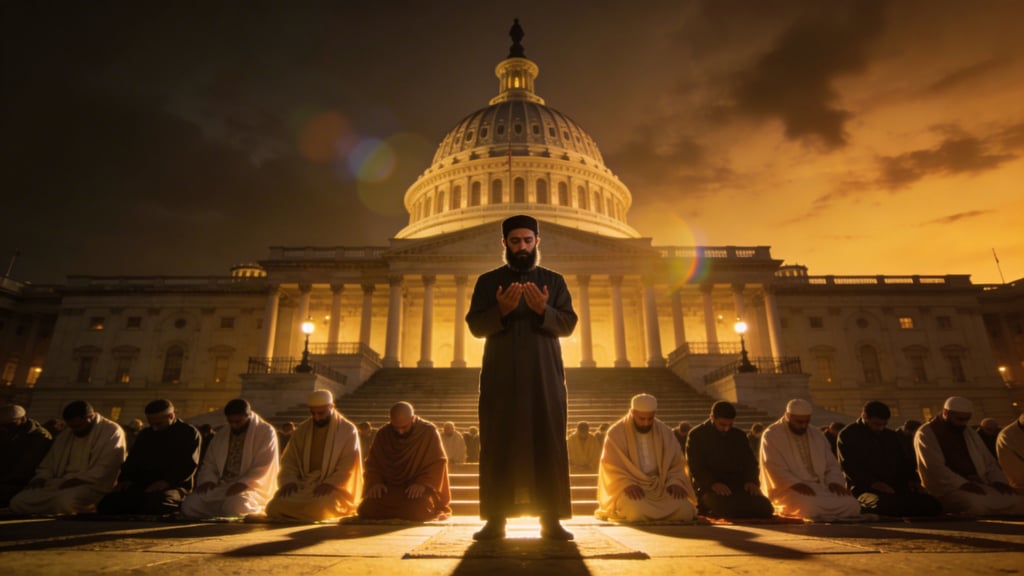
The documentary also captured al-Awlaki leading Muslim prayers on Capitol Hill, although he now appears to have been edited out. Present for al-Awlaki’s sermon was the Hamas-linked Council on American-Islamic Relations (CAIR)’s Nihad Awad, his henchman Ibrahim “Honest Ibe” Hooper, and convicted jihad terrorist Ismail Randall Royer, who was also a CAIR operative at the time. None of them stood up and denounced al-Awlaki for his supposed “extremism” and “hijacking” of Islam, or did so at any point afterward.
And no one in the West paused to consider the implications of that fact.