Order Jamie Glazov’s new book, ‘United in Hate: The Left’s Romance with Tyranny, Terror, and Hamas’: HERE.
The American and Israeli militaries on Saturday morning launched attacks on the Islamic Republic of Iran, hitting the supreme leader’s compound that includes the presidential palace, the Islamic Revolutionary Guards Corps (IRGC) senior leadership, ballistic missile launchers, nuclear enrichment sites, and more. In response, Iran has launched missiles at Israel, and at American bases in Kuwait, Qatar, the United Arab Emirates, Jordan, and Bahrain, as well as sites in Riyadh, Saudi Arabia. The Israelis believe that they may have killed the supreme leader, but Iran denies it. The Iranians have fired missiles at Israel, but so far, no casualties have been reported in the country.
In Bahrain, there was a missile attack by Iran on the U.S. Navy’s 5th Fleet, which it hosts. The Bahraini government called it a “treacherous attack” and “a blatant violation of the kingdom’s sovereignty and security.” In Qatar, the Iranians launched an attack on the Al Udeid airbase, which the U.S. shares with Qatar. The government of Qatar says all missiles were intercepted before entering the country’s air space. In the UAE, one civilian was reported killed from debris falling from an intercepted missile in Dubai, near the Jebel Ali Port used by the American navy. In addition, Iran hit a luxury hotel, the Fairmont, also in Dubai; four people were wounded. The UAE defense ministry said that the country had been the target of “a blatant attack involving Iranian ballistic missiles.” Kuwait’s Ministry of Defense said that the Ali al-Salem Air Base, where American servicemen are stationed, came under attack by ballistic missiles, all of which were intercepted by Kuwaiti air defense systems. The Saudi foreign ministry confirmed that Iran had targeted Riyadh and the kingdom’s eastern region, but announced that all the attacks were repelled. The Saudis have also threatened to respond in kind. In Jordan, the armed forces said they had shot down two ballistic missiles targeting its territory, while suffering no casualties.
Iran has now managed to enrage every Sunni Arab state in the Gulf region, including Saudi Arabia, Kuwait, Jordan, Qatar, the UAE, and Bahrain (the Bahraini ruler is Sunni, though the population is majority Shi’a). They are now cheering on the Americans (and quietly, the Israelis too), hoping for an end to the Shi’a regime that for 47 years has been the source of so much instability in the region.
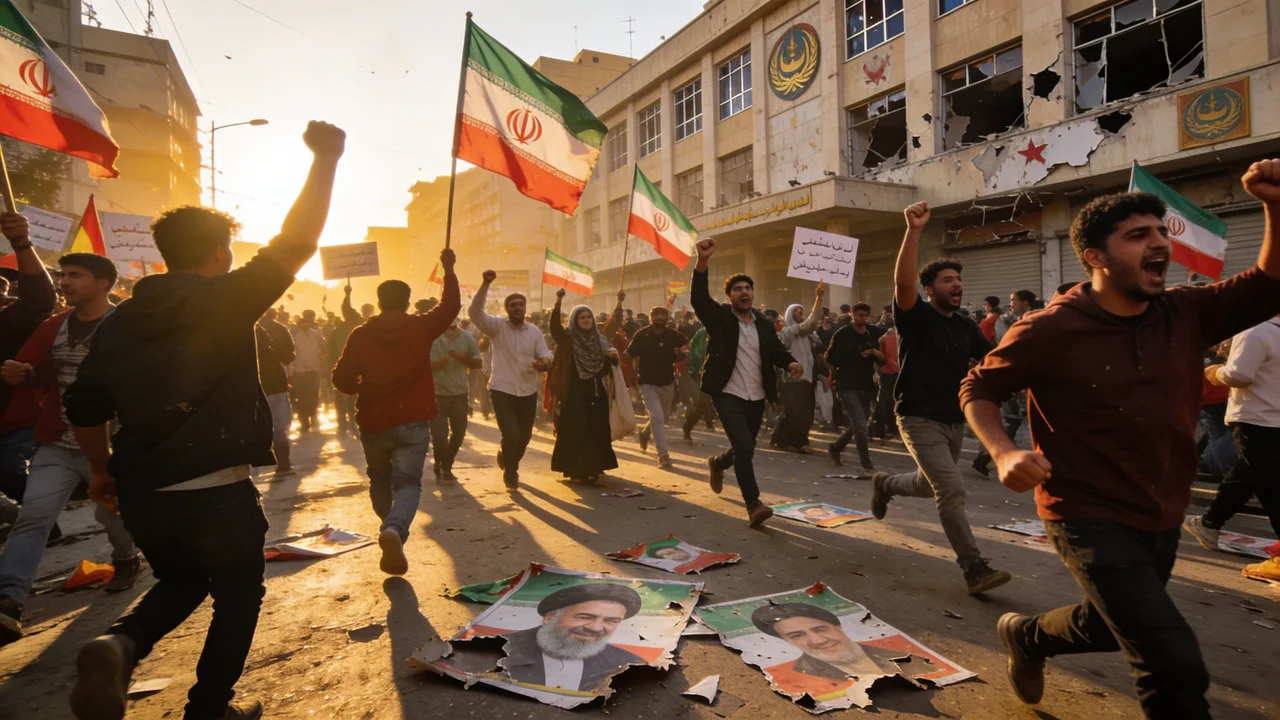
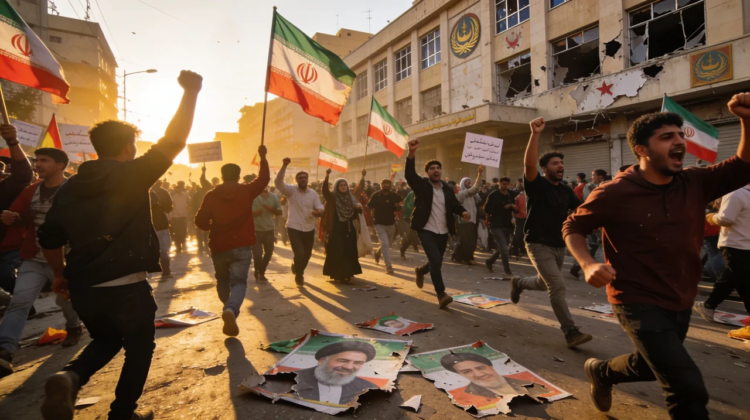
And what of the people in Iran? There are reports of cheering and dancing in the streets in Tehran, where bombs are still falling. People who witnessed the attack on the supreme leader’s compound reacted with disbelief, and then with laughter. We still don’t know if he survived, possibly by having been moved to another location before the attack on Iran began. Iran’s foreign minister, Abbas Aragchi, has announced that “the supreme leader is alive, as far as I know.” “As far as I know” — even the foreign minister isn’t certain about the fate of the supreme leader.
Meanwhile, the Israelis have announced that they have managed to kill in their first strikes about twenty of the senior IRGC commanders, including the head of the IRGC, Mohammed Pakpour, Iran’s defense minister, Amir Nasirzadeh, and the head of Iran’s intelligence. There are no reports as yet of IRGC troops laying down their arms, or even joining the anti-regime protesters. But it’s early in a war that will surely go on for a few weeks, and where, in just the first day, so many devastating blows have been delivered.
Hezbollah, which has for decades received money and weapons from Iran, announced several days ago that it would not be taking part in any U.S.-Iran war as long as American strikes were “limited.” Well, those strikes have not been limited, but Hezbollah hasn’t moved an inch, its leaders likely paralyzed with fear.
Countries around the world are declaring themselves for and against the operation. A welcome surprise: Canada’s far-left prime minister, Mark Carney, often so critical of the Trump administration, has come out foursquare in support. So has Australia’s left-wing prime minister, Anthony Albanese. UN’S Secretary-General António Guterres, however, condemned the attack, claiming it undermined international peace, issuing this statement: “The use of force by the United States and Israel against Iran, and the subsequent retaliation by Iran across the region, undermine international peace and security. I call for an immediate cessation of hostilities and de-escalation. Failing to do so risks a wider regional conflict with grave consequences for civilians and regional stability.”
In Europe, alas, the U.K., Germany and, most emphatically, France, have not been so supportive for the joint U.S.- Israel action. Instead, the three leaders — Merz of German, Starmer of the U.K., and Macron of France — issued a joint statement calling for an end to hostilities and for Iran to “seek a negotiated solution.” That statement further said that the three countries had long urged Iran to end its nuclear and ballistic missile programs, and to end the “appalling violence and repression against its own people…. We urge the Iranian leadership to seek a negotiated solution. Ultimately, the Iranian people must be allowed to determine their future.”
That’s how things stand, as of February 28, in the afternoon. Events are changing fast. One thing is clear: the Iranian regime, with so many of its senior leaders killed, and so much damage inflicted on ballistic missiles, missile launchers, and nuclear sites across Iran, is now hanging by a thread.