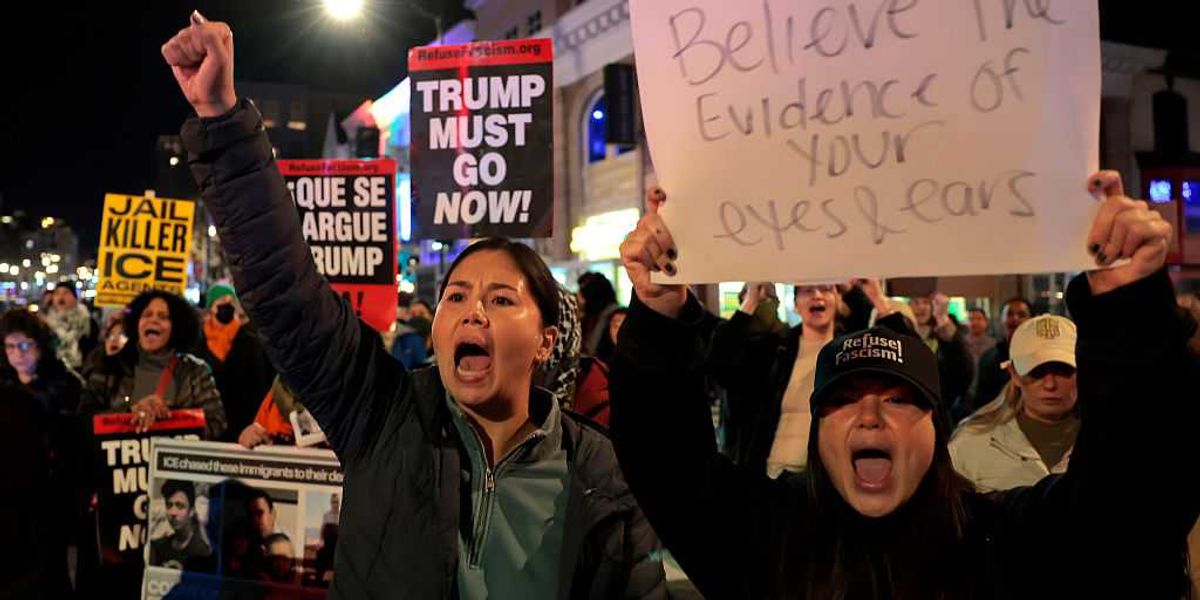
A few days ago, I found myself in a text exchange about two women killed by agents of the state.
One was Renée Nicole Good, a 37-year-old activist mother shot last week by an ICE agent in Minneapolis. The other was Ashli Babbitt, a 36-year-old U.S. Air Force veteran shot by a Capitol Police lieutenant inside the Speaker’s Lobby on January 6, 2021.
Are words being used to think — or to show whose side someone is on?
I asked what I thought was a simple moral question: Does the state ever have the moral right to kill an unarmed person who poses no immediate lethal threat?
I did not try to provoke. I did not claim the cases were the same. I said plainly that the facts, motives, and political contexts differed. My own answer was no. The purpose was not to merge the stories, but to test whether the same moral rule applied in both cases.
I was asking my friend to reason with me.
The response was not an argument. It came as a rush of narrative detail, moral verdicts, and firm insistence that the question itself was illegitimate. “Not comparable.” “Straw man.” The stories did not clarify the rule. They aimed to shut down the conversation.
But what struck me most was not the emotion. It was the disconnect.
I asked about a principle. I received a story. I tested a rule. I got a verdict. We used the same words — justice, murder, authority — but those words did very different work.
The exchange failed not because of tone or ideology. It failed because we spoke different civic languages. More troubling, we no longer agree on what civic language is for.
More than a failure of civility
For years, we have blamed polarization and tribalism. We shout past one another. We retreat into bubbles. All of that is true. But the deeper problem runs deeper than disagreement.
We no longer share a civic vocabulary shaped by common expectations about clarity, restraint, and universality.
We still speak words that are recognizably English. But we use the same words to reach very different ends.
One civic language treats words as tools for reasoning. Call it “principled” or “rule-based.” Questions test limits and consistency. Moral claims aim at rules that apply beyond one case. Disagreement is normal. When someone asks, “What rule applies here?” the question is not an attack. It is the point.
This language shapes law, constitutional argument, philosophy, and journalism at its best. Words like “justified” or “legitimate” refer to standards that others can test and challenge. If a claim fails under scrutiny, it loses force.
The other civic language works differently. Call it “narrative” or “moral-emergency” language. Here, words signal alignment more than reasoning. Stories carry moral weight on their own. Urgency overrides abstraction. Questions feel like invalidation. Consistency tests sound like hostility.
RELATED: The day the media taught me it’s always wrong to be right
 treety via iStock/Getty Images
In this mode, terms drift. “Murder” no longer means unlawful killing. It means moral outrage. “Straw man” stops meaning logical distortion and starts meaning emotional offense. “Not comparable” does not mean analytically distinct. It means do not apply your framework here.
Neither language is dishonest. That is the danger. Each serves a different purpose. The breakdown comes when speakers assume they are having the same kind of conversation.
The principled speaker hears evasion: “You didn’t answer my question.” The moral-emergency speaker hears bad faith: “You don’t care.”
Both walk away convinced the other is unreasonable.
Moral certainty over moral reasoning
Social media did not create this divide, but it rewards one language and punishes the other. Platforms favor speed over reflection, story over rule, accusation over inquiry. Moral certainty spreads faster than moral reasoning. Over time, abstraction starts to feel cruel and questions feel aggressive.
That is why so many political arguments stall at the same point. Facts do not resolve them because facts are not the dispute. The real question is whether rule-testing is even allowed. Once someone frames an issue as a moral emergency, universality itself looks suspect.
A simple test helps. Is this person using words to reason toward a general rule, or to signal moral alignment in a crisis?
Put more simply: Are words being used to think — or to show whose side someone is on?
RELATED: I don’t need your civil war
 Photo by Tom Williams/CQ-Roll Call Inc. via Getty Images
Once you see this, many conversations make sense. You understand why certain questions trigger anger. You see why consistency tests go unanswered. You recognize when dialogue cannot move forward, no matter how careful you sound.
This does not mean outrage is always wrong. It does not mean people should stop caring. It does mean we need better civic literacy about how language works. Sometimes restraint is a virtue. Walking away is not cowardice. Declining to argue is not surrender.
What cannot work is trying to make a principled argument within a moral-emergency frame.
America’s founders understood this. They designed institutions to slow decisions, force deliberation, and channel arguments into forms governed by rules rather than passion.
If we fail to see that we now speak different civic languages, we will lose the ability to talk calmly about the ideas and ideals that should bind us together. The alternative is full adoption of moral-emergency language — where persuasion gives way to force.
Too many Americans have already chosen that path.