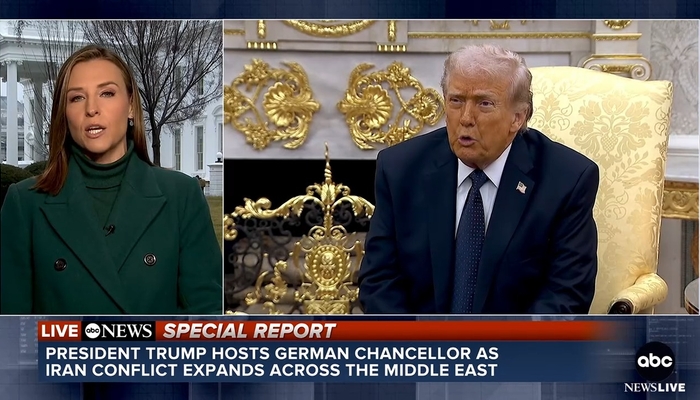
 Reacting Tuesday to President Trump’s Oval Office comments about the U.S. war against Iran, chief White House correspondent Mary Bruce beclowned herself during an ABC News Special Report with the insistence that Trump’s claim the U.S. alone decided to strike Iran was in contradiction to Secretary of State Marco Rubio stating Monday the U.S. was reacting to Israel’s decision to go first.
Bruce, as usual, was hurling partisan, fact-free drivel with this claim when, in reality, Rubio and Trump both said the U.S. alone made up its mind to go to war alongside Israel and protect American interests, based on intelligence from both countries.
First, here was what Bruce said:
FAKE NEWS: ABC’s @MaryKBruce falsely claims Secretary of State Marco Rubio told reporters yesterday that Israel dragged the U.S. into the war with Iran and that Trump’s comments Tuesday to reporters contradicted Rubio…
“Let’s unpack some of this, Kyra, because the President,… pic.twitter.com/MzVWIip9dV
— Curtis Houck (@CurtisHouck) March 3, 2026
Let’s unpack some of this, Kyra, because the President, first and foremost, is pushing back in that question by our Rachel Scott to this notion that Israel forced the U.S.’s hand here. And in doing so, he is directly contradicting what his own secretary of state, Marco Rubio, told reporters yesterday. Marco Rubio said that the U.S. faced an imminent threat because Israel was about to attack Iran, and then Iran was poised to retaliate against the U.S., so the U.S. decided to strike first. The President is saying that’s actually not the case. He says he might have forced Israel’s hand. He says that Iran was going to strike first, saying, “my opinion” — “it was my opinion that they were going to attack first,” which also raises question about whether it was his opinion or whether he actually had evidence of that[.]
Of course, she insisted “we continue to see this mixed messaging from the White House about why the U.S. decided to launch this campaign” along with “a pretty stunning comment” from Trump that left open the possibility that future Iranian leadership could, if the worst case scenario were to occur, worse than the now-incinerated mullahs.
Here’s the reality. Steve Deace Show producer Aaron McIntire snuffed out this disinformation campaign on X before it even truly began.
Rubio, in remarks to reporters on the Hill, said in a butchered clip that Trump chose to attack Iran knowing “that there was going to be an Israeli action” and their moves “would precipitate an attack against American forces” and likely “higher casualties” as the U.S. would be on the back foot.
“Rubio’s comments are being desperately (and probably maliciously) misconstrued. It was our intel that tipped Israel off to the Ayatollah’s location. Trump, de facto, gave them the order to attack. So of course we knew Israel was about to strike,” McIntire said.
He included a Trump Truth Social post from Saturday afternoon with this sentence highlighted: “[Ayatollah Khamenei] was unable to avoid our Intelligence and Highly Sophisticated Tracking Systems and, working closely with Israel, there was not a thing he, or the other leaders that hav been killed along with him, could do.”
And, over at National Review on Monday night, editor Philip Klein took aim in a piece titled “No, Marco Rubio Didn’t Claim That Israel Dragged Trump into War with Iran.”
After highlighting that snippet being shared, Klein placed it in proper context by citing this other portion of Rubio’s remarks:
That’s the question of why now, but this operation needed to happen because Iran, in about a year or a year and a half, would cross the line of immunity, meaning they would have so many short range missiles, so many drones, that no one could do anything about it, because they could hold the whole world hostage. Look at the damage they’re doing now. And this is a weakened Iran. Imagine a year from now. So that had to happen. Obviously, we were aware of Israeli intentions and understood what that would mean for us, and we had to be prepared to act as a result of it. But this had to happen, no matter what.
Thus, in Klein’s summation, Iran’s missile arsenal was growing at such a substantial pace that “if [it] grew large enough, [Rubio] said, [Iran] would be able to make it too costly to strike its nuclear program at a later date than it would be now” and, in turn, the U.S. believed an attack “had to happen no matter what.”
Klein also echoed McIntire: “Israel and the U.S. have been sharing intelligence closely…It was the CIA that obtained intelligence about when and where Ayatollah Ali Khamenei would be meeting with top officials…Why on earth would the U.S. share intelligence as to the time and location of Khamenei if the U.S. was not on board with attacking Iran?”
And, given the Trump administration’s reaction to Israel’s strike on Qatar ahead of the landmark peace deal, it’s safe to say Trump isn’t beholden to Israel (or anyone, for that matter).
Back to Bruce, she wasn’t alone in the negativity as correspondent Matt Rivers scoffed from Beirut, Lebanon that “[t]here’s a lot of confusion about what the President just said in the White House” domestically and abroad as those stranded in the region “are wondering what is going to happen next and how they can get out of here.”
“They all remain trapped for the most part at this point because airspace remains closed. And that’s not to mention the continued threats that U.S. bases, military bases, and U.S. embassies are experiencing here as they remain consistent targets of Iranian missiles…[T]his situation is incredibly volatile. It is incredibly chaotic, and no one has any idea where it’s going to go from here,” he added.
To see the relevant ABC transcript from March 3, click “expand.”
ABC News Special
March 3, 2026
12:05 p.m. Eastern
KYRA PHILLIPS: [A] lot of news was made here. Mary, a couple of things that stood out to me was his response as to why they attacked Iran and attacked Iran now while, at the same time, the president seems to have no idea who will lead Iran next. The President also saying these strikes will continue until they “finish off” Iran’s military.
MARY BRUCE: Yeah. And it is. Let’s unpack some of this, Kyra, because the President, first and foremost, is pushing back in that question by our Rachel Scott to this notion that Israel forced the U.S.’s hand here. And in doing so, he is directly contradicting what his own secretary of state, Marco Rubio, told reporters yesterday. Marco Rubio said that the U.S. faced an imminent threat because Israel was about to attack Iran, and then Iran was poised to retaliate against the U.S., so the U.S. decided to strike first. The President is saying that’s actually not the case. He says he might have forced Israel’s hand. He says that Iran was going to strike first, saying, “my opinion” — “it was my opinion that they were going to attack first,” which also raises question about whether it was his opinion or whether he actually had evidence of that, so we continue to see this mixed messaging from the White House about why the U.S. decided to launch this campaign. Now, as for what comes next, in a pretty stunning comment, the President said that — that many of the people who they had considered might be possible future leaders of Iran have now been killed in these attacks, and that he doesn’t necessarily have anyone in mind. He said he would like it to be a moderate, someone who’s popular with the Iranian people, and he did say that — he was asked what the worst case scenario could be, and he said the worst case scenario would be that we do this and then somebody takes over who is as bad as the previous person, and he said that could happen. So, still a lot of questions about why the U.S. decided to act now and where this goes from here, Kyra.
PHILLIPS: Indeed. And our Matt Rivers, you are in Beirut, Matt. We are seeing firsthand the security threats now embassies closing, travel out of the region becoming more difficult. What do we know this hour?
MATT RIVERS: Well, Kyra, there’s a lot of confusion about what the President just said in the White House. There’s also a lot of confusion from Americans here in this part of the world who are wondering what is going to happen next and how they can get out of here. There are a lot of Americans who live and work in this part of the world. There are people who are here on vacation. They all remain trapped for the most part at this point because airspace remains closed. And that’s not to mention the continued threats that U.S. bases, military bases, and U.S. embassies are experiencing here as they remain consistent targets of Iranian missiles. We know that roughly a half dozen U.S. embassies have now closed. We know a number of non-emergency personnel have been ordered out of the region by the U.S. State Department. The U.S. Embassy, right where I am here in Beirut, Lebanon, has been closed for the foreseeable future due to the ongoing nature of these threats. There are Iranian missiles flying all over the place right now as those targets continue to be struck in Tehran and of course, Israel continuing to attack targets for Hezbollah here in Lebanon, but this situation is incredibly volatile. It is incredibly chaotic, and no one has any idea where it’s going to go from here.
PHILLIPS: Yeah, clearly the war is expanding. Mary and Matt, thank you both. Also, we want to take a look at the big board right now. There’s been a lot of fears over this war impacting the markets, and you’re seeing it already, stocks plunging, oil prices surging, so it’s not just security that we’re talking about, but also the economic impact of this war.