Donald Trump’s 2026 foreign-policy maneuvers—from airstrikes in Iran to regime intervention in Venezuela and triumphalist rhetoric at Davos—signal a shift toward what Catholics can only describe as neo-imperial ambition. Far from embodying the restraint and responsibility expected of political authority, the emerging doctrine of force risks subordinating the common good to power, reviving patterns the Church has long warned threaten both peace and human dignity.
United States (US) Donald Trump’s recent foreign-policy actions against Iran, Greenland, and Venezuela, along with his saber-rattling rhetoric at the 2026 World Economic Forum (WEF) and the removal of Carrie Prejean Boller from the Religious Liberty Commission (RLC), reveal an alarming trend that Catholics can soberly portray as neo‑imperial in instinct and in contradiction with the Catholic Church’s social doctrine.
From a Catholic viewpoint, “imperialist” is a description of actions that breach the sovereignty of nations, subject peoples to another power’s economic or strategic interests, and neglect the requirements of justice and the common good. As Pope John XXIII’s Pacem in Terris stated:
“With respect to States themselves, Our predecessors have constantly taught, and We wish to lend the weight of Our own authority to their teaching, that nations are the subjects of reciprocal rights and duties. Their relationships, therefore, must likewise be harmonized in accordance with the dictates of truth, justice, willing cooperation, and freedom. The same law of nature that governs the life and conduct of individuals must also regulate the relations of political communities with one another. This will be readily understood when one reflects that it is quite impossible for political leaders to lay aside their natural dignity while acting in their country’s name and in its interests They are still bound by the natural law, which is the rule that governs all moral conduct, and they have no authority to depart from its slightest precepts. The idea that men, by the fact of their appointment to public office, are compelled to lay aside their own humanity, is quite inconceivable Their very attainment to this high-ranking office was due to their exceptional gifts and intellectual qualities, which earned for them their reputation as outstanding representatives of the body politic Moreover, a ruling authority is indispensable to civil society. That is a fact which follows from the moral order itself. Such authority, therefore, cannot be misdirected against the moral order. It would immediately cease to exit, being deprived of its whole raison d’être. God Himself warns us of this: ‘Hear, therefore, ye kings, and understand: learn, ye that are judges of the ends of the earth. Give ear, you that rule the people, and that please yourselves in multitudes of nations. For power is given you by the Lord, and strength by the Most High, who will examine your works, and search out your thoughts.’ And lastly one must bear in mind that, even when it regulates the relations between States, authority must be exercised for the promotion of the common good. That is the primary reason for its existence.”
In Davos earlier this year, Trump hailed the US as the “economic engine on the planet,” portraying American growth as the bellwether of global well-being. Although it is understandable that a leader would wish to bask in his nation’s prosperity, Trump’s tone was not one of stewardship but of American hegemonic dominance.
Trump’s use of words was not the language of a statesman hoping to obtain peace through justice; rather, such language was one belonging to someone boasting to the world that military and economic coercion were not out of the question…
Disturbingly, Trump’s language regarding the use of American power when discussing American leverage over other countries, threatening that the US could use “excessive strength and force” and be “frankly unstoppable,” before theatrically reassuring his audience that he “won’t use force.” Trump’s use of words was not the language of a statesman hoping to obtain peace through justice; rather, such language was one belonging to someone boasting to the world that military and economic coercion were not out of the question if the US was bent on achieving its agenda.
The past couple of months have shown how Trump is a man of his word, with his actions proving his pugilistic foreign policy agenda.
For example, in Venezuela, Trump oversaw a sudden US military operation that arrested Nicolás Maduro and his wife , before declaring that the US would “run” the country, with key American oil firms broadening operations there. These series of actions like regime change, extraterritorial law-enforcement claims, and resource extraction mirror typical imperialist behavior, which Catholic social teaching has consistently denounced.
Whatever one thinks of Maduro and his Communist leanings, Catholic teaching reinforces the axiom that the end never justifies the means. To bomb a country, eradicate its leadership, and then openly speak of “running” the nation and ensuring U.S. companies gain priority access to its resources transgresses a moral boundary, escalating domination on the pretext of humanitarianism.
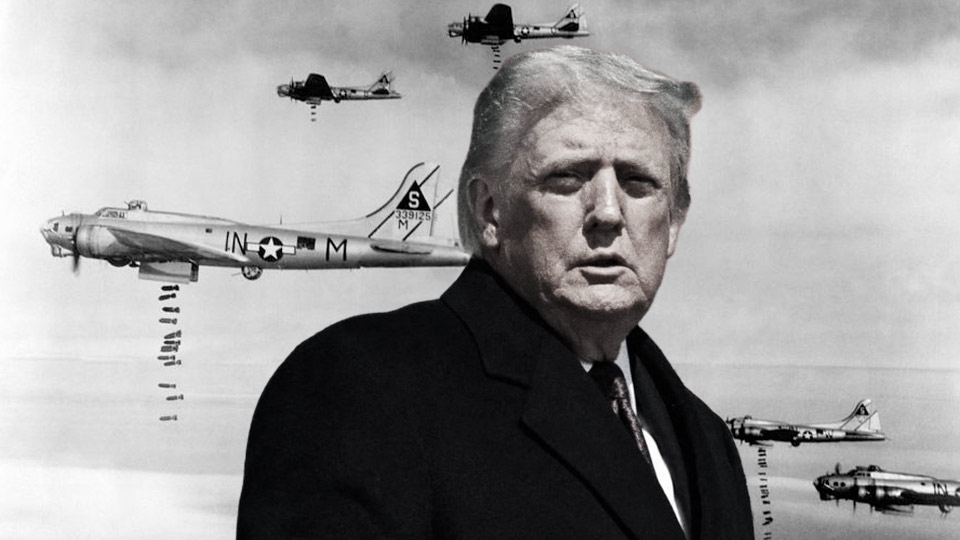
Alarmingly, Trump’s move to order airstrikes on Iranian military targets in 2026—an action that has purportedly caused the deaths of both combatants and innocent civilians—necessitates sober scrutiny in light of Catholic teaching on just war, human dignity, and the moral responsibilities of leaders.
To bomb a country, eradicate its leadership, and then openly speak of ‘running’ the nation… transgresses a moral boundary, escalating domination on the pretext of humanitarianism.
The Catholic Church, beginning with St. Augustine and later through St. Thomas Aquinas, has long acknowledged that although war may occasionally be justified, “all citizens and all governments are obliged to work for the avoidance of war. (The Catechism of the Catholic Church (CCC 2307–2317)) In light of Catholic teaching, armed conflict should only be a last resort according to stringent moral criteria.
In an article published by the Catholic Herald, Fr. Gavan Jennings examined how the recent US-Israeli strike on Iran compared against the four criteria (namely, “just cause, last resort, probability of success and proportionality”) for a war to be considered a “just” one in view of Catholic precepts. Fr Jennings wrote:
“One wonders, however, whether the threat of nuclear action by Iran was more remote than proximate, in which case the US–Israeli action looks more preventive (eliminating a possible future threat) than pre-emptive (responding to an imminent attack), the latter being morally defensible but the former risking a recipe for world anarchy, as Cardinal Pietro Parolin, the Vatican’s Secretary of State, recently pointed out. And is this military action a last resort? Did it take place only after ‘all other means of putting an end to it … were shown to be impractical or ineffective’, as the second condition stipulates? This is debatable, though Robert Royal thinks that military action has been justified by the failure of the world’s decades of “dialogue” with Iran’ to stop its ‘developing long-range missiles, enriching uranium and sponsoring terrorism – for half a century’. We can only assume that the US–Israeli alliance was convinced before acting that the ‘serious prospects of success’ – the third condition required in the Catechism – did indeed exist, even if what constitutes ‘success’ seems a bit unclear. There appear to be several contenders for measuring success: the destruction of Iran’s capacity to produce and deploy nuclear weapons; the destruction of the Iranian ballistic missile programme and of its navy; the reduction of Iran’s capacity to fund and supply its proxies; and lastly the freeing of the Iranian people from theocratic tyranny. But already it appears that this war least clearly fulfils the condition of proportionality, that ‘the use of arms must not produce evils and disorders graver than the evil to be eliminated’. An assessment of proportionality evaluates foreseeable consequences. Presumably it would not have been difficult to foresee at least some of the chaos that might emerge from this military action.”
As can be seen, no political calculus can dismiss the moral tragedy of innocent lives lost. Trump’s 2026 bombing of Iran fails to be justified by Catholic teaching and disregards the sanctity of human life.
No political calculus can dismiss the moral tragedy of innocent lives lost. Every person killed was created in the image and likeness of God.
Instead of leveraging all diplomatic avenues available such as via negotiation and agreements, the Trump administration has regrettably succumbed to the logic of force: missiles, decapitation strikes, and the strategic destruction of infrastructure.
Yet, among the war-mongering salvo missile fusillades, the reality that every person killed in the recent US-Israeli strikes on Iran, whether a soldier, a technician, or a civilian, was created in the image and likeness of God, seems to have been conveniently chucked aside.
In periods of chaos and crisis, Catholics must remember that war showcases the futility of placing trust in violence or in the saying, “might is right”. The Gospel of Matthew reminds us, “Blessed are the peacemakers, for they shall be called children of God.” Trump’s imperialistic rhetoric, his bombing of Iran (reportedly influenced by political Zionists) is a clear failure of justice and a lamentable offense against the Prince of Peace.
Maria, Regina Pacis, ora pro nobis.