Order Michael Finch’s new book, A Time to Stand: HERE. Prof. Jason Hill calls it “an aesthetic and political tour de force.”
On April 15, 2019, it was the Cathedral of Notre Dame in Paris that was burned almost entirely to the ground. The cause was not immediately known – or, at least, not immediately announced. A year later the public was told that the fire was likely caused either by a cigarette or an electrical short circuit – which sounds rather like saying that a patient died either of nephritis or defenestration. As of November 2024 – a month before the church’s official reopening after its fast, expensive, and meticulous restoration – investigators had supposedly not gotten any closer to determining a precise cause. Given the number of churches in Paris and elsewhere in France – indeed, elsewhere in Europe – that have been burned down by Muslims, it may well be that even if the French authorities did discover the cause of the blaze, they’d decide to keep it to themselves, for much the same reason that English authorities kept the grooming-gangs scandal under wraps for so long.
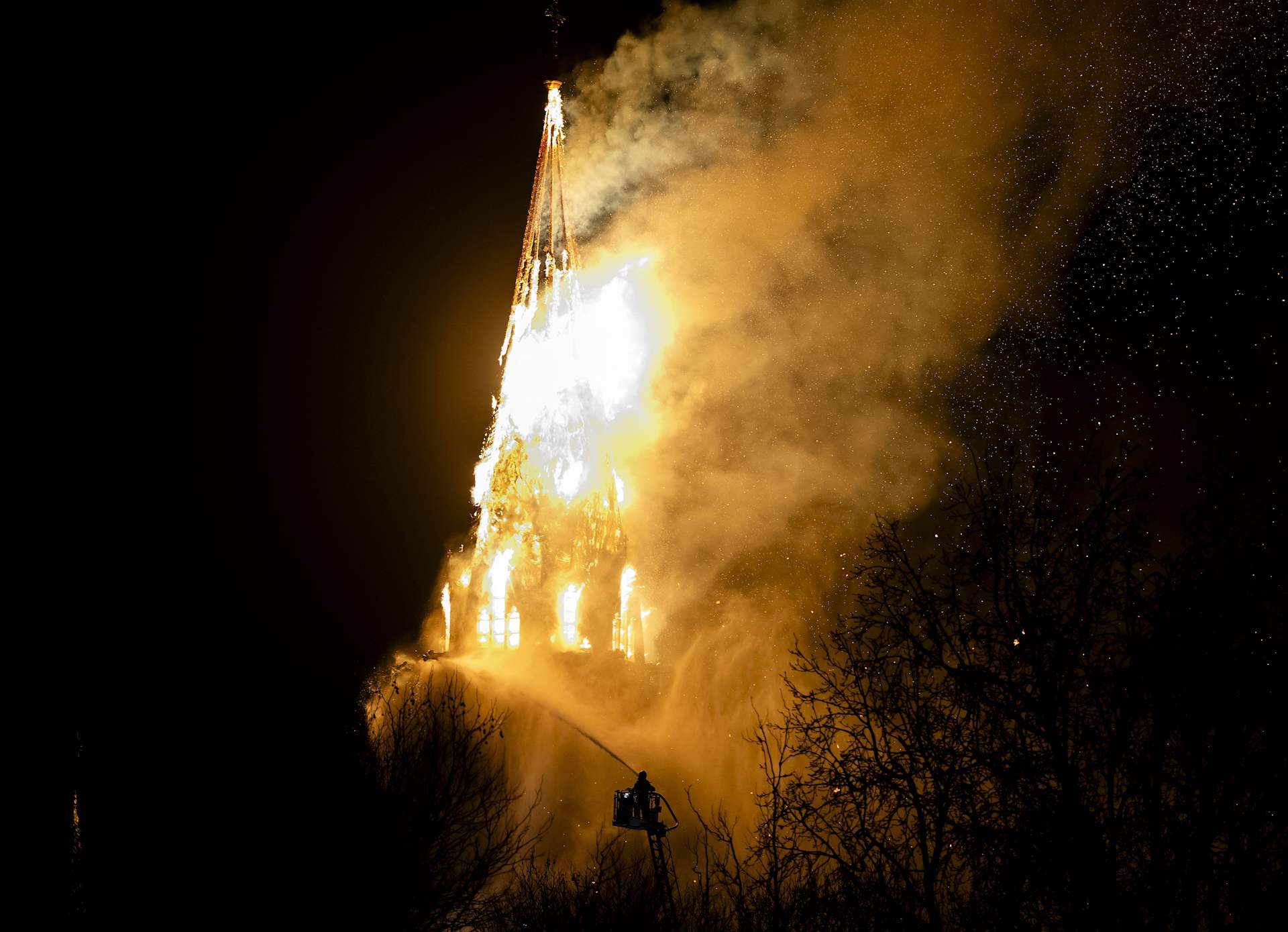
Now, on this past New Year’s Eve, another venerable Roman Catholic church – the Vondelkerk in Amsterdam – has been almost entirely destroyed by fire. In this case, the neo-Gothic house of worship – built in 1872 by Pierre Cuypers, the architect behind Amsterdam’s Central Station and Rijksmuseum – is beyond restoration. In De Volkskrant, Elsbeth Stoker sought to capture the melancholy mood: she quoted a local resident, Jörgen Sassen, who, when he received a photo of the church in flames on his phone shortly after midnight, thought at first that it was AI-generated. He soon knew better: at 8:30 on the “windy, drizzling” morning of New Year’s Day, he stood, “huddled in a light blue raincoat, near a police cordon,” looking at what was left of the church, his nose assaulted by the scent of smoke, his ears violated by the wail of sirens. “I saw the tower disappear before my eyes,” he told the reporter. “It was bizarre how quickly it happened.” Another local, a man of 75, grew moist-eyed at the sight of the smouldering ruins; a third declared: “It was such a beautiful church.”
Well, that’s one way to cover a story. Only toward the end of her article did Stoker touch on the possible cause of the fire, quoting Sassen’s theory that it was kindled by a firework.
In NRC, Peter van der Ploeg chose to proffer a graphic description of the damage (“charred beams…a gaping hole the size of a large van…the large tower in the center of the building landed on the rear of the roof and collapsed into the church”) and to provide some history (an earlier fire occurred in 1904; the restored church survived World War II; in 1978, by which time the neighborhood had declined, the church was closed “due to cracks in the walls, a lack of funds, and a lack of worshippers,” and was taken over by squatters; later, it became a cultural center, a venue for weddings, concerts, and the like). Van der Ploeg told us that Cuypers considered the church his best work and that its rest rooms (a decidedly Dutch detail) were voted the most beautiful in the country.
Like Stoker, Van der Ploeg left it to a bystander to theorize about the fire’s cause: an elderly woman from the neighborhood said that “when kids set off fireworks here, they always aim for that spire.”
Was Vondelkerk felled by fireworks? If so, was the destruction intentional? Or was there another cause? Will the explanation, if it’s ever discovered, be shared with the public?
Dutch commentator Eva Vlaadingerbroek wasn’t in doubt about the cause: “We’re being kept in the dark as to who did this, of course, but I think we all recognize an act of war when we see one.”
Wherever the truth may lie, one statement about the loss of Vondelkerk can’t be denied: it’s as much a loss for Europe’s Christian heritage as it is a New Year’s gift for the adherents of that other religion for whom such emblems of Western faith are anathema.
One thing we already do know about this New Year’s Eve in the Netherlands is that it involved what Suzanne Leigh of the BBC called “unprecedented” violence. Cops and firefighters in Amsterdam, The Hague, and other cities were targeted by fireworks and physical violence. “Petrol bombs,” wrote Leigh, “were thrown at police in the southern city of Breda. In Rotterdam, the city’s eye hospital said it had treated 14 patients, including 10 minors, for eye injuries.” A couple of videos of Dam Square, in the heart of Amsterdam, show crowds of unruly Muslim men, some of whom can be seen standing on the National Monument and waving a Syrian flag.
I’ve only been in the Netherlands for one New Year’s Eve. It was in 1998-99. I attended a party at a bar on the Singel, a three-minute walk from the Dam. I don’t remember much about it except that it was crowded, that there was a general air of joie d’vivre, and that there was a large bowl of oljebollen on the bar, which I’d never tasted before, and which turned out to be a lot less appetizing than I’d expected.But there no drama, either in the bar or outside on the street – and, when I left, way after midnight, to stroll around for a while before heading home, there were no crowds of boisterous Muslims, whether on the Singel, or the nearby Muntplein, or the Dam, or anywhere else.
Yes, even then there were enough Muslims in Amsterdam to set off my radar. It was during those months when I lived in Amsterdam in 1998-9 – months that feel like a lifetime ago – that I first realized Europe was in trouble. But the trouble was just beginning. In the years since then, the commemoration of New Year’s in that city, and throughout Western Europe, has been increasingly plagued by crime and unrest. The reason, which the news media almost almost delicately omit, is the ever-rising population of young male Muslims.
Speaking of which, this New Year’s Eve marked the tenth anniversary of a night to remember, boulevards and squares in city centers across Germany were the sites of over a thousand sexual assaults, with Muslim men – many of them part of the tsunami of immigrants welcomed by Angela Merkel in 2015 – gang-raping German women. Such offenses also occurred, in smaller numbers, in other Western European cities.
This year there are no reports of mass New Year’s rapes in Germany, but photos and videos of public spaces show rowdy, disorderly crowds that look distinctly non-German. In several of the largest German cities, hundreds of people were arrested for attacking police and first responders with firecrackers, rockets, and bottles, and for setting garbage bins on fire.
On X, the German commentator Naomi Seibt wrote: “Where are all the blonde German women? Hiding at home because they don’t want to become victims of MASS R@PE and get KlLLED.” Balázs Orbán, political director for Hungarian leader Viktor Orbán, tweeted: “What happened in Berlin on New Year’s Eve is something we are increasingly witnessing on the streets of major Western European cities: a migration-based public order breakdown.”
Elsewhere in Western Europe the picture was much the same. A headline in Le Soir read: “New Year’s Eve celebrations turn violent in Brussels: 70 people arrested, emergency services targeted with fireworks.” In Antwerp, cops “used tear gas and arrested more than 100 people,” many of them “minors as young as 10 or 11” who “targeted officers and emergency services with fireworks and stones, setting fire to bikes, cars and trash cans.”
In London, a 23-year-old man was stabbed to death; police have omitted to release a description of the perpetrator, who is still at large. And in France, there were 505 arrests, more than 100 of them in Paris; 1,173 cars were burned, up from 984 last New Year’s Eve. The good news, noted Le Parisien, was that in French cities there were somewhat fewer assaults on police than last year. Félicitations!
Yes, in every country there were the usual accidental injuries, and even deaths, caused by the reckless handling of fireworks. By far the worst such incident took place at a bar in Crans–Montana, a Swiss ski resort, where about forty people died and 119 were injured in a fire that was reportedly caused by a mere sparkler. Such accidents, alas, have always been with us and perhaps always will be.
But the big headline, as on every New Year’s Eve in Western Europe during the past generation or so, is that the holiday continues its steady transformation from a night for safe, festive get-togethers to an occasion for aggressive displays of rising Islamic power. So make no mistake: setting fire to cars and trash cans, and throwing firecrackers and bottles at police officers, is not behavior that was common in Europe before the Muslim influx began.
So it is that as 2026 gets underway in Amsterdam, yet another superb building – a Dutch architectural treasure, a reminder of the West’s religious legacy, and hence an egregious affront to the worshipers of Allah who seek to become our masters – is gone forever. Let’s all mourn Vondelkerk – for its intrinsic beauty, for its deservedly earned place in the annals of a great city, for what it meant to the people who called it their church home over the generations, and for what its loss symbolizes for all of us.