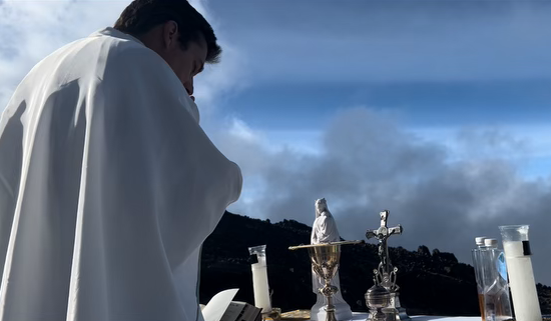
Mount Kilimajaro. Eight day trek. The Traditional Latin Mass at dawn and dusk, all the way up to the summit. This is a pilgrimage and an expedition; a marathon whose cause is the reign of Mary and the expansion of a humble yet thriving and bustling traditional Catholic mission in Tanzania. Are you in?
There are, in every age of the Church, certain undertakings which resist immediate explanation, not because they are obscure in their purpose, but because they refuse to conform to the categories by which modern men and woman have grown accustomed to judging what is reasonable, efficient, or even necessary.
To organize a pilgrimage to Africa is not unusual; to raise funds for a seminary is not unusual; even to climb a mountain, in itself, is no longer remarkable. But to combine these things—to ascend the highest free-standing mountain in the world, accompanied by a priest, offering daily the Traditional Latin Mass at altitude, and to do so as an act of reparation ordered toward the formation of future priests—is to enter into a mode of action that the contemporary Catholic imagination has, for the most part, forgotten how to recognize.
And yet, from August 1–17, such an undertaking will once again take place, as the Ave Maria Expedition sets out along the Lemosho Route of Mount Kilimanjaro, an eight-day ascent that begins in dense rainforest and rises, gradually but inexorably, through plateau and volcanic desert into the thin and unforgiving air of the summit at 19,341 feet.
A Structure That Reveals Its Purpose
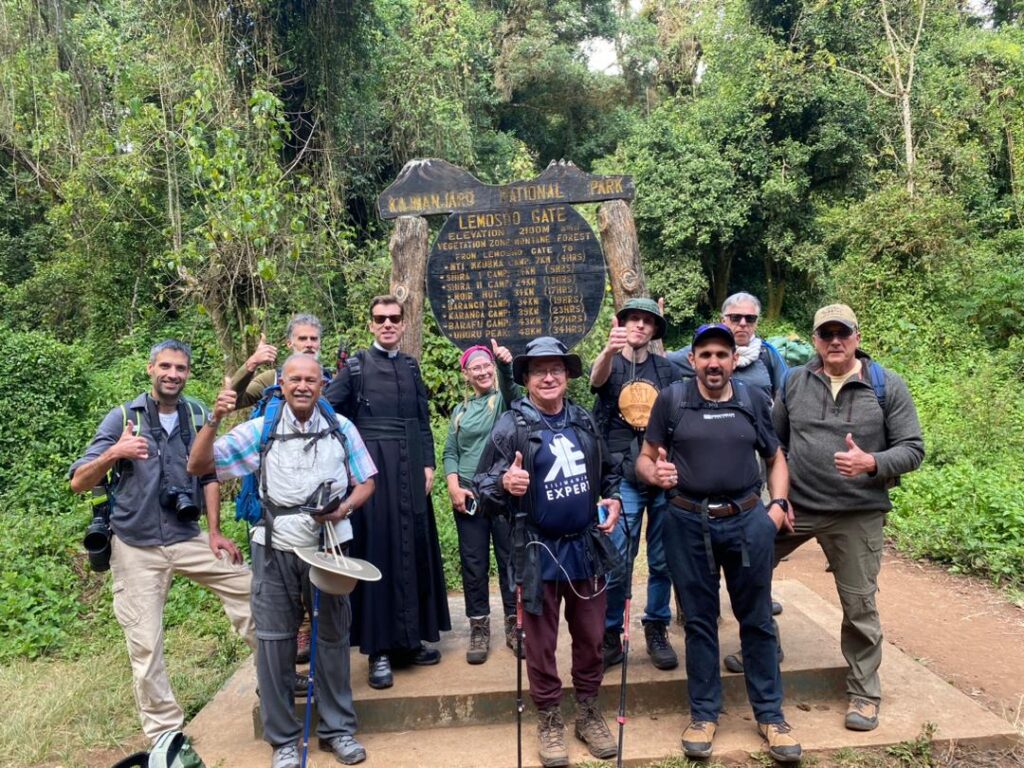
At first glance, the expedition appears carefully organized according to the standards of any well-run climb: there are professional guides and porters, daily medical checks, controlled acclimatization, and a deliberate pacing designed to maximize the likelihood of reaching the summit.
But it is precisely within this ordinary framework that something decidedly non-modern intrudes, altering not merely the atmosphere of the journey but its very meaning.
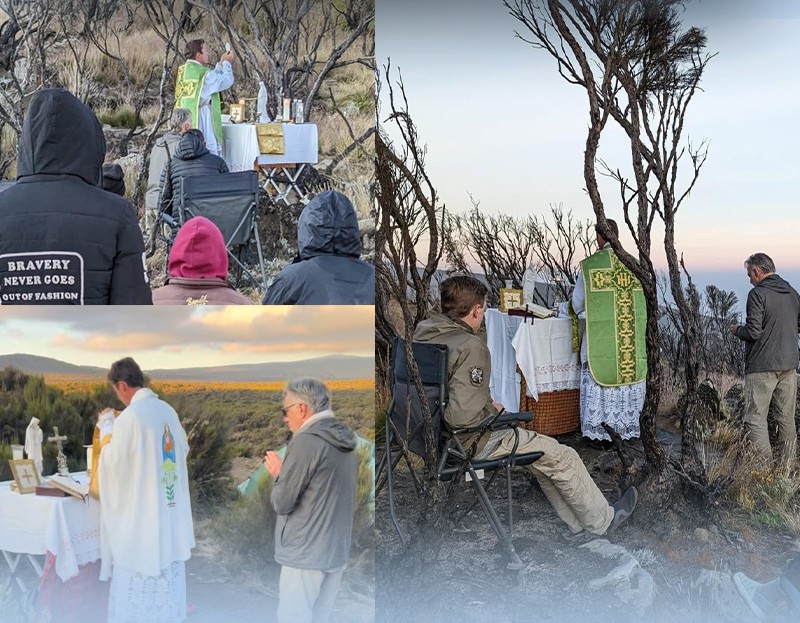
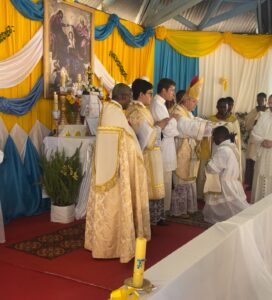
For each day of the ascent is not structured around distance or elevation gain, but around the liturgical life of the Church; the Rosary is prayed, spiritual conferences are given, and most notably, the Holy Sacrifice of the Mass is offered daily according to the 1962 Missal, even in conditions that would, by any practical standard, seem to discourage such insistence.
This single fact—so easily stated and yet so difficult to absorb—transforms the entire enterprise, for it removes the climb from the realm of adventure and places it squarely within the older and more demanding category of pilgrimage.
The Recovery of a Lost Instinct
What is striking about this expedition is not that it is extreme, but that it is recognizably traditional in a way that feels, to the modern mind, almost foreign.
The medieval pilgrim did not ask whether a journey was efficient; he asked whether it was worthy. He did not attempt to minimize hardship; he sought to offer it. Distance, fatigue, uncertainty—these were not inconveniences to be engineered away, but elements of a sacrifice that, precisely because it cost something, could be united to the greater sacrifice of the Mass.
It is this logic—once ordinary, now nearly extinguished—that reappears, almost unexpectedly, in the decision to carry the liturgical life of the Church up the slopes of Kilimanjaro, not because it is easy, nor even because it is practical, but because it is fitting.
The Offense of Excess
The modern objection presents itself almost immediately, and not without a certain superficial plausibility: if the goal is to build a seminary, why not simply raise the funds directly; if the need is real, why not address it through ordinary means; if efficiency is possible, why embrace difficulty?
But such objections rest upon an assumption that the Catholic tradition has never accepted, namely, that the value of an action is determined solely by its measurable outcome.
The expedition is indeed ordered toward a concrete and urgent need—the construction of the St. Benedict House of Studies in Tanzania, where vocations are abundant but the physical infrastructure required for their formation remains insufficient, lacking adequate dormitories, classrooms, and chapel space.
Each climber commits himself to raising $5,000 toward this end, thus linking the physical ascent of the mountain with a corresponding act of material sacrifice.
Yet to interpret the climb merely as a fundraising strategy would be to misunderstand it entirely, for the climb is not the means by which the mission is made visible—it is itself part of the offering.
The Reality of the Mountain
It is tempting, especially for those observing from a distance, to romanticize the climb, to imagine it as an elevated retreat set against a dramatic landscape.
The reality is less accommodating.
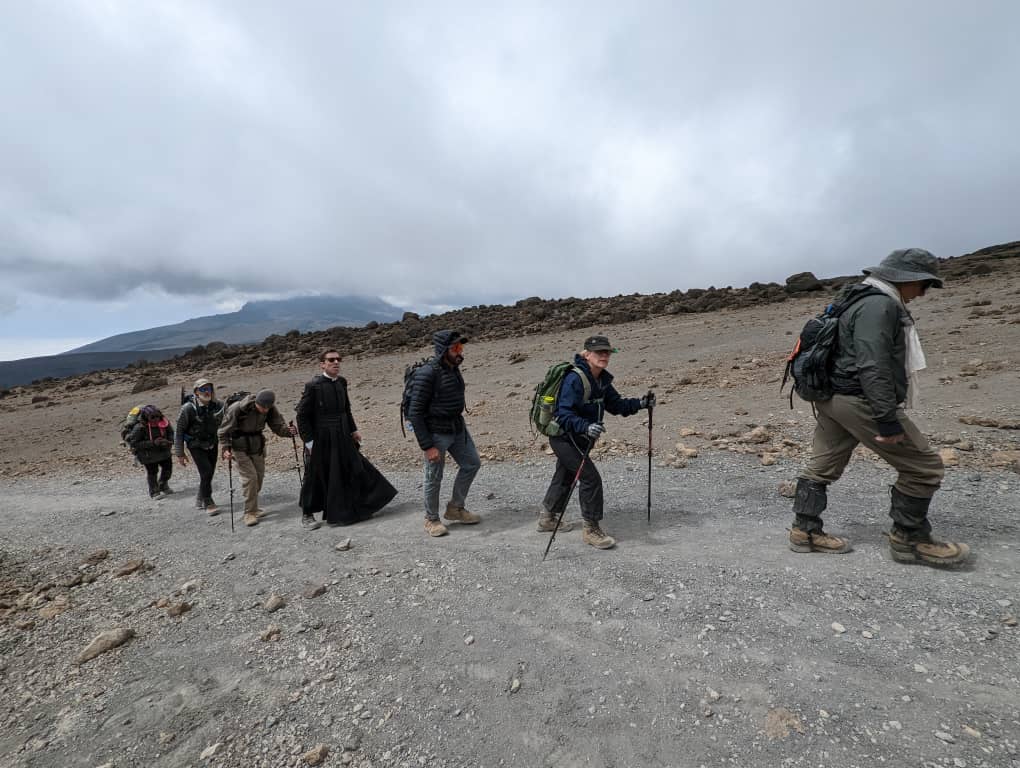
The Lemosho Route, though often described as one of the most beautiful paths on Kilimanjaro, is nonetheless a sustained physical demand, covering approximately seventy kilometers over the course of eight days, with significant elevation gain and increasingly hostile environmental conditions.
The ascent passes through distinct ecological zones—rainforest, moorland, alpine desert—before reaching the upper slopes, where oxygen levels are dramatically reduced and even simple movement requires effort and concentration.
Summit night, which begins shortly after midnight, represents the most severe portion of the climb, as pilgrims ascend in darkness and cold, often for six hours or more, before reaching the crater rim at sunrise and continuing to the summit itself.
And yet, within this context, the Mass is still offered, not because the conditions are favorable, but because they are not.
A Sign Rather Than a Strategy
It would be a mistake to view this expedition primarily as an initiative requiring broad participation, or even as a model to be widely replicated.
It is better understood as a sign—one that points, not to itself, but to a deeper reality that has not entirely disappeared from the life of the Church, even if it is no longer widely practiced.
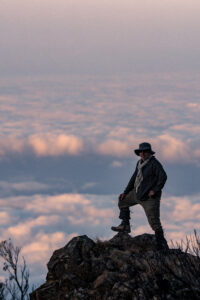
For what is being demonstrated here is not merely that men and woman can climb a mountain, nor even that they can do so for a good cause, but that the instinct for costly devotion—the willingness to undertake something objectively difficult, unnecessary, and even excessive, simply because it is worthy of God—still exists.
The Question It Leaves Behind
The expedition does not demand a response in the ordinary sense, nor does it require explanation or defense in the manner of more conventional undertakings.
But it does, by its very existence, introduce a question that is difficult to ignore.
If such a thing is possible—if men and woman can organize their lives, even temporarily, around sacrifice, liturgy, and mission in so concentrated a form—then what, precisely, prevents the rest of us from doing something proportionate within our own circumstances?
The question is not whether one is called to climb Kilimanjaro.
It is whether one is willing to accept the principle that such a climb represents.
Adveniat Regnum Mariae
At the summit, where the air is thin and time is limited, the climbers will not remain long; the body demands descent, and the mountain permits no lingering.
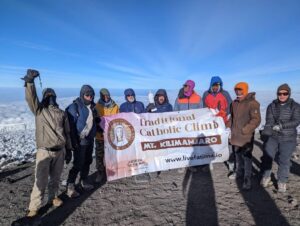
But for a brief moment—hardly more than a pause—they will stand at the highest point in Africa and offer what they have carried with them: their fatigue, their effort, their intention, and the prayers entrusted to them.
And in that moment, the words that have guided the entire undertaking will be spoken once more, not as a slogan, but as a petition that has, quite literally, been carried to the heights:
Adveniat Regnum Mariae.
The question that remains long after the descent is not whether the mountain has been climbed.
It is whether we have remembered what such an act is meant to signify.
How to Join the Expedition
For those who find themselves not merely interested, but quietly compelled by what has been described above, the practical details are, in fact, straightforward.
The Ave Maria Expedition is scheduled for August 1–17, following the liturgical calendar of the Traditional Latin Mass, and is open to Catholic men and woman willing to undertake both the physical demands of the climb and the spiritual discipline that accompanies it.
Participation requires two commitments, both of which are integral to the nature of the pilgrimage itself. The first is logistical: the cost of the expedition is $3,950 per pilgrim, which includes the guided ascent via the Lemosho Route, accommodations, meals on the mountain, park permits, and the post-climb mission visit and safari.
The second is apostolic: each climber undertakes to raise $5,000 in support of the St. Benedict House of Studies in Tanzania, thereby ensuring that the effort of the ascent is united to a concrete work for the future of the priesthood.
Registration is completed directly through the expedition page:
Register for the Ave Maria Expedition
There, one may also download the full brochure, review the detailed itinerary, and begin the process of discernment in earnest.
It should be said plainly that this is not an excursion to be entered into lightly. The climb demands preparation—physical, logistical, and spiritual—and the days on the mountain are structured not for comfort, but for purpose.
And yet, for those who recognize in this work something more than an undertaking—something closer to a call—the path upward has already, in a sense, begun.