The Council of Centers on Jewish-Christian Relations pays the following tribute to the way in which Cardinal Augustin Bea helped overcome various challenges to advance Vatican II’s Declaration on the Relation of the Church to Non-Christian Religions, Nostra Aetate:
“The process of bringing Nostra Aetate to birth was a difficult challenge for Cardinal Augustin Bea, president of the Secretariat for Christian Unity, to whom Pope John XXIII had given this task. . . . There was opposition to the endeavor from both inside and outside the Council. Some bishops recoiled at the thought of changing long-standing teachings, while others feared for the safety of Christian minorities in predominantly Muslim countries. . . . Despite these travails, after working through a series of drafts the declaration was officially promulgated following a final, overwhelmingly favorable vote of Yes: 2221; No: 88 on October 28, 1965. For the first time in its almost two thousand year history, a formal council of the Catholic Church had issued an authoritative declaration on Catholic-Jewish relations.”
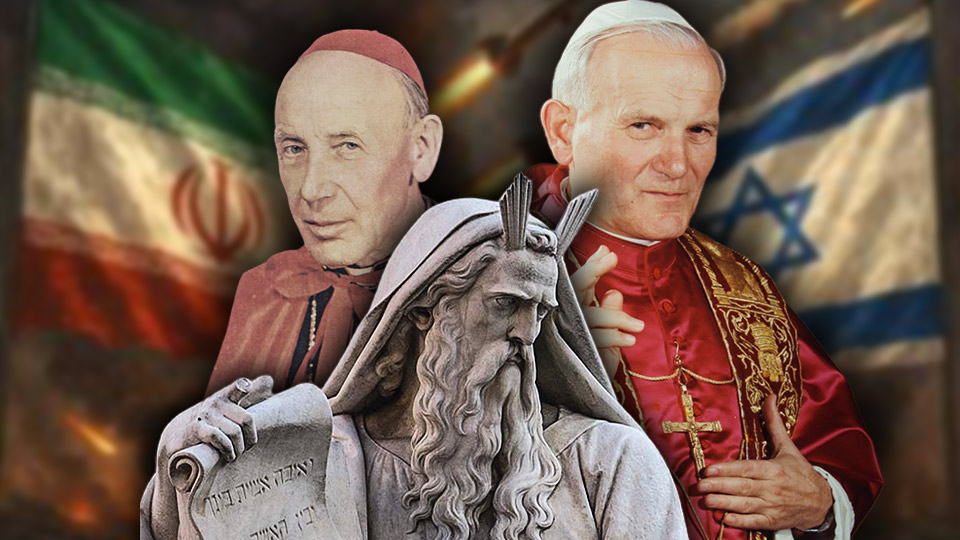
As much as Traditional Catholics have reason to oppose the work of Cardinal Bea (including Nostra Aetate), it is beyond question that he was uniquely qualified to interpret Nostra Aetate by virtue of the fact that he was the document’s architect and led all of the negotiations related to it. Moreover, as we can see from the tribute above, he is still acclaimed by Jews as one of the great Christian champions of the Jewish cause for his work at the Council. For this reason, it is significant that John Paul II’s positions (below) related to the Old Covenant were firmly opposed to those espoused by Cardinal Bea in his book about Nostra Aetate. As Christian Zionists insist that the Bible requires us to support the war against Iran, this opposition between John Paul II and Cardinal Bea has become far more impactful.
By saying the Old Covenant was ‘never revoked,’ John Paul II implied that conversion to Catholicism is unnecessary.
We can begin with the words of John Paul II about the Old Covenant, which many Catholics naturally believe to be representative of the Catholic position:
November 17, 1980: “The first dimension of this dialogue, that is, the encounter between the people of God of the Old Covenant, never denounced by God (cf. Rom 11:29), and that of the New Covenant, is at the same time a dialogue within our Church, so to speak between the first and second parts of her Bible.”
September 11, 1987: “It is fitting at the beginning of our meeting to emphasize our faith in the One God, who chose Abraham, Isaac and Jacob, and made with them a Covenant of eternal love, which was never revoked (Cfr. Gen. 27, 12; Rom. 11, 29).”
April 28, 1999: “A few great feasts like Easter and Pentecost recall the Jewish liturgical year and are excellent occasions for remembering in prayer the people God chose and loves (cf. Rom 11:2). Today dialogue means that Christians should be more aware of these elements which bring us closer together. Just as we take note of the ‘covenant never revoked by God’ (cf. Insegnamenti, 1980, [III/2], pp. 1272-1276), so we should consider the intrinsic value of the Old Testament (cf. Dei Verbum, n. 3), even if this only acquires its full meaning in the light of the New Testament and contains promises that are fulfilled in Jesus.”
Clearly the question of whether the Old Covenant has been revoked is of immense importance in Catholic theology, and John Paul II unambiguously asserted that God did not revoke the Old Covenant. By saying that the Old Covenant has not been revoked, John Paul II represented that it is the Catholic position that Jews can be saved by practicing either the Jewish religion or the Catholic religion — God is pleased with both. Naturally, then, there is no real need to try to convert Jews to Catholicism if John Paul II was correct.
Cardinal Bea made it clear: the Old Covenant fulfilled its role—salvation now comes through the New.
Against this backdrop, we can evaluate the words of Cardinal Augustin Bea from his The Church and the Jewish People: A Commentary on the Second Vatican Council’s Declaration on the Relation of the Church to Non-Christian Religions. One of the first important ideas in his book is that charity demands that Catholics speak truthfully about non-Catholic religions, including Judaism:
“Respect for the truth demands that certain things should be said in the course of this commentary which do no great credit to the Jews, and though it is our duty to express them fairly, moderately and charitably, they must still be said.” (p. 17)
Although Traditional Catholics have good reason to criticize Bea’s liberties with the truth, especially in regard to false ecumenism, he is of course correct here. Charity and respect for the truth demand that Catholics properly represent the Catholic religion, even if it means that it disappoints non-Catholics.
Turning to the relevant substance of his book on Nostra Aetate, Bea addressed the question of the Old Covenant with as much deference as possible to the Jewish people, to the point of dismissing any suggestion that God had “rejected” them. However, it is clear from what he said (below) that this does not mean that the Old Covenant remains in effect — rather, he was asserting that the Jews may now be saved in the same way that St. Paul and many others have been, by following the Catholic religion. Three passages set forth his views:
- “In consequence of the refusal of many Jews to accept the Gospel . . . God entrusted His harvest to the gentiles by offering the Gospel to them. As is recounted at length in the Acts of the Apostles, many of the gentiles did, in fact, receive it and welcome it. Applying the metaphor of the olive tree to this situation, St. Paul writes: ‘. . . some of the shoots of the good olive tree were broken off,’ that is to say that many of the members of the chosen people, who were originally intended to be the first citizens of the kingdom of God, remained excluded from the new people of God because of their refusal to believe.” (pp. 61-62)
- “We have already seen above some of the evidence which clearly shows that even after the condemnation of Jesus, God did not in any way reject the people He had chosen. On the contrary, He continued to offer them the Gospel of salvation. The apostles spend the first decades of their ministry preaching to the Jews of Palestine and when they began to go beyond its borders, they addressed themselves in the first place to the Jews of the diaspora.” (p. 91)
- “Evidently it is true that the Jewish people is no longer the people of God in the sense of an institution for the salvation of mankind. The reason for this, however, is not that it has been rejected, but simply that its function in preparing the kingdom of God finished with the advent of Christ and the founding of the Church. From then on, the nature of the people of God and the way of becoming incorporated into it changed completely: the ‘people of God’ of the New Testament is no longer confined to a single nation and is no longer propagated by descent according to the flesh but by faith.” (p. 96)
Cardinal Bea’s message was clear: the Old Covenant is no longer in effect, but Jews can be saved if they follow the religion of the New Covenant. If it had been possible for Nostra Aetate to have been more favorable to the Jewish religion, it would have been. But we can conclude from Cardinal Bea’s words that there was no way the Catholic religion could accommodate the position that the Old Covenant remains in effect. As such, John Paul II’s position was clearly opposed to Catholicism and Vatican II’s Nostra Aetate.
We had the Vicar of Christ telling the world that rejecting Christ could still be pleasing to God.
Unfortunately, the consequences of this go well beyond questions related to John Paul II’s orthodoxy. Although we cannot quantify the damage with any precision, there are at least four significant harms that flow from John Paul II’s misrepresentation of the Catholic position:
First and most importantly, it is a stunning insult to God for the ostensible leaders of the Catholic Church to assert that it is not necessary to become Catholic. False ecumenism perpetuates this offense in a general way, but John Paul II’s position is immensely worse because adherence to the Old Covenant today involves a specific rejection of Jesus Christ. Thus, we had the Vicar of Christ telling the world that the Jews were serving God in a pleasing way by rejecting Christ. This (along with many other “reforms” of the Vatican II era) surely invites the wrath of God, which we experience when He allows us to experience the evils brought about by the false shepherds.
Second, it is evident that this position generally counteracts efforts to bring Jews to the Catholic Faith. This thoroughly uncharitable abandonment of efforts to convert Jews not only leads to the loss of souls but also to a diminution in the overall influence of the Catholic religion — fewer Jewish converts means fewer Catholics, which ordinarily leads to the impairment of Catholic influence in the world. This is particularly meaningful today when the light of actual Catholic teaching is so necessary and yet in such scant supply.
Christian Zionism is not just political—it is rooted in a theology the Church has never taught.
Third, this misguided effort to change Catholic teaching has given ammunition to Catholicism’s enemies. While there is nothing anti-Semitic about the true Catholic position, the real thrust of John Paul II’s words above is to “rectify” the “unkind” Catholic teaching such that Cardinal Bea’s words above would now be considered anti-Semitic, even by some Catholic bishops.
Finally, supposed changes in Catholic teaching such as those perpetuated by John Paul II call into question the Church’s moral and doctrinal authority. If the Church can completely change its teaching in this way, reasonable men may ask, how can we trust it on anything else? This catastrophic reality dissuades souls from joining the Church, and leads those already in it to leave.
The Iran war has, in dramatic fashion, manifested and amplified these harms of misrepresenting Catholic beliefs. As Christian Zionists exert their influence by pushing the United States to cripple itself and spread chaos throughout the world to serve Israel, we desperately need God’s grace and His truth. And yet, more and more, stating the true Catholic positions is met with unjust and nonsensical accusations of anti-Semitism. Without God’s intervention, we face not only the prospect of worldwide calamity but also a dramatic increase of physical persecution simply for adhering to what the Church has always taught.
Even without the Iran war, it would be important for Catholic leaders to correct the errors spread by John Paul II regarding the Old Covenant. Now, though, it seems that there is a pressing need for Catholics to find the courage to speak honestly about the fact that Christian Zionists have dragged us into a religious war based on heretical beliefs that are directly opposed to the unambiguous teaching of Christ. To do so, more serious Catholics need to awaken to the unpleasant reality that John Paul II had certain talents but was as wrong as could be about the Old Covenant. If, however, Catholics remain silent in the face of the Christian Zionist promotion of the Old Covenant, then we are scarcely living up to our duties under the New Covenant. Immaculate Heart of Mary, pray for us!