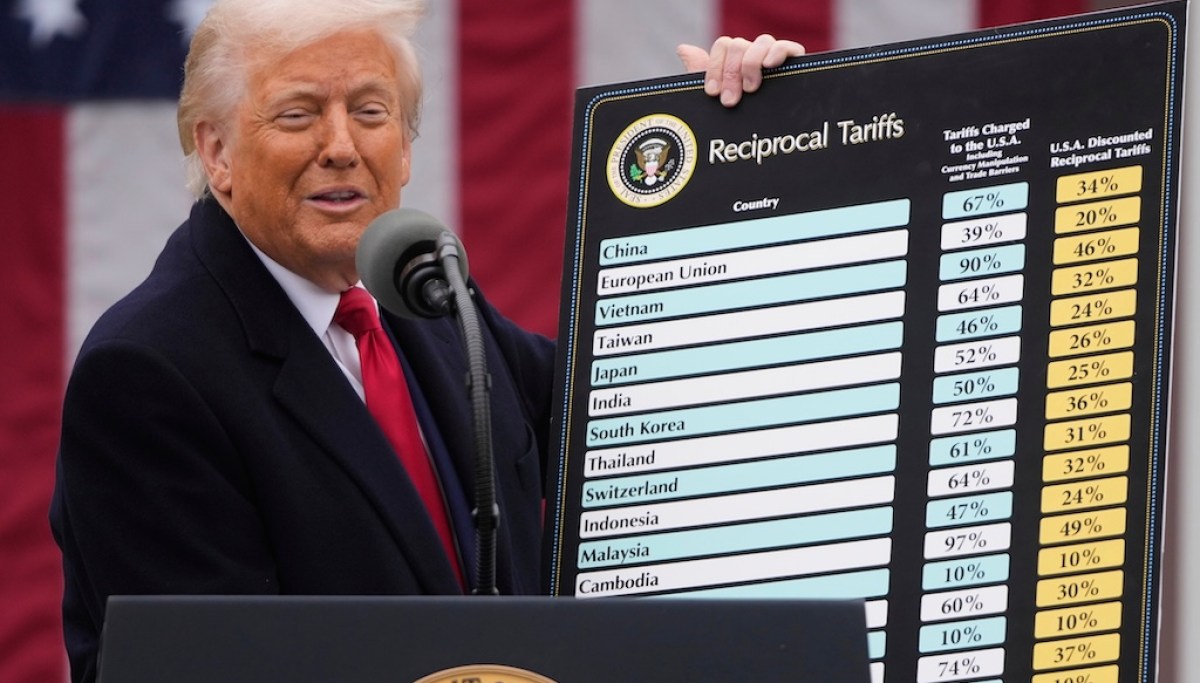
President Donald Trump promised that “April 2, 2025, will forever be remembered as the day American industry was reborn.” The Liberation Day tariffs, he said then, were going to “make America wealthy again,” ushering in the “golden age of America.”
Unfortunately for blue-collar workers, almost every single prediction that the president made went unfulfilled: from the so-called “reciprocity” of the tariffs to the wealth and jobs they would usher in, especially for the agricultural and manufacturing sectors. Instead of a Golden Age, we got labor force dropouts and slower growth.
While Trump used targeted tariffs in his first administration in pursuit of narrow goals like securing the border and countering China’s dominance in certain critical sectors, his second administration’s tariff agenda has been anything but serious or coherent: 10% tariffs on a remote Australian territory populated only by seals and penguins; “reciprocal” 15% tariffs on Israel, a close ally with almost zero tariffs on the U.S.; and all of it justified by a contrived formula that masked its unseriousness with pointless Greek symbols.
Instead of taking the China problem seriously, the United States waived tariffs on China’s high-tech sector while keeping tariffs in place on low-tech, low-skill goods such as clothing. The administration compounded its error on this point by bartering away advanced semiconductors to China and refusing to force the sale of the Chinese Communist Party’s favorite social media app, TikTok. Further imposing tariffs on traditional Asia-Pacific allies like Japan, South Korea, and India has only driven them into the hands of China.
It was not long before the tariffs rattled bond markets, sending them into a frenzy that made Trump waver. To contain the damage, he issued a 90-day pause capping most tariffs at 10%, followed by a partial truce with China that softened its rates without bringing them down to the new global baseline. That truce remains in effect today.
The Supreme Court even offered the president its own off-ramp this year when it struck down his IEEPA tariffs as unconstitutional. Rather than taking it, Trump returned to the precarious penumbras of federal law in search of another path to enforce his unilateral protectionist trade agenda.
But the problems with Liberation Day tariffs go even further.
Last year, Trump promised that the tariffs were “going to be fantastic for the workers.” Instead of a renaissance, the U.S. relapsed: the share of adults working or looking for work has shrunk by half a percentage point since March 2025, representing 1.4 million Americans who dropped out of the labor force. The July 2025 jobs report and revisions were so embarrassing that the Bureau of Labor Statistics Commissioner lost her job.
Outside of the COVID-19 pandemic and the Great Recession, the American economy experienced its most anemic year of job growth in more than two decades. Rather than deliver the country from President Joe Biden’s brutal inflation and stagnant economy, Trump’s tariffs exacerbated them by saddling households with a tariff tax bill of over $1,000.
Fortunately, the extension of historic tax relief and deregulation has offset some of these costs. However, this administration has asked Americans to accept “short-term pain” for the promise of long-term gain.
And yet, to date, there is no discernible evidence of any such gains. Manufacturing jobs declined in every month but one after Liberation Day, as the industry shed 93,000 jobs since March 2025. Farmers, whom the president described as “brutalized by nations all over the world,” found no consolation in the president’s trade policy, suffering 96,000 job losses during that same period, as rumors continue to swirl of a taxpayer-funded bailout for the ag sector.
One sector did benefit from the president’s protectionism: K Street. Lobbyists were one of the few industries to come out unambiguously ahead after Liberation Day, almost as if the president had promised to “make it rain” in the swamp instead of draining it. Tariff lobbying revenue increased 496% in Q4 of 2025 compared to 2024, after the president’s more than 120 tariff actions and selective exemptions drove a lobbying contract-inking frenzy.
A year after Liberation Day, it is clear that the golden age probably isn’t coming any time soon. The promises were bold; the outcomes have been banal. Unless the president has a change of heart, the consequences of that disappointment will likely become politically salient in November.
Marc Short was the director of legislative affairs for President Donald Trump. He is the chairman of Advancing American Freedom.
John Shelton is the vice president of policy of Advancing American Freedom.