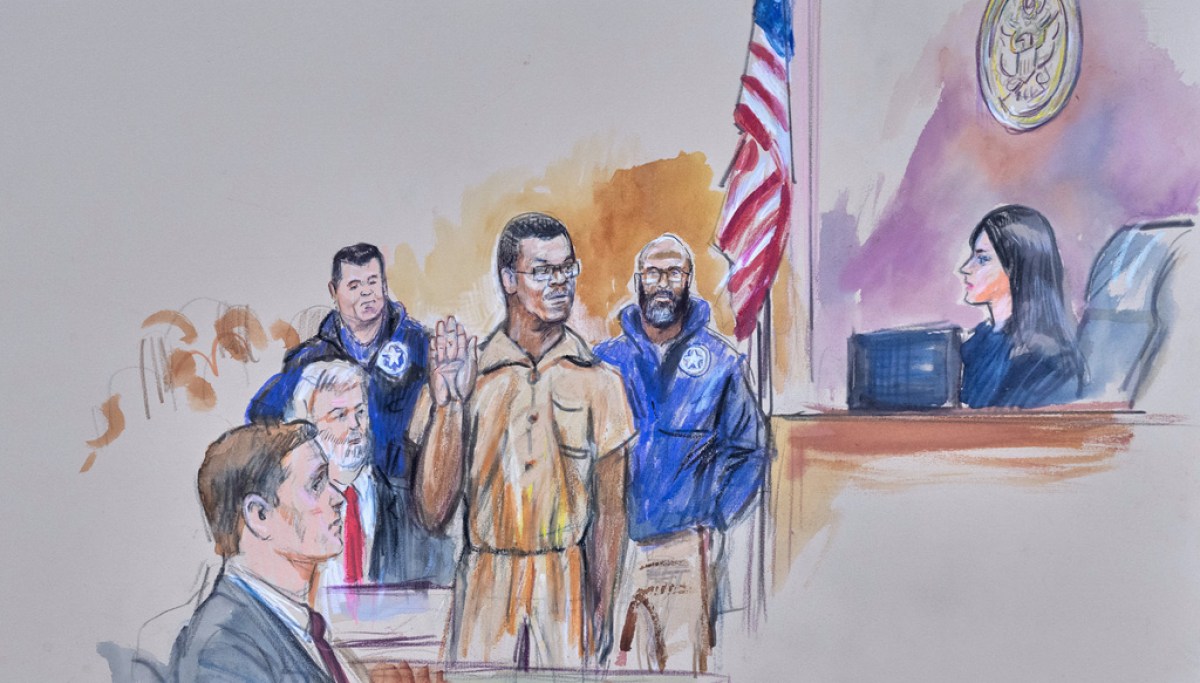
The FBI investigated a former U.S. Capitol Police officer as a potential suspect in the Jan. 6 pipe bomb case, according to newly filed court documents in the prosecution of accused bomber Brian Cole Jr.
Defense attorneys for Cole said in a Wednesday filing that Shauni Kerkhoff, who was on duty at the Capitol during the Jan. 6, 2021, attack, was at one point treated by investigators as a “person of interest” and subjected to extensive scrutiny.
According to the eight-page filing, the FBI “began investigating, questioning, and covertly surveilling” Kerkhoff around the same time agents began building their case against Cole.
Kerkhoff, who now works for the CIA, was interviewed by the FBI on Nov. 6 and underwent a polygraph examination in which she was asked directly whether she had placed the pipe bombs. She was formally named as a person of interest on Nov. 7, according to the filing. The defense notably claimed that she failed the polygraph test, with an examiner noting her “very controlled reaction” and “seemingly rehearsed responses.”
After the bureau opened its investigation, the FBI issued subpoenas tied to her electronic accounts, interviewed her associates, and reviewed surveillance footage related to her movements, according to the filing.
Former FBI Deputy Director Dan Bongino, who was lauded by ranking department officials, including Attorney General Pam Bondi, for his work in identifying Cole as the suspect shortly before his departure from the bureau, did not divulge that Kerkhoff was investigated and pushed back on a report last year that named Kerkhoff as a potential suspect.
One day after she was secretly identified as a person of interest in the FBI investigation, the Blaze first reported on Nov. 8 that a gait analysis of the Jan. 6 pipe bomber was a close match to Kerkhoff. Bongino posted to X on Nov. 13 that some reporting about “prior persons of interest is grossly inaccurate and serves only to mislead the public.” The Blaze later retracted its article after Kerkhoff’s attorney said his client “categorically denies” that she planted the pipe bombs and after Cole was charged for the pipe boms.
However, Bongino’s statement to X came well before the Kerkhoff investigation formally closed on Jan. 7, Cole’s lawyers said. According to the defense filing, the FBI ultimately closed that investigative lead roughly a month after Cole was arrested and charged in connection with the devices planted outside the Republican and Democratic National Committee headquarters the night before the Jan. 6, 2021, riot.
Cole, who was living with his family in Woodbridge, Virginia, was arrested on Dec. 4 and pleaded not guilty to charges of interstate transportation earlier this year.
His attorneys are now seeking subpoenas for Kerkhoff, her boyfriend — also a Capitol Police officer — and a podiatrist that the defense lawyers tied to gait analysis evidence, arguing the materials are critical to mounting a defense that “Ms. Kerkhoff—not Mr. Cole—placed the pipe bombs.”
The filing underscores the still-unresolved questions surrounding one of the most perplexing aspects of the Jan. 6 riot.
Over five years after the riot, the pipe bomb case remains one of the Justice Department’s most enduring mysteries, even as officials — including U.S. Attorney Jeanine Pirro, who is prosecuting the case — have publicly expressed confidence that Cole is the right suspect. Even so, the DOJ’s own prosecutors have cited no clear motive for Cole, nor have they provided evidence so far of how they believe Cole was able to evade what the FBI described as a massive law enforcement effort to track down the pipe bomber for years.
In the immediate aftermath of the riot, the FBI assigned more than 50 agents to the case and launched a sweeping digital and forensic effort to identify the suspect. Investigators analyzed surveillance footage, tracked cell phone data, subpoenaed purchase records for bomb components, and even attempted to match footwear seen in video evidence to retail sales.
Agents narrowed down hundreds of potential cellphone hits to a small pool of individuals but said they failed to identify a suspect through digital tracing. They also examined thousands of retail transactions for materials used in the devices, including battery connectors and pipes, but found no clear overlap pointing to a single individual.
At various points, investigators pursued multiple leads, including a gym employee whose gait resembled the suspect and a Georgia teenager whose purchases triggered alarms, but none ultimately tied back to the bombs placed in Washington, according to the Washington Post.
The devices were discovered on Jan. 5 near the RNC and DNC headquarters and were deemed by the FBI as viable, though they did not detonate.
The investigation has also drawn political scrutiny, with some Republican lawmakers, including Rep. Thomas Massie (R-KY), suggesting the case has not been fully resolved or transparently handled. More recently, online speculation has resurfaced around Kerkhoff following claims about gait analysis linking her to the suspect — allegations her attorney has called “recklessly false.”
Cole’s defense team has now brought those investigative threads into court, where his attorneys are attempting to force disclosure of materials that would allow them to present the theory of an alternative suspect to a jury. The disclosure, through discovery materials, that the FBI invested resources into investigating Kerkhoff around the same time it began building the case against Cole could help the defense do that.
The FBI said in December that no new evidence led to a break in the case and that agents instead combed through existing material, raising questions about why it took nearly five years for the FBI to investigate Kerkhoff and Cole.
‘LIKE IT OR NOT’: ATTORNEYS SAY TRUMP PARDON APPLIES TO JAN. 6 PIPE BOMBER
The defendant’s team has also engaged in a handful of other tactics aimed at defanging the government’s case, including an accusation that the DOJ did not follow the correct course of action to detain Cole under a grand jury indictment using D.C.’s Super Court, and a claim that Cole should be covered by President Donald Trump’s Jan. 6 pardons.
A spokesperson for the FBI and an attorney for Kerkhoff did not respond to a request for comment. The Washington Examiner contacted the CIA.