Order Jamie Glazov’s new book, ‘United in Hate: The Left’s Romance with Tyranny, Terror, and Hamas’: HERE.
The economic collapse in the Islamic Republic of Iran has led to widespread despair. For most Iranians, mere survival has become an unendiing daily struggle. A small group — those who belong to the Islamic Revolutionary Guard Corps, or the Basij, or to the Shia clerisy — have so far not shared the general fate. More on the economic degringolade can be found here: “Iran risks renewed protests as citizens reach ‘breaking point’ amid war-stricken economy,” by Omid Habibinia, The Media Line, March 28, 2026:
Iran’s already dying economy is now being pushed toward full collapse after several weeks of war. Food prices are rising not only day by day but hour by hour, with some staples increasing by at least 50 percent compared to pre-war levels.
At the same time, the disruption of internet access has halted many services. Factories and production facilities are facing acute shortages of raw materials, and the country’s administrative system has been severely impaired. “It has become impossible to endure this situation any longer,” a Tehran resident told The Media Line.
According to figures cited by state-affiliated institutions and some economists, more than 40% of the population now lives below the absolute poverty line, with that figure exceeding 50% in the capital. Economists warn, however, that the real poverty rate may have climbed above 60% nationwide.
As the middle class erodes, the gap between those earning less than 50 million tomans per month (about $320) and those earning more than 200 million tomans per month (about $1,280) has widened sharply.
However, across most occupations, the average monthly income of employees and skilled workers in Tehran does not exceed 25 million tomans (about $160), meaning that the majority fall below the poverty line, which economists say would require at least twice that amount to sustain a basic standard of living….
Government intervention in the currency market has failed to stabilize the exchange rate; instead, the US dollar nearly doubled in less than 7 months, triggering a sharp collapse of the national currency….
Iran’s currency continues to sink. In 1979, when the Ayatollah Khomeini took power, the exchange rate was 70 rials to the dollar. Today there are 1.3 million rials to the dollar, the greatest collapse of any currency in the last one hundred years.
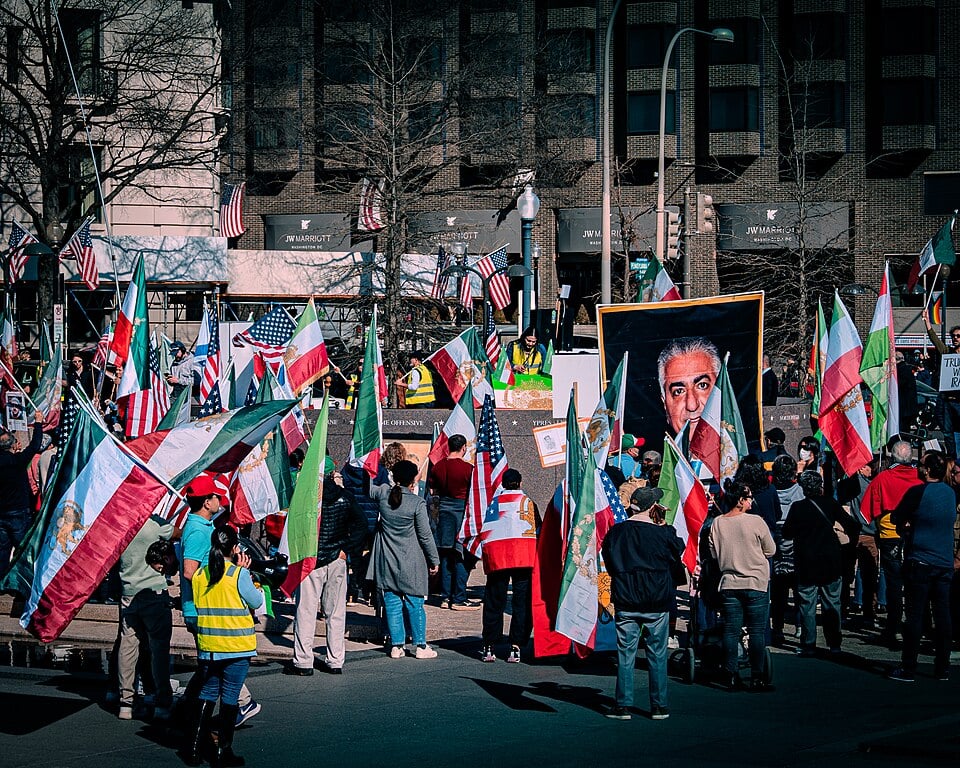
The suppression of the protesters, many of whom were protesting economic conditions rather than the absence of political freedom, was brutal: in just two days — Jan. 8 and 9 — 36,500 protesters were killed and several hundred thousand were wounded.
Unfortunately for Iran, the people placed in charge of the economy have often been chosen not on the basis of expertise, but for loyalty to the regime; most turn out to be economic nitwits, while real economists, many of whom are suspect politically, have been sidelined. The Iranian economy has been mismanaged for the past 47 years. $500 billion has been grossly misallocated to weapons development — consisting of both an extensive nuclear project and a ballistic missile program that has involved the building of 27 vast underground “missile cities” — both programs are now being battered to great effect by the Israelis and the Americans, and hundreds of millions of dollars spent by Iran on its weaponry has already gone up in smoke, with much more damage to come.
Many have suggested that if Iran does not accept the 15-point program of concessions that the Trump administration has demanded of it, the war will continue for many weeks to come, with all the additional expense to Iran of conducting hostilities not only against the United States and Israel, but against the seven Gulf Arab states hosting American military bases that are now suggesting that they will begin attacking Iran.
Nowruz was particularly painful this year. It’s the time when families traditionally spend more on new clothes for the spring, and on food for family celebrations of the holiday. In Iran, the cost of such spending skyrocketed this year, so that even the most basic of commodities, such as pasta and canned tuna, are no longer within reach of an average Iranian family.
The Iranians are at the end of their tether. Food prices are sky high; the simplest of foodstuffs can cost someone half of his monthly salary. The value of the rial keeps sinking. Despite this nightmarish situation, Iran’s rulers are still plowing billions of dollars into its twenty-seven ballistic missile cities built deep underground, and using up thousands of its multimillion-dollar ballistic missiles in attacks on Israel and eight of Iran’s Arab neighbors. It continues running, at great expense, the nuclear facilities also built deep underground in Natanz, Fordow, and Isfahan. The rulers of Iran had a choice — guns or butter — and they long ago chose guns sensu lato, with a little “butter” set aside just for themselves and their extended families. How much longer can the regime in Tehran survive with an impoverished population that feels it has nothing left to lose?
Photo credit: Ted Eytan, Wikimedia Commons