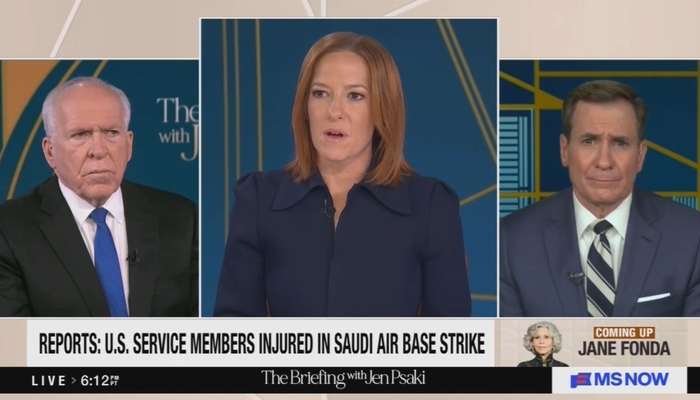
John Brennan is a man who managed to become Director of the CIA and turn that into a national security analyst position on MS NOW, but based off what he told The Briefing host Jen Psaki on Friday, one can only wonder how he was able to do that. According to Brennan, the reason why Iran’s rate of missile fire decreased over 90 percent since day one of the war is not because of the success of the U.S. and Israeli militaries, but because the Iranian military is actually full of strategic geniuses.
Psaki began by wondering what Brennan thought, “When you saw the news of them, the troops that have been impacted in Saudi Arabia, that they’ve been successful in hitting a number of bases, it seems.”
Man who somehow managed to become CIA director/MS NOW national security guy Jon Brennan tells Jen Psaki that Iran’s declining missile fire rate is actually proof of strategic genius, “Well, I think, as John pointed out, I think the Iranians have been very strategic in terms of… pic.twitter.com/GOH0EpMgFt
— Alex Christy (@alexchristy17) March 31, 2026
If Baseball Team A beats Baseball Team B 20-2, Team B is not being successful just because they manage to score two runs, but Brennan seemed to think otherwise:
Well, I think, as John pointed out, I think the Iranians have been very strategic in terms of husbanding some of their inventory of missiles, rockets, drones, and others so that they would wait until a lot of the air defense capabilities in the Gulf states, Saudi Arabia, even in Israel, are going to be depleted as they overwhelm some of these air defenses and pointed out how many Patriot missiles have been expended. So again, I think the Iranians are being—
That makes zero sense. There is no benefit for Iran to hold back because the number of interceptors expended is correlated to the number of missiles defended against not the number of days the war goes on. However, the number of days the war goes on is correlated to the number of missiles and missile launchers the U.S. and Israel are able to destroy before they are fired.
Nevertheless, Psaki interrupted, “Let me pause you for a second, ‘cause I just want you to put in perspective how many they have used and how many we have used. Like, what does that, kind of, mean? As I just gave the numbers there.”
Brennan was not done making nonsensical points, “Well, I think the number of strikes against Iran is up in the 16, 18,000 going after targets, the number of munitions that have been used by the U.S. military is just astronomical. And therefore, where are we getting those munitions from?”
The U.S. has been so successful that we have long since shifted to using precision-guided gravity bombs instead of the costly standoff weapons Brennan was probably alluding to.
Still, he continued, “We’re getting them from our stockpiles, as well as from those munitions that we were sending to Ukraine or whatever else. But we need to have a certain amount of munitions and missiles and capabilities around the globe, including in the area of China and Taiwan. And so as we are continuing to draw down this inventory, it really does not allow us to provide the type of capabilities that we need in order to ensure that we’re not just dealing with the current crisis, but also we are trying to make sure that our national security is not going to be threatened and at risk in other areas as well.”
Speaking of Ukraine and drones, Ukraine is leveraging its anti-drone expertise to sign agreements with the Gulf states to help them defend against those cheap Iranian drones. Furthermore, much to Ukraine’s disappointment, we haven’t given them some of the weapons, like Tomahawk cruise missiles. In war, sometimes the enemy has moments of success, but a look at the whole picture shows that the U.S. and Israel have dominated the fighting, and it should not be hard for MS NOW to acknowledge that.
Here is a transcript for the March 30 show:
MS NOW The Briefing with Jen Psaki
3/27/2026
9:12 PM ET
JEN PSAKI: What about you, Director Brennan? When you saw the news of them, the troops that have been impacted in Saudi Arabia, that they’ve been successful in hitting a number of bases, it seems.
JOHN BRENNAN: Well, I think, as John pointed out, I think the Iranians have been very strategic in terms of husbanding some of their inventory of missiles, rockets, drones, and others so that they would wait until a lot of the air defense capabilities in the Gulf states, Saudi Arabia, even in Israel, are going to be depleted as they overwhelm some of these air defenses and pointed out how many Patriot missiles have been expended. So again, I think the Iranians are being—
PSAKI: Let me pause you for a second, ‘cause I just want you to put in perspective how many they have used and how many we have used. Like, what does that, kind of, mean? As I just gave the numbers there.
BRENNAN: Well, I think the number of strikes against Iran is up in the 16, 18,000 going after targets, the number of munitions that have been used by the U.S. military is just astronomical.
And therefore, where are we getting those munitions from? We’re getting them from our stockpiles, as well as from those munitions that we were sending to Ukraine or whatever else. But we need to have a certain amount of munitions and missiles and capabilities around the globe, including in the area of China and Taiwan. And so as we are continuing to draw down this inventory, it really does not allow us to provide the type of capabilities that we need in order to ensure that we’re not just dealing with the current crisis, but also we are trying to make sure that our national security is not going to be threatened and at risk in other areas as well.