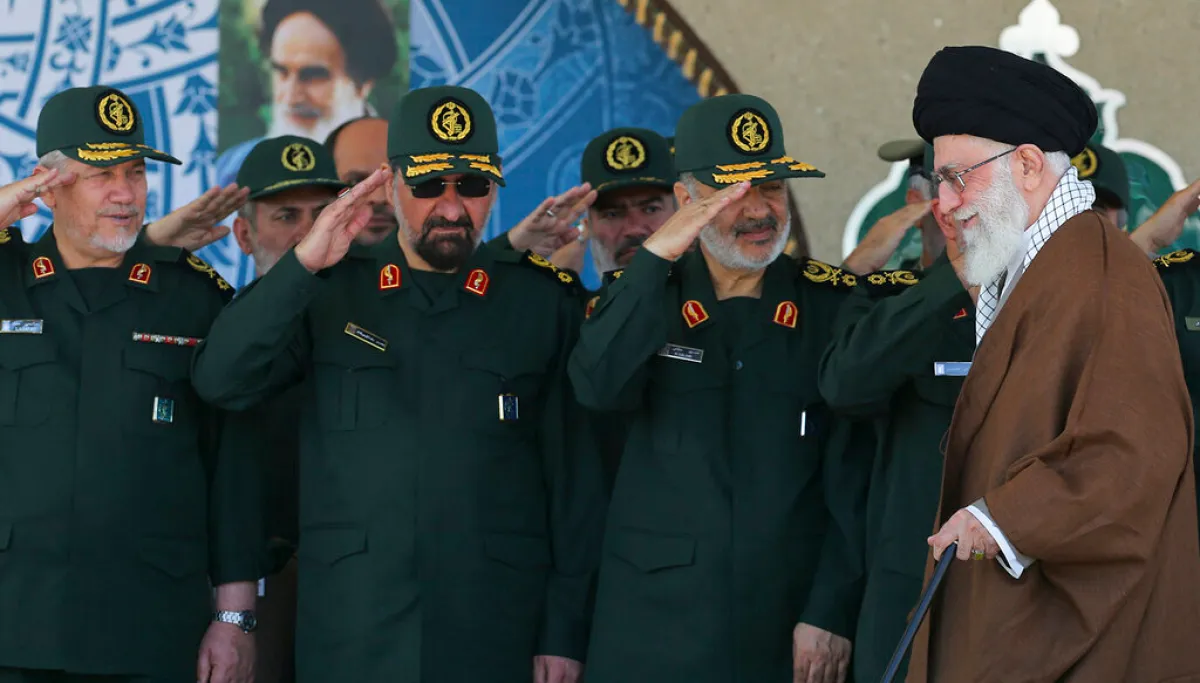
The accession of Ayatollah Mojtaba Khamenei in early March completed a decades-long process, solidifying the transformation of the Islamic Republic of Iran from a theocracy into a de facto military dictatorship.
The Islamic Revolutionary Guard Corps was founded as a sort of praetorian guard, intended to be only a few thousand strong, meant to safeguard the Islamic revolution. A combination of factors, including Iraq’s invasion in 1980, successes in Lebanon, sanctions, and most of all former Supreme Leader Ayatollah Ali Khamenei’s maneuvering to take and secure power, all contributed to transforming the Guards into a political, military, and economic juggernaut that de facto rules the country. Their absolute hold on power was solidified after Ali Khamenei’s death, when they were able to strong-arm their preferred candidate, Mojtaba Khamenei, through.
Professor Ali Alfoneh, a senior fellow at the Arab Gulf States Institute and expert on the Guards and succession politics in Iran, has been tracking Iran’s transformation for well over a decade. He predicted the series of events that followed in his 2020 book, Political Succession in the Islamic Republic of Iran: Demise of the Clergy and the Rise of the Revolutionary Guard Corps.
WORLD FACES SEVERE FOOD SUPPLY CRISIS IF STRAIT OF HORMUZ BLOCKADE CONTINUES
“More likely, the [Guards] will prevail in the factional struggle for Khamenei’s succession, and the future supreme leader, whoever he may be, will, for all practical purposes, be in full alliance and share power with the [Guards],” Alfoneh wrote at the time.
Alfoneh spoke with the Washington Examiner to expand upon his work and outline how the current war has affected the Guards’ consolidation of power.
Birth and transformation of the Islamic Revolutionary Guard Corps
The Islamic Republic of Iran was founded as a theocracy, with Shiite clerics meant to decide the affairs of the state, led by former Ayatollah Ruhollah Khomeini’s version of a Platonic philosopher-king regime, called the Guardianship of the Jurist. The Guards were established to help secure this system.
Khomeini was skeptical of the loyalty of Iran’s military, being led by officers formerly loyal to the Shah. The Guards were established as a paramilitary counterweight to this military, with the added tasks of securing the ideological fervor of the Islamic Revolution, protecting the supreme leader, maintaining internal security, and more. Iraq’s surprise invasion in 1980 served as a wind in the sails of the Guards, who saw their role drastically expanded to keep Iraqi dictator Saddam Hussein’s forces at bay.
The deciding factor in the Guards’ rise came after Khomeini suffered a heart attack on Jan. 23, 1980. Unable to carry out his full duties as supreme leader, Iran quickly became run by a triumvirate: Ayatollah Akbar Hashemi Rafsanjani, Ali Khamenei, and Khomeini’s son, Ahmad Khomeini. They were to empower the Guards during the period of de facto rule, relying on them for defense against Iraq and anti-regime insurgents within Iran.
Rafsanjani and Khamenei became wary of the Guards’ increasing power in the late 1980s and sought to rein them in. After Khomeini died in 1989, however, Khamenei reversed his position towards the Guards and used them as his primary instrument in seizing absolute power.
The Assembly of Experts, which gathered to select the next supreme leader, was largely skeptical of selecting Khamenei due to his lack of religious credentials as laid out by the former supreme leader. After a fair bit of intrigue and the help of Rafsanjani, Khamenei was able to seize the supreme leadership. However, doubts persisted, and he couldn’t rely on the Shia clergy to be loyal to him as Khomeini could. To secure his power, over the ensuing decades, he purged the assembly and wider clergy, hollowing them out. He was increasingly forced to turn to the Guards amid this power vacuum, giving them greater economic and political power in the process.
“The clergy was already weakened under Khomeini, who managed to rise above his theological competitors and other sources of emulation by utilizing his political power as head of state. Khamenei did much the same by forcing the clergy to recognize him as the leader of the Islamic Revolution despite his lack of qualifications. Khamenei also manipulated elections to the Assembly of Experts and, over the years, effectively changed its composition by installing insignificant clerics without a social base of their own as members,” Alfoneh wrote.
“Finally, by forcing sources of emulation to also recognize him as a source of emulation, Khamenei dealt a deadly blow to any remaining integrity and standing of the sources of emulation in the Iranian public,” he added.
Economic rise
Many of the Guards’ main instruments of economic power were granted during this succession period in the late 1980s and early 1990s.
After the conclusion of the Iran-Iraq War in 1988, Khamenei and Rafsanjani “entrusted post-war reconstruction to the IRGC’s engineering arm, later formalized as the Khatam al-Anbia Construction Headquarters, which remains the largest contractor in Iran,” Alfoneh told the Washington Examiner.
“The IRGC accumulated significant capital through reconstruction projects, channeling profits into its own financial institutions and subsequently acquiring state-owned enterprises ‘privatized’ under President Mahmoud Ahmadinejad,” he added.
The Guards’ stranglehold on oil revenue came in response to U.S. sanctions targeting Iran’s oil sector.
“Khamenei further empowered the IRGC by allowing it to bypass the monopoly of the National Iranian Oil Company and engage directly in oil exports—activities that have since become a primary revenue stream for the organization,” Alfoneh said.
Strength abroad strengthens the Guards at home
Zineb Riboua, a research fellow and Middle East expert at the Center for Peace and Security in the Middle East at the Hudson Institute, stressed the impact the Guards’ foreign adventures had in boosting their political, economic, and military power. The group became the central instrument of Tehran’s foreign policy, playing key roles in politics and conflicts in Iraq, Syria, Lebanon, Yemen, and elsewhere.
Riboua puts the peak of the Guards’ military presence at 2017, just before President Donald Trump’s “maximum pressure” sanctions regime and at the height of wars in Syria, Iraq, and Yemen.
Their success can be largely credited to the leadership of the talented and charismatic Qassem Soleimani, head of the Guards’ elite Quds Force. His assassination on Trump’s orders in January 2020 served as a “turning point” for the Guards, in Riboua’s view.
“Qassem Soleimani played a big role in the Syrian Civil War. He organized several Shia militias, Hezbollah, and the Syrian army. He played a big role in that. I think what [the Guards] did in Syria was a good example that demonstrates their peak as military operators,” she said.
Alfoneh was partially in agreement, with some caveats.
“The assassination of Major General Qassem Soleimani did not significantly weaken the highly institutionalized Quds Force,” he said, arguing that Israel’s gutting of Hezbollah in 2024 had a much larger impact. However, he noted that his death “deprived the [Guards] of a charismatic figure capable of emerging as a political savior for the regime during periods of crisis.”
Internal Protests and the Guards’ rise in domestic politics
While the Guards enjoyed success abroad, their stranglehold on political power domestically was ensured when Khamenei turned to them to counter domestic dissent against his theocratic regime. The first major nationwide protests against the Islamic regime began in June 2009, with demonstrators angered by the fraudulent presidential election. Rising fuel prices triggered a more fierce round of protests in November 2019-2020, triggering a crackdown that killed over 1,500 protesters.
In both cases, Khamenei had to rely on the Guards to crush the protests. This was only a portent of things to come — the protests were dwarfed by massive protests and riots against the regime in September 2022-2023, then the largest protests in December 2025 to January 2026. The final round of protests, triggered by the skyrocketing cost of living, triggered the greatest mass killing by the regime in its history, with Khamenei ordering a Guards-led crackdown that killed an estimated 30,000-40,000 protesters.
The massacre ensured the end of the regime’s domestic popular legitimacy and has made it completely reliant on the repression of the Guards to stay in power. With the ideological fervor of the Islamic Revolution having run out and the clerical establishment delegitimized, true power now lies with the IRGC.
Despite absolute rulership always resting with the ayatollah, Iran has some functioning republican institutions, including presidential elections. The election of the reformist former President Mohammad Khatami in 1997, for instance, was an expression of the popular will and explicitly against the wishes of Ali Khamenei, but he was still allowed to take the presidency.
With the consolidation of the Guards, elections, including presidential elections, have been neutered. The Guards cracked down on the centrist Reformist faction in the aftermath of the January massacre, arresting many of its leaders, leaving it largely listless. The popularly elected reformist President Masoud Pezeshkian still occupies the presidency, but doesn’t seem to have any influence on Iran’s policy.
Early in the ongoing war, Pezeshkian apologized to the Gulf countries for attacking them with ballistic missiles and drones, only to quickly backtrack when the Guards communicated a different message.
Impact of the U.S.-Israeli war with Iran on the Guards
Though Mojtaba Khamenei’s succession may have confirmed the Guards’ hold on power, Alfoneh said that the devastating strikes also had a real negative impact on the group. He argued that it may even have prevented their complete seizure of power, as would have taken place without Operation Epic Fury.
“The gradual consolidation of IRGC control at the expense of the clergy has accelerated since the June 2025 war. However, Israel’s decapitation of the organization has reduced the likelihood of a sudden IRGC coup d’état. For now, the IRGC appears content with a power-sharing arrangement within a five-member collective leadership composed of the president, the parliamentary speaker, the judiciary chief, and one representative each from the regular Army and the IRGC, either Mohsen Rezaei or Ahmad Vahidi,” he told the Washington Examiner.
Despite the institutionalized nature of the Guards, it can’t easily shake off the assassination of most of its senior leadership. Iran’s conduct in the war hints at its listless nature, with Tehran and the Guards sometimes communicating different things to the outside world.
Ideology and future of the Guards
With the theocratic government haviing been essentially replaced by a military junta with a clerical figurehead, the next question is naturally what the new regime believes, and how they will act. Experts are split on the subject, but Alfoneh argued the key differences will be a greater stress on Iranian nationalism and less concern with the puritanical social policies of the clerical government.
“Over time, the IRGC has fused Shia Islamism with Iranian nationalism. It is also likely to tolerate greater personal freedoms while continuing to restrict political rights (exemplified in non-enforcement of the hijab and chastity law),” he wrote.
Their main concern is national security, with a particular focus on Iran’s rivalry with the U.S. and Israel.
“Regarding negotiations with the United States, the IRGC’s position appears to have been adopted by the de facto collective leadership: to pursue an economic war of attrition aimed at imposing costs on the global economy, driving up oil prices, and influencing U.S. domestic politics—particularly with an eye toward affecting Republican prospects in the November midterm elections,” he said.
Riboua argued that the Guards’ ideology can be mainly characterized by a pragmatism with hardliner characteristics.
“They are definitely in the business of promoting the revolution. But as with every revolutionary state, the ideology is in service of power,” she said. “So the ideology is what helps them recruit. That’s what helps in psychological warfare and information warfare. They have much more of a pragmatic way of using ideology, which for a long time resonated in the Arab world, but now less so.”
The closeness between the Guards and the clerical regime over the past 20 years, Riboua argued, means a large ideological split from the old regime may not be forthcoming.
“I don’t think that we’ll see a bigger split, ideologically speaking. I think like the Ayatollah, they’re very anti-Western, some of them really do adhere to a lot of that,” she said.
“There is this idea that if you precipitate the collapse of the clerical system, you can find the [Guards] are much more pragmatic, and so on. I don’t think so. I think that the [Guards] themselves worked with the clerical system for a very long time, and they both see things the same way, which is why they are making the same mistakes,” Riboua added.
WHAT DO IRAN PEACE NEGOTIATIONS MEAN FOR ISRAEL’S OPERATION IN LEBANON?
To think in terms of the Guards being more or less moderate than the clerical establishment is a misdirection, she argued, and the better pursuit for the U.S. would be to identify elements within the Guards that are more willing to negotiate with the U.S.
“I think that it’s a fallacy to think in terms of moderate or not moderate when we’re talking about the decline of the Islamic Republic. I think that the better contest is to see who is more willing to talk to the United States and who isn’t. Because at the end of the day, I think that’s what really matters,” Riboua concluded.