Pope Leo XIV speaks of “unity” in the Church’s liturgical life—but beneath the language of reconciliation lies a deeper question: unity in what truth? As Cardinal Parolin doubles down and progressive bishops advance radical reforms, the future of the Traditional Mass may not be suppression—but something more subtle—and more dangerous.
The meaning of Pope Leo’s Letter to the French Bishops
Last March 18, Cardinal Pietro Parolin sent, on behalf of Pope Leo XIV, a letter to the French bishops, gathered in Plenary Assembly in Lourdes from March 24 to 27, 2026, in which the Pope emphasized, among other things, that he is “particularly attentive” to the liturgical question, “in the context of the growth of communities linked to the Vetus Ordo.”
This reference has enthused many Catholics close to the world of Tradition. Let us, however, read the reference of the letter in its entirety: “[it is] troubling that a painful wound continues to open in the Church regarding the celebration of the Mass, the very Sacrament of unity. To heal [this wound], it is certainly necessary to have a new outlook on each of us, with a greater understanding of one’s own sensibility; an outlook that can allow brothers rich in diversity to welcome one another, in charity and in the unity of faith. May the Holy Spirit suggest to you concrete solutions that allow you to generously include those who are sincerely attached to the Vetus Ordo, in conformity with the guidelines established by the Second Vatican Council regarding the Liturgy.”
This letter is situated within a very particular context and historical moment. France today represents one of those Western countries in which a peak of conversions to Catholicism is being recorded, largely connected to the Traditional world. These are not only communities traceable to the Priestly Society of Saint Pius X, as demonstrated for example by the annual Chartres Pilgrimage, a testimony of a vitality that contrasts with the general crisis of ordinary parish structures.
Leo XIV wishes to place Tradition on the same level as other sensibilities—liturgical and doctrinal—which have very little in common with the Catholic faith. It is an approach that, paradoxically, ends up producing the same effect as that of Francis, even though it starts from opposite premises.
Although this letter has rekindled the hopes (perhaps illusory) of many Catholics of Tradition, which I have already discussed in my previous analysis, in reality, a careful and contextual reading of the event can only confirm what I stated precisely on that occasion. The entire discourse of Pope Leo is once again focused on the formal unity of the Church, that is, cohesion, where “brothers rich in diversity” must understand and welcome one another, “in the unity of the faith.” However, one may ask: which faith? How can the priest who studies and applies Amoris Laetitia and the priest who studies and applies Casti connubii belong to the same faith?
Pope Leo’s problem is not his desire to reintegrate Traditional liturgical “sensibility” into the life of the Church — something that distinguishes him from Francis — but the way in which he intends to do so. Leo XIV does not simply wish to recover Tradition: he wants to place it on the same level as other sensibilities, not only liturgical but also doctrinal, which have very little in common with the Catholic faith.
It is an approach that, paradoxically, ends up producing the same effect as that of Francis, even though it starts from opposite premises. Francis tended to exclude Tradition; Leo XIV tends to include everything, Tradition included. But including the truth alongside positions incompatible with it — a position shared and practiced also by a hyper-modernist cardinal such as Matteo Maria Zuppi — inevitably means relativizing the truth itself.
Parolin’s statement: backtracking or coherence?
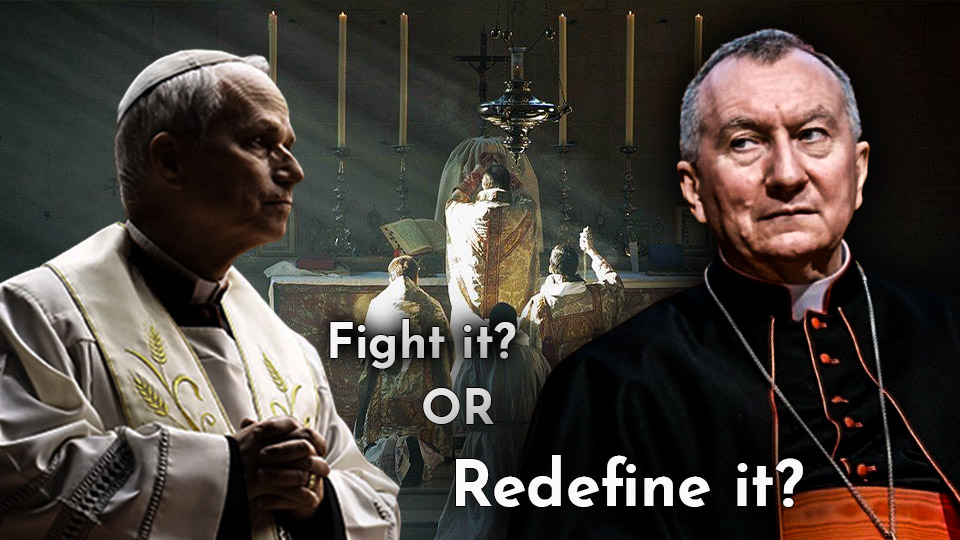
Cardinal Pietro Parolin, on March 26, 2026, in remarks to Vaticanist Niwa Limbu, reaffirmed the Pope’s position: “I think we all share this assessment that the Pope gives, right? In the sense that the liturgy must not become a source of conflict and division among us.” He added: “It will be necessary to find the formula that can meet legitimate needs. But I believe that this can happen without turning the liturgy into a battlefield.”
Parolin remains perfectly aligned with Francis on a decisive point: the idea that the Traditional lex orandi represents a vision of God, Church, and Redemption that has now been superseded by the Second Vatican Council.
Parolin and Leo share a Fabian approach to the transformation of the Church: no sudden shocks, but a gradual and constant aggiornamento (‘updating’). However, Parolin remains perfectly aligned with Francis on a decisive point: the idea that the Traditional lex orandi represents a vision of God, Church, and Redemption that has now been superseded by the Second Vatican Council. A Council which, in Parolin’s reading, marked the transition from an “only Catholic” Church to an “also global” Church.
Parolin’s reading has direct consequences also on the liturgical level, consistent with Bergoglio’s intentions and, ultimately, with the implementation of Traditionis custodes up to the definitive shelving of the Traditional liturgy. Among these consequences, we find strong inculturation, so-called liturgical creativity, and the adaptation of the Missal to local sensibilities and cultures. In this framework, it is no longer the cultural product of man that must convert to the liturgy, but the liturgy that must convert to man.
Some might interpret Parolin’s words as an attempt not to contradict the reigning Pope, perhaps out of fear of a possible reformation of the Secretariat of State. But in reality, Parolin expressed a very simple concept, nothing more: “The liturgy must not be a battlefield.”
The most direct way to eliminate liturgical conflict, according to Parolin, is imple: Apply Traditionis custodes to the full, recognizing the new Rite as the “only legitimate form of the Catholic lex orandi.”
And what is the most direct way to eliminate liturgical conflict, according to Parolin? Simple: to apply Traditionis custodes to the full, marginalizing the ancient Rite and recognizing the new Rite as the “only legitimate form of the Catholic lex orandi.” Moreover, even with the possible removal of Parolin from the Secretariat of State, it is difficult to imagine, at least in the current state of affairs, a downsizing of the Secretariat that would penalize the line represented by Pietro Parolin. The choice of the new Substitute, Paolo Rudelli, confirms this: a diplomat formed in the Villot–Casaroli–Silvestrini–Parolin line, favorable to Ostpolitik and therefore perfectly inserted into the dominant school in the Secretariat of State at least since the 1970s.
Parolin’s vision, therefore, partially aligns with that of Pope Leo, but this does not in the least jeopardize his weight in the Vatican and in the Secretariat of State. And he knows it well. This is precisely because Leo XIV does not govern by exclusion, but by the coexistence of different sensibilities: he willingly accepts a plurality of positions, even when they do not coincide with his own. In such a system, Parolin not only does not lose influence, but continues to move with ease in his environment, strengthened by the fact that plurality — even the most dissonant — is exactly what the current Pope considers a value.
The eloquent promotion of Heiner Wilmer
To confirm all this, what has happened in recent days on the episcopal front is very interesting. In my previous analysis I argued that, between bishops formed under Francis and those promoted by Leo XIV, there is no difference. At most, we can speak of nuances within the same pattern: a continuum that ranges from the moderate synodalist Iannone to the openly heterodox Grunwidl, the two symbolic poles of Prevost’s episcopate.
I had also criticized the idea — apparently very widespread but unrealistic — according to which progressive bishops would hold their tongue as long as the Pope dictates a clear line contrary to their positions. The events of recent days unfortunately confirm that this reading does not hold: the Pope’s line does not restrains the bishops, precisely because — again — Leo XIV does not ask for uniformity, but for a plurality of opinions, even when they openly diverge from his own. But let us turn to the facts.
Leo XIV does not govern by exclusion, but by the coexistence of contradictions.
On March 26, 2026, Heiner Wilmer — a heterodox bishop, protagonist of the German Synodal Way and now president of the Bishops’ Conference in Germany — was promoted from the diocese of Hildesheim to the more prestigious see of Münster. A choice that comes precisely while the Holy See is evaluating the statutes of the Synodalkonferenz, the body that would in fact function as a permanent ecclesial parliament, with a lay majority and episcopal minority, endowed with decision-making powers on doctrine, morality, discipline, and pastoral care, and which would even operate as a body of oversight, exposure, and sanction of possible “dissenting” bishops. A true juridical monstrum, devoid of any canonical foundation.
The eloquent announcement of Johan Bonny
Even more eloquent is the development that has come in recent days from Antwerp, Belgium. The local bishop, Johan Bonny, has published a pastoral letter in which he announces a very concrete plan: to form and ordain married men to the priesthood by 2028, presenting this choice as a response to the crisis of vocations and as a natural development of the synodal process.
In other words: if the synodal path is moving in that direction, why pretend that nothing has changed? For Bonny, the question is no longer whether the Church will ordain married men, but when and who the first will be. In the same letter, Bonny also criticizes recent pronouncements of the Holy See on the female diaconate, judging the arguments against it “theologically weak” and “anthropologically outdated,” going so far as to affirm that the ordained ministry “has a right to women.”
Among progressive bishops there seems to be a widespread sentiment that today in the Church one can act as if a “state of exception” exists.
Over the Belgian context in particular, there is still an element that remains unclear. It is difficult to prove, but various indications suggest that not a few priests — among the few remaining — live more uxorio, openly ignoring ecclesiastical discipline. This is suggested by two recent obituaries of priests, in which “life partners” and “children of the heart” are mentioned without embarrassment: expressions that allude to stable relationships with divorced women or widows with children. Curiously, a few weeks ago, the Belgian diocese of Namur assured me that the phenomenon of concubinary clergy did not exist, and that those two cases were exceptions. Bonny’s insistence on the issue seems to contradict this narrative.
Not only that: also the chaplain of St. Stephen’s Cathedral in Vienna, Anton Faber, has stated that “celibacy is an elastic concept” and regularly appears in public with a woman, without Archbishop Grunwidl — notoriously heterodox — having intervened to date. In Vienna, faithful hope, or perhaps delude themselves, that he will do so in the future. When all these pieces of the puzzle are placed side by side, it is not difficult to have a sufficiently clear overall picture.
Do progressive bishops believe in a state of exception?
In my view, these are not extemporaneous outbursts of “unhinged” progressive bishops. They are, rather, bishops who act coherently with what they believe. They follow a precise strategy: gradually shifting the Overton window through scandals toward the normalization of reforms already outlined decades ago. Let’s recall the famous “agenda of four knots” presented in 1999 by Cardinal Carlo Maria Martini — true mastermind of the St. Gallen Group together with Achille Silvestrini — which explicitly included the overcoming of ecclesiastical celibacy in the clergy.
The deeper point, however, is another. Among progressive bishops, especially in the Franco-German area, there seems to be a widespread implicit sentiment, perhaps not yet developed into a theory, namely the idea that today in the Church one can act as if a state of exception exists. It is essential to clarify at this point that a state of necessity and a state of exception are not the same thing. The state of necessity is contemplated by canon law; the state of exception is not.
The state of necessity justifies the violation of a norm to avoid a greater, immediate, and otherwise inevitable harm. The state of exception, on the other hand, is the temporary suspension of the normative order to deal with a perceived emergency.
The state of necessity justifies the violation of a norm to avoid a greater, immediate, and otherwise inevitable harm. A man who breaks down a door to save a child from a fire acts according to a state of necessity, because the violation and damage to property is absorbed and juridically nullified by the necessity of saving a life, since the life of the child is worth more than the damaged private property.
The state of exception, on the other hand, is the temporary suspension of the normative order to deal with a perceived emergency. Applied to the Church, it would mean suspending — totally or partially — divine law, which in the canonical order is the foundation of all the remaining ecclesiastical human law. Divine ecclesiastical law is irreformable; ecclesiastical human law is reformable. The Pope is absolute sovereign with regard to human law, but minister (that is, at the service) of divine law, over which he has no power.
For this reason, the state of necessity — which is not a state of exception — can never go against divine law, and the violation of an ecclesiastical norm can be justified if carried out to defend a greater, pressing, and otherwise unattainable good, such as the salvation of souls (the supreme good of the Church).
The question is no longer whether change will come—but who will impose it first.
Progressive bishops, on the other hand, push toward changing discipline and doctrine, thus coming to touch divine law itself — as in the case of women’s ordinations or the blessings of homosexual couples. The possible ordination of married men without pontifical dispensation would be an illicit but valid act, because priestly celibacy belongs to ecclesiastical human law; but this is not the ultimate goal of Bonny and his associates. Their aim is the subversion of the entire Catholic framework.
This mentality is particularly evident in Germany. The Synodalkonferenz is contrary to canon law and, above all, to the divine law of the Church. And yet, it is carried forward precisely because its promoters act as if they recognize today a state of exception in the Church. On the one hand, therefore, these bishops deny that a state of necessity exists today, even contradicting the post-conciliar Pontiffs; on the other hand, these same bishops speak and act as if a state of exception exists, which in reality cannot be contemplated by the law of the Church.