The House voted on party lines to pass a short-term funding patch for the Department of Homeland Security late Friday night, rebelling against a plan from Senate Republicans that omitted funding for immigration enforcement agencies.
House Republican leaders pushed a bill, through a rare procedural vote that bypasses an hour of debate and a second vote, that would fund all of DHS until May 22, punting the burden to reopen the government back to the Senate, which left for its scheduled two-week recess on Friday after sending over their bipartisan deal that was swiftly rejected by lower chamber Republicans.
The Rules Committee reconvened on Friday afternoon to tee up a party-line vote, that bypassed typical House rules to require a procedural vote before final passage. The committee adopted the rule as an amendment to the Senate-passed bill, which allowed them to use this rare procedural tool and pass it through one simple vote for a quicker adoption, as the House heads home for their two-week congressional recess.
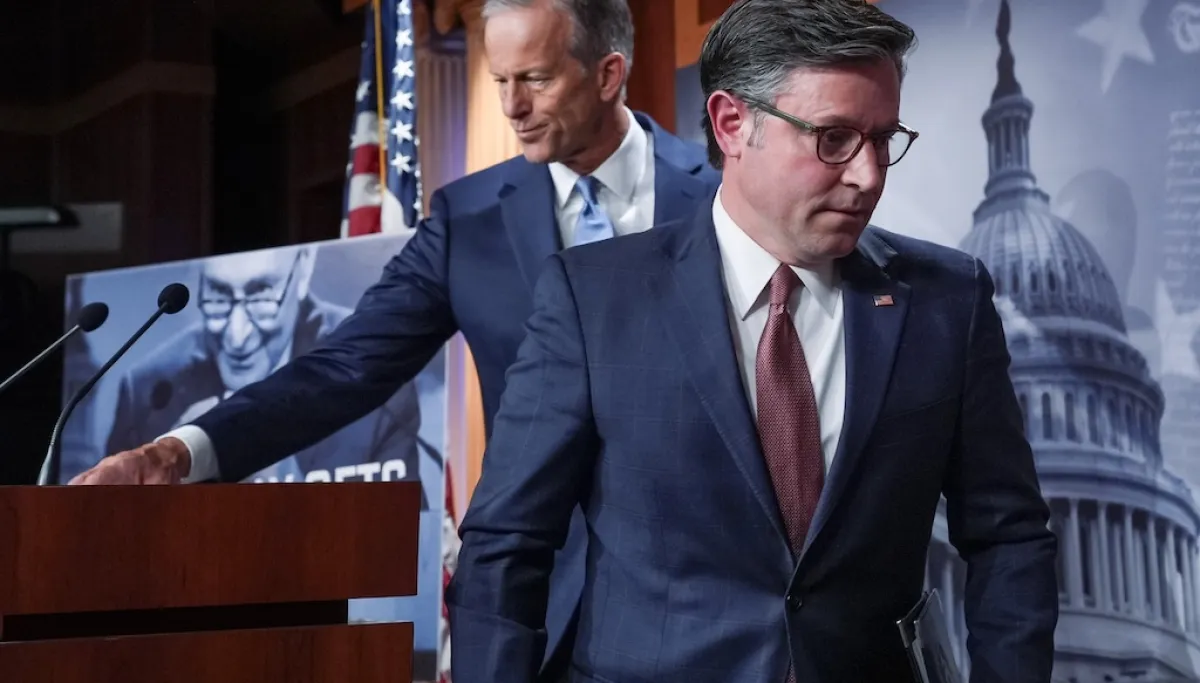
The eight-week continuing resolution drew a line in the sand between House Speaker Mike Johnson (R-LA) and Senate Majority Leader John Thune (R-SD). Republicans erupted at the Senate after the upper chamber jammed a last-minute deal to the House at 2:30 a.m. that would have funded all of the departments except for Immigration and Customs Enforcement and Border Patrol.
The eight-week CR has already been declared everything from nearly impossible to completely “dead on arrival” by Senate Republicans and Democrats.
“Maybe he’ll [Senate Minority Leader Chuck Schumer (D-NY)] have a rode to Damascus experience over the weekend,” House Appropriations Chairman Tom Cole (R-OK) joked with the Washington Examiner.
“They didn’t worry about us,” Cole went on to say of what comes next with the bill already “dead on arrival.”
The Senate’s deal was designed to overcome a month-long impasse with Democrats over immigration agencies’ deportation policies, with Democrats demanding strict reforms and restrictions on ICE in exchange for funding. The Senate bill does not include ICE reforms, but House Democrats were prepared to vote for the deal given the funding to the immigration agencies would continue to be stalled.
“Given the staunch opposition from Senate Democrats, the clearest path to ending this harmful shutdown is for the House to adopt what the Senate just overwhelmingly approved,” a Senate GOP aide told the Washington Examiner.
Attendance on Friday night was key for Johnson, who can only afford to lose one vote due to razor-thin margins. Eleven House Republicans were absent for a vote on Friday, with several having to fly back to Washington on Friday night to pass the first step on the eight-week CR. Five Republicans and 11 Democrats did not vote.
Democrats erupt over Johnson’s decision to ignore Senate deal
Johnson said on Friday that he would not bring the Senate deal to the floor, drawing opposition from House Democrats as almost all of them planned to vote for the deal, and even signaled they could help him with a procedural vote almost always left to pass on party lines.
House Minority Leader Hakeem Jeffries (D-NY) said on Friday that Republicans are moving forward with a partisan CR because “they decided they would rather create chaos for you and your families so they can continue to spend billions of dollars for ICE to brutalize and kill American citizens.”
Jeffries said if Johnson put the Senate’s DHS bill on the House floor, “it will pass.”
“Unfortunately, MAGA extremists in the House of Representatives continue to inflict pain on the American people,” the leader said during a press conference.
One option for Johnson could have been to bring the bill under “suspension,” which allows leadership to bypass the normal committee process and send legislation directly to the House floor. But under House rules, bills cannot be put on the floor under “suspension” on Thursdays, Fridays, or the weekend.
Passing something under suspension also requires two-thirds support within the chamber, meaning Johnson would have to rely on Democratic votes — a likely kiss of death for the Republican speaker, after Johnson’s predecessor was ousted for cutting a deal with Democrats to avoid a government shutdown.
The conservative Freedom Caucus said early on Friday that they would strongly oppose a suspension vote and had made that clear to leadership. This prompted Johnson to engage in a two-hour conference call with his members to pitch the roughly 60-day CR, which has the support of most Republicans, despite some concerns about the optics of rejecting a deal that could end the shutdown immediately.
Rules Committee ranking member Jim McGovern (D-MA) blasted Republicans for bypassing typical House procedure and not giving the Senate deal a vote during the committee’s last-minute, Friday afternoon hearing.
“Instead of doing the responsible thing, the obvious thing, the speaker is cowardly bowing to a handful of extremist wackos in the Republican conference,” McGovern said.
“To Speaker Mike Johnson, you are the speaker of the whole House. You’re not a member of Trump’s cabinet, or the chairman of the House Freedom Caucus. You’re not just the speaker of a small minority of crazy members who will throw a fit every time we’re about to solve a problem …So act like it.”
Senate GOP doesn’t escape critique from fellow Republicans
Johnson and conservatives have targeted most of their anger toward Democrats, who they said “forced” the Senate to take up the all-but-immigration enforcement deal. But the speaker did not mince words about his counterparts in the upper chamber.
“This gambit that was done last night is a joke,” Johnson told reporters Friday, making it the latest sign that he and Thune are not on the same page when it comes to DHS funding. “I’m quite convinced that it can’t be that every Senate Republican read the language of this bill.”
MIKE JOHNSON SPLITS FROM THUNE WITH EIGHT-WEEK DHS FUNDING BILL
The Freedom Caucus and other conservatives have lambasted the Senate GOP as “lazy” and cowards, with one calling it a “dereliction of duty.”
“I think it was just pure laziness and desire for the Senate to go on vacation instead of doing their job,” Rep. Austin Scott (R-GA) said. “For them to take a voice vote in the middle of the night…it is ridiculous.”