An interesting, if extremely early, poll of New Hampshire Democrats dropped recently that may scramble assumptions about the 2028 presidential race.
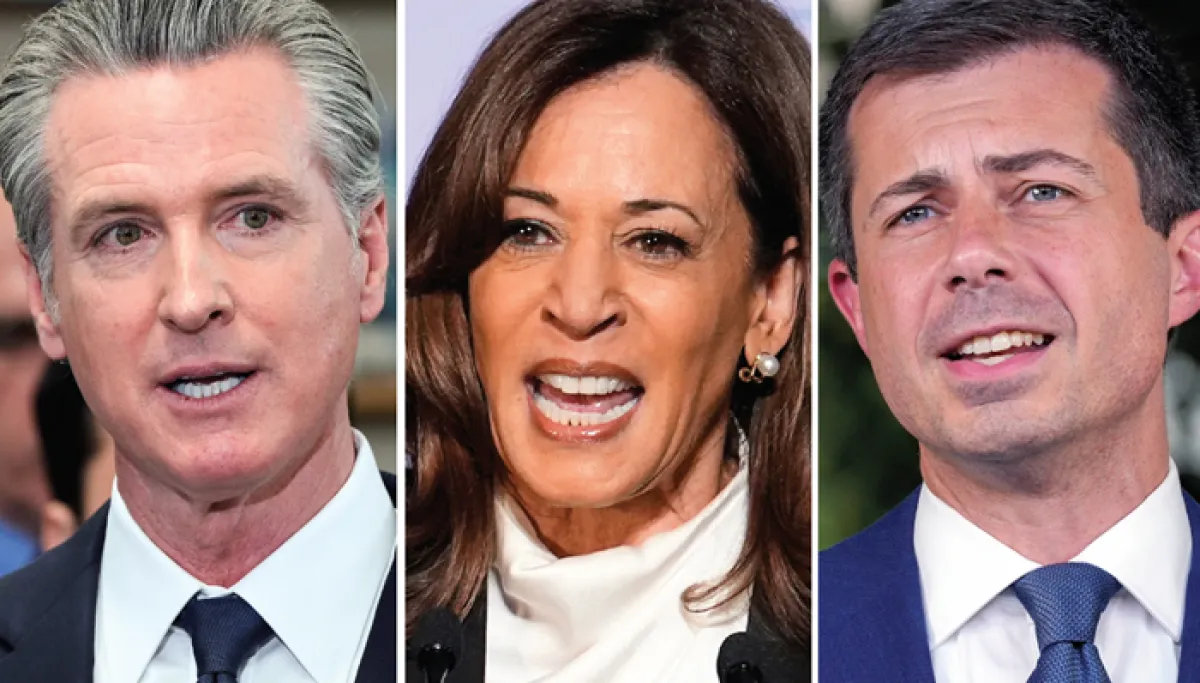
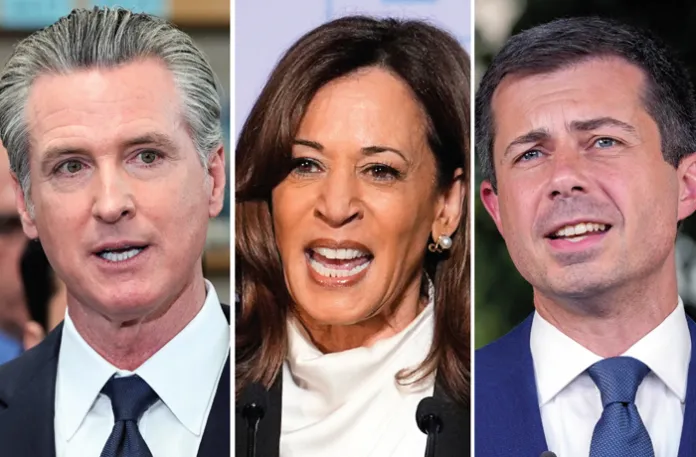
The survey by St. Anslem College found former Transportation Secretary Pete Buttigieg in the lead with 29% of the vote, nearly double the share claimed by Gov. Gavin Newsom (D-CA). Former Vice President Kamala Harris, the 2024 Democratic nominee after she leapfrogged then-President Joe Biden to lead the ticket, was in single digits with just 6% of the vote. She notably trailed Rep. Alexandria Ocasio-Cortez (D-NY), who broke 10%.
Newsom and Harris are widely viewed as the Democratic frontrunners in the run-up to 2028. The former vice president is up by 7 points in the RealClearPolitics polling average, but her numbers vary widely based on individual surveys and a few polls taken this year still have Newsom out in front.
But these are national polls. And while they are an important early indicator of rank-and-file support, there is no true national primary. These individual states will get their say through the primaries and caucuses. If Buttigieg is in third place nationally, often a good bit behind Harris and Newsom, but is actually leading in New Hampshire, the former South Bend, Indiana, mayor-turned-Michigan resident might be much better positioned than he appears in the national polling averages.
Numerous caveats apply, however. The first is that we are talking about one poll, conducted months before the midterm elections have even taken place, much less any of the presidential voting. But we also don’t yet know how early New Hampshire will vote or how influential it will be on other states if it retains something like its traditional first-in-the-nation status.
The Democrats’ primary calendar is still somewhat in a state of flux. New Hampshire was among a dozen states seeking an early spot when the national party notified Democratic officials that it was accepting bids at the beginning of the year. The Granite State was also mostly irrelevant during the last round of competitive primaries in 2020. Buttigieg was strong then, too, barely losing the primary to Sen. Bernie Sanders (I-VT). Biden finished fifth, failing to crack double digits.
We all remember what happened next. Black Democrats rallied to save Biden’s candidacy in South Carolina, possibly fearful of Sanders’s general election prospects. Buttigieg’s standing among black voters was at zero percent in some polls. Rep. James Clyburn (D-SC) threw his weight behind Biden in what turned out to be the most important endorsement of that election cycle.
Biden won South Carolina by a landslide despite sleepwalking through most of the other early states. From then on, he encountered little resistance in his march to the Democratic nomination after weeks of chatter that the party elder might have to drop out.
In 2024, Democrats made sure South Carolina voted early to help protect Biden from a competitive primary. Declaring for reelection as an octogenarian, Biden faced only token opposition for renomination. If he hadn’t agreed to a general election debate before the Democratic National Convention, he might have been the Democrats’ nominee that November. The party would like a somewhat more robust process this time around.
History doesn’t always repeat itself. “Jesse Jackson won South Carolina in ’84 and ’88,” former President Bill Clinton said in 2008 to dismiss then Sen. Barack Obama’s primary victory over his wife there. Unfortunately for the Clintons, Obama’s win had a bit more relevance to the outcome than Jackson’s.
Perhaps even more important to Obama was his win in Iowa, a state that also propelled Democrat Jimmy Carter to the nomination in 1976. But the caucuses haven’t always mattered much to Democrats — does anyone remember then-Sen. Tom Harkin, an Iowan, won more than 77% of the vote there in 1992 while Clinton ran behind “uncommitted” and took just 2.54%? And the state has been regarded as something of an embarrassment after a botched 2020 vote.
The large dynamic that could matter, however, is the racial divide among primary voters. Black Democrats are a major reason Harris remains a viable national candidate after her 2024 defeat and widely panned campaign. Buttigieg continues to struggle with this demographic, with a poll last year by the Republican firm Echelon Insights once again finding him at zero percent. But this time, he isn’t alone.
The same poll found most other potential Democratic candidates with single-digit support from black primary voters. The only exception besides Harris, Rep. Jasmine Crockett (D-TX), just lost a Democratic Senate primary and faces an uncertain future in the House due to Texas’s congressional redistricting.
Harris’s current status as the Democrat to beat among minority voters is something of a paradox, since her overreliance on college-educated whites was a major factor in her loss to President Donald Trump. It could also be fleeting because Harris, having been vice president for four years and her party’s standard-bearer in the last presidential election, has by far the highest name recognition.
It also remains to be seen whether Harris, who has blamed her 2024 campaign woes on the brevity of her time at the top of the ticket, can repair her relationship with top Democratic donors. She blew through $1 billion as she was shut out in all seven battleground states and became just the second Democratic presidential nominee since the 1980s to lose the popular vote.
Then-Sen. Hillary Clinton’s overwhelming black support did not hold up against Obama in 2008, ultimately costing her the nomination. But 2016 was a different story, when black primary voters stuck with her and kept Sanders from having a diverse enough coalition to take the party’s nod from her. Black Democrats as a group have become more pragmatic in their presidential choices since the aforementioned 1980s Jackson campaigns.
It is, nevertheless, something the party of the Rainbow Coalition has struggled with in recent years, after Obama’s two presidential wins convinced many Democrats that demography was destiny and theirs was the “coalition of the ascendant.” A diverse set of voters is highly valuable, but it can be difficult to keep every voting bloc on the same page and feeling well represented.
One of the reasons Harris was chosen to replace Biden in an uncompetitive process is Democrats wanted to avoid the poor optics of passing over a black and Asian woman who was already vice president in favor of a white Rust Belt state governor — even if Govs. Josh Shapiro (D-PA) or Gretchen Whitmer (D-MI) might have been stronger candidates against Trump. As it happened, Harris lost both Pennsylvania and Michigan.
A 2026 gubernatorial debate in Newsom and Harris’s home state of California was scrapped after only white candidates qualified, leaving some nonwhite Democrats off the stage. The invitations and eligibility criteria were deemed insufficiently inclusive. Democrats are having a hard time coalescing around a successor to Newsom.
It’s entirely possible that by the time 2028 rolls around, none of this will matter. Democrats did extremely well in last year’s off-year elections and have had generally strong results in this year’s special elections across the country. The party is heavily favored in this year’s midterm elections, with Democratic strategists once again daring to dream of a blue wave, while inflation, Iran, and incumbency remain albatrosses around Republican necks.
But the fact that 2028 is a lifetime away should temper Democrats’ optimism, as well as their anxieties. The midterm elections of 1994 and 2010 were huge Republican years, but Democratic presidents were reelected fairly easily two years later both times. It’s possible Trump would have rebounded from the 2018 midterm elections, the last true blue wave, and won reelection on the back of a strong economy if the pandemic hadn’t happened.
On the other hand, the Democrats’ big wins in the 2006 midterm elections — President George W. Bush memorably described it as a “thumpin’” — were a precursor to further victories in 2008. Adding to the uncertainty is that the Democrats’ 2028 general election opponent is not going to be the Republican incumbent president.
TRUMP’S MAR-A-LAGO TO BE REPRESENTED BY DEMOCRAT AFTER FLORIDA SPECIAL ELECTION UPSET
But Democrats are going to have to manage some tricky intraparty coalition politics in choosing a nominee, and they need to design a primary system that a broad cross-section of the party regards as fair. They are going to need that while mending fences with Hispanic voters, who may have fallen away from Trump since 2024 but are still typically not as enthusiastic for Democrats as in past years.
It will be an interesting two years. Democrats may have to hope that new faces emerge if they do as well as expected this November.
W. James Antle III (@jimantle) is executive editor of the Washington Examiner magazine.