
Order Daniel Greenfield’s new book, Domestic Enemies: The Founding Fathers’ Fight Against the Left: HERE.
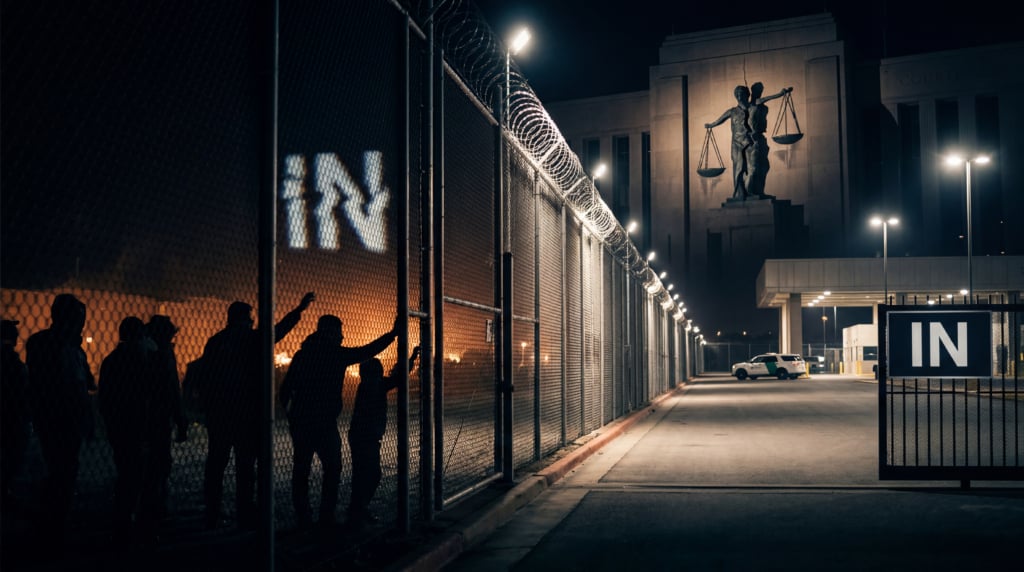
What does “in the United States mean”? Can you be in Mexico and still be considered “in the United States”? Bill Clinton famously tried to defend his lie to a grand jury by arguing about what the definition of “Is” was and now the question of whether millions of illegal aliens can invade America through the southern border hinges on what another two letter word, “In”, means.
The definition of “In” should be simple, but the plain meaning of words is the last thing that activist judges bent on twisting the law for their own political ends have any interest in.
The disastrous Immigration and Nationality Act states that “any alien who is physically present in the United States or who arrives in the United States… may apply for asylum.” Is an alien migrant in Mexico trying to enter the United States physically present in this country? Has he “arrived in” the United States if he doesn’t cross the border? Common sense would say not.
But the majority decision of the 9th Circuit Court of Appeals in Noem v. Al Otro Lado argued that “arrives in the United States” actually “encompasses those stopped at the border, whichever side they are standing on.” Either the definition of the United States encompasses Mexico or the definition of “In” also means “around”, “nearby”, “outside” or in the “very general vicinity”.
However you define it, that means every illegal alien migrant who approaches the border has to be let in and have his or her application for asylum based on whatever nonsense he copied off the internet (crime, climate, boredom) because being in Mexico is like being in America.
As Judge Nelson noted in his dissent, “A person at the border, but on the Mexican side, might be close to the United States. She might have arrived at the United States border. But until she crosses the border, she has not arrived in the United States. This is not just the best reading of the statute; it is the only reading. The majority has not pointed to any example in which ‘arrives in’ means anything besides crossing the border into the destination.”
The brief filed by Sen. Ted Cruz highlights the absurdity of the decision that an “alien stopped on the Mexico side of the U.S.–Mexico border ‘arrives’ in the United States,’ even if he never sets foot ‘in’ the United States.” And furthermore, “if an alien ‘arrives’ when he is still in Mexico, how could the Attorney General ‘return’ that alien to Mexico? He is still in Mexico. He is not being returned anywhere.”
When, like John Lennon, you imagine that there are no nations or borders, the concept of “in” becomes confusing. However, turning to more classic compositions, when Rodgers and Hammerstein wrote, “If you’ll excuse an expression I use/I’m in love, I’m in love, I’m in love, I’m in love”, they meant she was in love, not somewhere adjacent to love. When Ginger Rogers sang, “We’re in the money”, she didn’t mean the money was in a dynamic process of tenses..
The Justice Department’s attorneys have been reduced to asserting that “in” doesn’t mean out.
“A person ‘arrives in’ a country only when he comes within its borders. A person does not ‘arrive in the United States’ if he is stopped in Mexico,” Solicitor General John Sauer had argued during the original case. “You can’t arrive in the United States while you’re still standing in Mexico. That should be the end of this case,” Vivek Suri echoed to the Supreme Court.
But liberal justices set out to argue that arriving “in” something was a dynamic process.
“Someone on a plane arriving to land in LaGuardia may not have put their foot on US land. But they’ve arrived in the United States. They’re arriving. They’re knocking on the door,” Justice Sonia Sotomayor contended in a confused conjecture of unintentionally scattered tenses.
No one had apparently informed the ‘Wise Latina’ of the concept of international airspace.
But Sotomayor’s argument was consistent with the Otro Lado open borders position that arrival was an ongoing process and that the “in” part should be entirely disregarded. Borders are not a firm state of place, but a fluid and nebulous one that can be bum-rushed by foreign bums.
The Otro Lado filing by the open borders group turns entirely metaphysical as it contends that “as the government notes, the verb ‘arrive’ means “to come to the end of a journey, to a destination, or to some definite place but that definition does not identify where the relevant ‘destination’ or ‘definite place’ is… here Congress used the present tense ‘arrives’ rather than the past tense ‘arrived.’ If Congress wanted the law to cover only noncitizens who had arrived, it would have said so instead of using ‘the present progressive tense’” to describe arrival as an ongoing process that only ends when the United States becomes the past progressive tense.
And “in” is out because “”in’ is simply the correct preposition when specifying a geographic area where arrival takes place” because “it would make no sense to say someone arrives ‘at the United States’ or ‘upon the United States.’” Or, you know “near the United States border.”
The more sensible Supreme Court justices however had questions about the meaning of “in”.
“How close do you have to be to the border?” Justice Amy Coney Barrett asked. “What is the magic thing, or the dispositive thing, that we’re looking for where we say, ‘Ah, now that person, we can say, arrives in the United States?’” Chief Justice Roberts asked whether migrants at the back of the line were considered to have arrived in America or just those at the front of the line.
Justice Neil Gorsuch asked if a migrant climbing the border wall had arrived in America. And what about the migrant at the bottom of the border wall. Has he also arrived in America?
“It depends on what the meaning of the word ‘is’ is. If the—if he—if ‘is’ means is and never has been, that is not—that is one thing. If it means there is none, that was a completely true statement,” Bill Clinton had argued. His ideological forbears have now taken to arguing that the meaning of “in” is equally existentially nebulous and heavily dependent on the tension of tenses.
No wonder that there is a crisis of meaning and the language is in deep trouble (by which I mean that the language is currently in deep trouble, not that deep trouble may one day arrive.)
Still there is a wonderful way for any court to clarify the matter of “in”. When a judge proclaims that “court is in session”, she doesn’t mean that the court is approaching the point of being in session as part of a dynamic process of sessioning, but that it is actually in session right now.
America, like the court, should be able to wall off its borders with a clear assertion of “in”. Once we know where “is” is, we’ll be able to protect the inside of that “in” from the outside world.