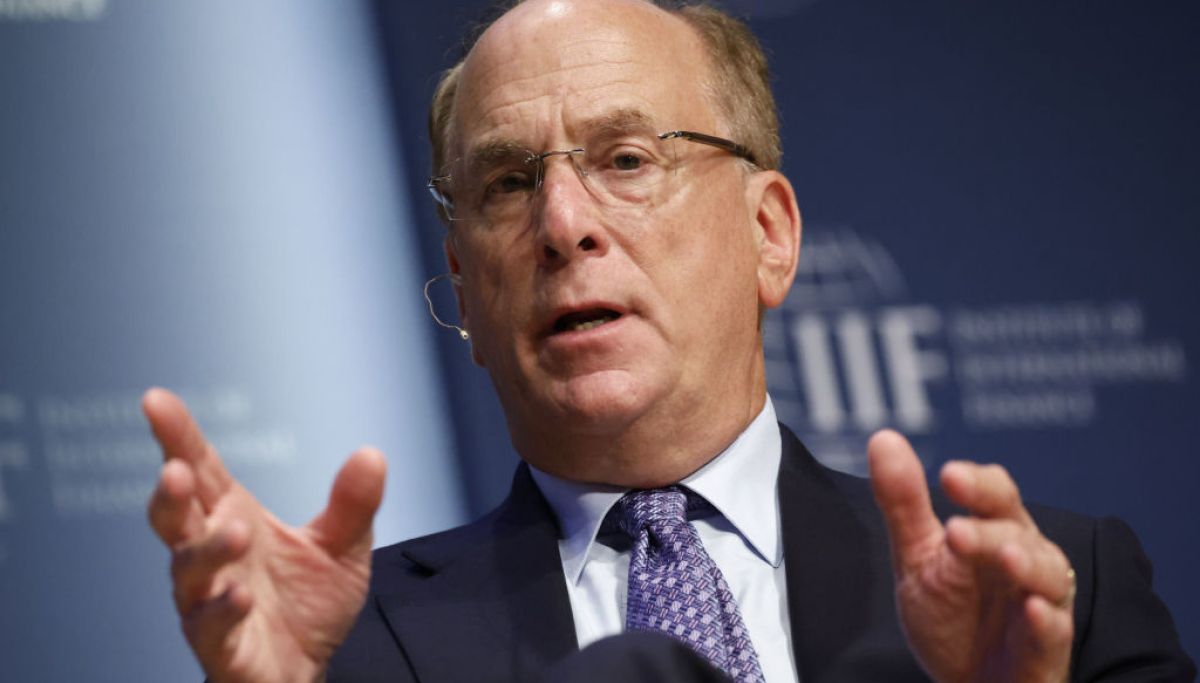
BlackRock CEO Larry Fink warned this week that the war in Iran could result in a global recession due to the pressure the conflict is putting on international energy markets.
Fink, who leads the world’s largest asset manager, said he sees the war ending in one of two “extreme scenarios,” during a BBC interview published Wednesday. One outcome could see Iran again accepted into the international community, with oil prices plunging to record lows. The other could see energy prices driven to historic highs, he mused, noting that “I don’t think anybody knows what the outcome will be.”
“I could paint a scenario where I could see, a year from now, oil at $40 a barrel; I could see it above $150. We have two very extreme outcomes,” Fink said. “Everybody has to recognize that there’s not going to come somewhere in the middle. It’s going to be [one] of two extremes.”
Fink’s comments come as the joint U.S.-Israel war on Tehran has sparked uproar in the Strait of Hormuz, a critical international shipping waterway bordering Iran that connects to the Persian Gulf. Most of the world’s energy supply flows through the strait, but vessels transporting oil have seen an intense backlog in activity since the conflict sparked on Feb. 28, as shipping insurers are hesitant to take on the risk of backing containers looking to make their way through the waterway.
Fink weighed in on the Starit of Hormuz crisis in the interview released Wednesday, saying Iran is a threat to trade in the region.
“Iran remains a threat,” Fink said. “A threat to trade, a threat to the Strait of Hormuz, a threat to the peaceful coexistence of the GCC [Gulf Cooperation Council] region. I would argue that we could have years of above $100 [oil prices], closer to $150, which has profound implications in the economy. The $40 oil implication is one of abundance and growth; the other is an outcome of a probably stark, steep recession. I don’t think anybody knows what the outcome will be.”
HOW DOES ISRAEL FIT IN THE US-IRAN TALKS?
The conflict has sparked the largest disruption to the global energy supply in history. Brent crude, the global oil benchmark, has approached $120 a barrel, marking a roughly 40% surge from pre-war prices. Prices have partially stabilized, with the markets appearing to settle somewhat in reaction to President Donald Trump announcing the U.S. is engaged in negotiations with Iran to draw down the war and resolve tensions in the strait.
“It was made clear to the United States that Iran wanted to talk. President Trump is willing to listen,” White House press secretary Karoline Leavitt said Wednesday. “But if Iran fails to accept the reality of the current moment, if they fail to understand that they have been defeated militarily and will continue to be, President Trump will ensure they are hit harder than they have ever been hit before. President Trump did not bluff, and he is prepared to unleash hell. Iran should not miscalculate again.”