Order Jamie Glazov’s new book, ‘United in Hate: The Left’s Romance with Tyranny, Terror, and Hamas’: HERE.
“Comrades, everything is under control.”
— The Firemen’s Ball (1967), Czech Movie.
In the early hours of March 23 at 2:15 a.m., Turner Classic Movies will broadcast one of the most devastating political satires ever committed to film: The Firemen’s Ball. When Miloš Forman released the film in 1967, it was immediately recognized as something more than comedy. It was a quiet but merciless dissection of bureaucratic incompetence—of institutions that become so absorbed in ceremony, committees, and appearances that they forget their original purpose.
Nearly sixty years later, the film feels less like satire than prophecy. Forman’s story unfolds in a small provincial town where the local fire brigade has decided to host a grand charity ball. The evening is meant to celebrate their civic virtue and honor a retiring fire chief. The hall is decorated. Speeches are prepared. A raffle has been organized to raise money. The town band plays while uniformed officials move through the crowd congratulating one another on their competence and public spirit.
Everything looks orderly, but almost immediately the façade begins to crumble. The raffle prizes—carefully displayed on a table—begin disappearing one by one. Bottles of liquor vanish. Cakes vanish. Gifts vanish. Committee members whisper to each other in confusion while quietly moving the remaining prizes out of sight before the entire table is stripped bare. No one can explain what is happening.
Meanwhile, the fire brigade has also organized a beauty pageant as part of the festivities. The judges argue endlessly over which young woman should be crowned “Miss Firemen’s Ball.” The contestants themselves appear embarrassed by the whole spectacle. Some try to flee backstage to avoid being paraded before the crowd. Officials scramble after them, dragging them awkwardly back under the lights. The scene is excruciatingly funny precisely because it is so painfully recognizable.
Institutions love ceremony. They love speeches, ribbons, official titles, committees, and staged displays of competence. What they do not always love—what they do not always manage particularly well—is the actual work they were created to perform. Then reality intrudes. During the ball, a real fire breaks out in town.
The brigade rushes out with great urgency, only to reveal its complete helplessness. The firefighters cannot stop the blaze. An elderly man’s house burns to the ground while the brigade fumbles with ladders and hoses in the dark.
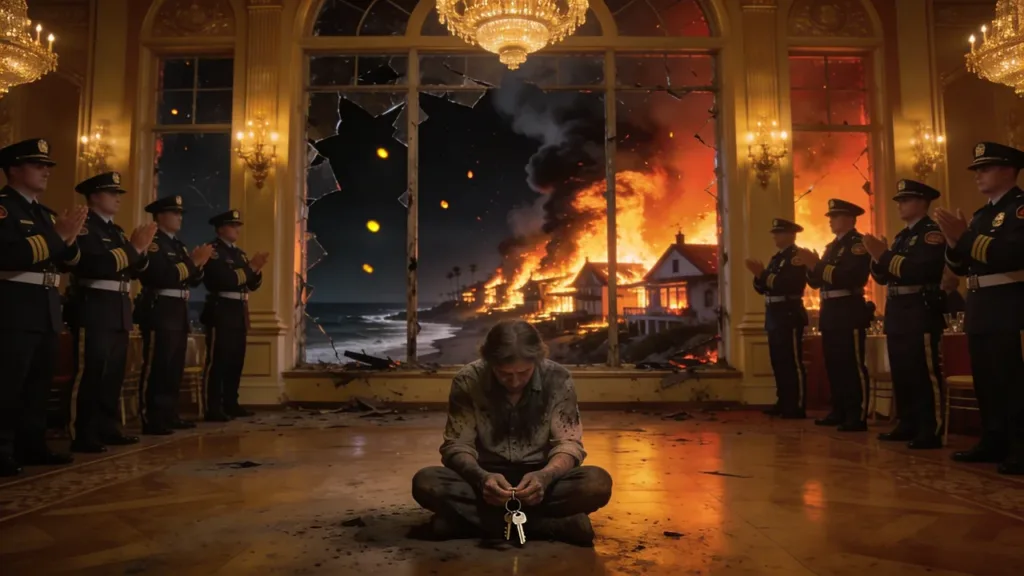
Afterward, the firefighters bring the old man back to the ballroom and seat him awkwardly among the decorations meant to celebrate their success. The band continues to play. Speeches continue. Officials continue congratulating one another. The victim sits quietly at a table while the ceremony goes on around him. If this sounds strangely familiar, it should.
The recent wildfire disaster that devastated neighborhoods in Pacific Palisades and Malibu has produced its own version of Forman’s tragic farce. The fires destroyed homes, businesses, and entire neighborhoods along one of the most beautiful stretches of coastline in the United States. Families were displaced. Communities were reduced to ash. Yet the aftermath has often seemed to follow the script of The Firemen’s Ball with eerie precision.
In the months following the disaster, residents began navigating what many described as an exhausting bureaucratic labyrinth before they could even begin rebuilding their homes. Permits had to be obtained. Environmental reviews conducted. Soil testing completed. Insurance disputes negotiated. Contractors approved. Each step required new forms, new approvals, and new delays. Entire neighborhoods remain empty lots while victims struggle through the slow machinery of government process.
Meanwhile, controversies have emerged over the decisions made during the firefighting effort itself. Firefighters later testified that portions of the burn area were still smoldering when crews were ordered to leave the site, warning that hot debris and embers remained. The claims became serious enough that officials opened investigations into the command decisions that led crews to withdraw from the area. In other words, the people on the ground believed the fire was not yet fully extinguished, and yet the order came to pack up and leave.
Questions have also been raised about the leadership culture within the Los Angeles Fire Department, where critics argue that administrative priorities in recent years have sometimes appeared more focused on internal policy initiatives and public messaging than on the unglamorous fundamentals of disaster preparedness. Whether those criticisms are entirely fair or not, the perception among many residents is that the system meant to protect them has become entangled in bureaucracy and political signaling at the very moment it is most needed.
Leadership during the crisis also became a subject of political controversy. Karen Bass happened to be in Ghana as part of a diplomatic delegation when the fires erupted, returning to Los Angeles as the disaster escalated. Critics quickly pointed out that during her campaign she had suggested she would avoid international travel while serving as mayor. The optics were striking.
While entire neighborhoods in Los Angeles burned, the city’s mayor was halfway around the world. But perhaps the most surreal episode came in the form of a star-studded charity spectacle known as “FireAid Benefit Concert.” The event reportedly raised roughly $100 million for wildfire relief. Celebrities appeared. Musicians performed. Cameras flashed while audiences applauded the generosity of those involved.
Many victims of the fire’s devastating impact later reported that they had received little or no direct assistance from the funds raised in their name. Investigations revealed that much of the money was distributed through nonprofit organizations and grant programs rather than direct payments to fire victims themselves. The result left many residents bewildered. Millions raised in their name, and yet they still faced the slow bureaucratic ordeal of rebuilding largely on their own. One could almost imagine the scene unfolding inside Forman’s ballroom: the raffle prizes disappearing quietly while officials continue the festivities.
In recent years critics have also questioned whether the leadership culture within the Los Angeles Fire Department has drifted toward administrative priorities and political messaging rather than the quiet, unglamorous work of disaster preparedness. Large institutions often develop this tendency over time: committees expand, initiatives multiply, and public messaging becomes increasingly elaborate. Yet the essential mission remains unchanged—to respond quickly and effectively when disaster strikes.
It is precisely this gap between institutional presentation and operational performance that Miloš Forman captured so perfectly in The Firemen’s Ball. The officials in the film are not wicked men; they are simply so absorbed in organizing ceremonies, speeches, and spectacles that they forget the simple purpose of a fire brigade: to put out fires.
What makes The Firemen’s Ball so enduring is not that it mocks individuals. The firefighters in the film are not villains. They are ordinary people trapped within a system that rewards ceremony over competence, procedure over action, and appearances over results. The satire lands because it exposes something universal about bureaucratic institutions that become obsessed with looking effective.
Press conferences are held. Task forces are announced. Charity concerts are organized. Committees gather around conference tables to demonstrate that something—anything—is being done, but when the moment arrives that truly tests the system, the machinery of bureaucracy often proves slow, confused, and strangely disconnected from the human reality unfolding outside the conference room.
Forman understood this perfectly when he made his film in Communist Czechoslovakia. The authorities there quickly recognized themselves in the satire and banned the film shortly after its release. The reason was obvious.
The Firemen’s Ball was not merely a joke about firefighters; it was a mirror held up to every bureaucratic system that mistakes ceremony for competence, and that mirror remains uncomfortably clear today.
In the final scene of the film, the elderly man whose house has burned down sits quietly in the ballroom while the decorations celebrating the fire brigade still hang from the ceiling. The band plays softly. The officials continue their speeches.
The tragedy of the film is not simply that the firefighters failed to stop the fire. It is that the ceremony continues as though nothing has happened. Sometimes satire does not exaggerate reality, it merely describes it.
And along the Pacific shore, the waves lap quietly against the sand where magnificent homes once stood, as the ceremony continues.