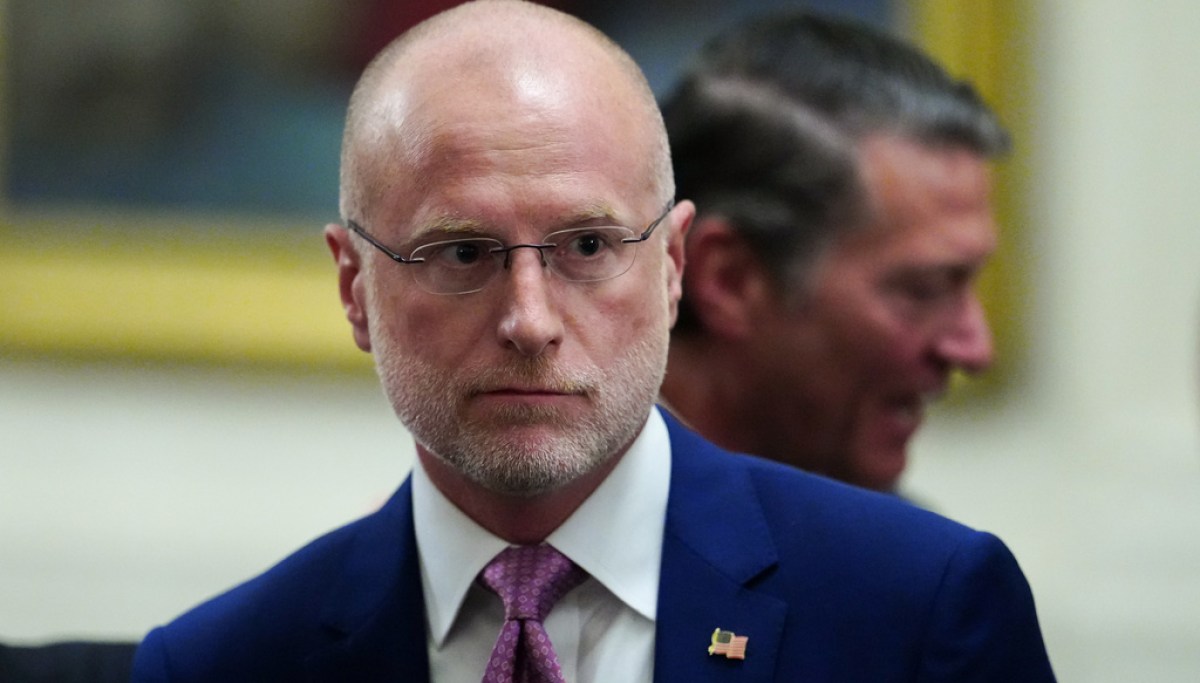
Republicans are increasingly pointing fingers at FCC Commissioner Brendan Carr as an unlikely factor reshaping the Texas Senate race, warning his aggressive posture toward broadcasters may have backfired and put a once-reliable GOP seat into play.
What party operatives once saw as a favorable matchup, with many privately viewing Rep. Jasmine Crockett (D-TX) as the easier general election Democratic opponent, has been upended by a chain reaction tied to Carr’s clashes with media outlets. That sequence culminated in a viral moment that appears to have helped Rep. James Talarico (D-TX) win the primary.
Now, with new polling showing Talarico narrowly leading both Sen. John Cornyn (R-TX) and Texas Attorney General Ken Paxton, who are headed to a Republican runoff, Republicans are voicing concern that the episode has complicated the party’s path forward in a state they typically count as a safe hold.
One Texas-based Republican strategist warned that Carr’s approach risks backfiring beyond the party’s base, particularly with independent voters wary of government overreach.
“I think there’s a real deep risk,” the strategist said, speaking on condition of anonymity to discuss party dynamics.
At the center of the shift was a late-night interview that never aired.
Talarico taped an appearance with Stephen Colbert during the Democratic primary, but the segment was pulled from television amid concerns inside the network about potential FCC scrutiny. Instead, the interview was posted online, where it quickly went viral, drawing millions of views and generating more than $2.5 million in donations within 24 hours.
The moment, now widely referred to as the “Colbert bump,” became a turning point in the race. For some Republicans, the effects were immediate and measurable.
“It’s like a very clear red pen moment,” a Republican strategist with experience in Senate and House races said, speaking on the condition of anonymity to discuss the race candidly. “You can see the shift right after that interview didn’t air but went viral.”
That shift is reflected in the polling. RealClearPolitics averages show Talarico surging in the days following the interview, flipping from a deficit against Crockett in mid-February to a clear lead by the end of the month.
The tightening contest is also showing up in general election data.
Recent polling shows Talarico with a narrow edge over both potential Republican nominees. An Impact Research survey, conducted March 12–17, found Talarico leading Cornyn by 2 points, 43% to 41%, and edging Paxton by 1 point, 44% to 43%. A separate Public Policy Polling survey from early March showed similar margins, with Talarico ahead of Paxton by 2 points and Cornyn by 1.
The numbers mark a striking shift from earlier expectations that Republicans would enter the general election with a clear advantage.
The same Texas-focused strategist said the controversy may have altered the outcome of the primary, arguing Crockett likely would have won absent the surge in attention around Talarico, who Republicans viewed as a stronger general election opponent.
“I think she would have won if we didn’t do this to ourselves,” the strategist said. “We’d be looking at a very different election in November.”
The National Republican Senatorial Committee, for its part, is not embracing that argument.
“Who would have thought Jasmine Crockett was the moderate in this primary?” said NRSC Regional press secretary Samantha Cantrell. “Thanks in part to Stephen Colbert, Texas Democrats now have the most radical candidate they have ever had in ‘God is nonbinary,’ meat-hating James Talarico.”
Other Republicans, however, have pointed more directly to the sequence of events surrounding Carr and the Colbert interview as a contributing factor.
GOP strategist Brad Todd suggested the moment may not have been accidental, floating the possibility that it ultimately worked to Talarico’s advantage by elevating him over a weaker opponent.
“Colbert used Carr as a prop to hoist Talarico at the expense of Jasmine Crockett,” Todd wrote on X.
Apart from potentially boosting Talarico, there are also concerns about the precedent Carr set.
“Trying to clamp down on a particular host or candidate could draw considerably more attention to that individual and end up amplifying their message,” said Brandon Arnold, executive vice president of the National Taxpayers Union, in a statement to the Washington Examiner. “The FCC should tread very carefully here going forward.”
The FCC did not respond to a request for comment.
Gregg Nunziata, a longtime conservative legal strategist, framed the episode as a departure from traditional Republican principles on free speech and limited government.
“He had a choice: to support the principles he once avowed … or to serve a powerful master and lead an assault on American liberties,” Nunziata said. “He chose the latter path.”
Trump has not yet weighed in on the runoff between Cornyn and Paxton, leaving open questions about how the party will approach the race as it heads toward the general election.
Some Republicans say the contest has become more competitive than initially expected, particularly as Democrats rally behind Talarico following his primary victory.
How the party navigates the runoff, and whether the dynamics that reshaped the Democratic primary carry into the general election, could determine whether a race once seen as safely Republican remains that way.
FCC CHAIR’S BROADCAST LICENSE WARNING SPARKS GOP CONCERN AHEAD OF MIDTERM ELECTIONS
For some Republicans, the lesson is less about any one race and more about how the party approaches media battles moving forward.
“Trying to censor or limit those moments can actually work against us,” the national GOP strategist said. “Using regulatory pressure on the media is not helpful.”