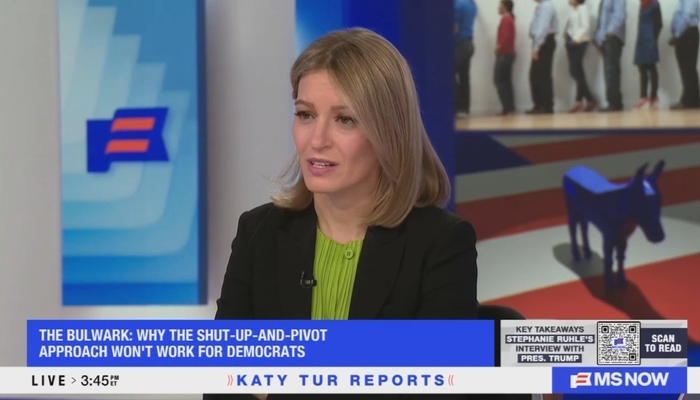
On her eponymous MS NOW show on Friday afternoon, host Katy Tur fretted that Republicans are sometimes “mean” and “demonize” transgenders as she hosted a discussion of how Democrats should respond to culture war issues to avoid electoral losses.
She went on to claim that “it’s hurting everybody” when Democrats lose because of such issues. The MS NOW host introduced the segment:
Here’s a question: Why do Republicans do so well with identity politics, be it attacking antiwar activists, feminists, socialists, transgender people, drag queens, social justice warriors — and if you were watching yesterday, vegans? Over the decades, political pundits have all circled the same thesis that working and middle class Americans run toward the right when culture and identity enter the conversation, and that Democrats should focus on kitchen tables instead of following them in that direction. Only identity politics aren’t up for negotiation for a lot of Americans.
After bringing aboard MS NOW contributor Molly Jong-Fast and the Bulwark’s Lauren Egan, Tur turned to Egan and posed: “So is it a good idea to run away from these culture war issues? Do — do voters really take kitchen table issues, pocketbook issues, and value them more than culture issues?”
As she followed up, Tur suggested that Republicans are “screwing up” economic issues:
Is it true that that voters want to relate to somebody — they want to feel like that person knows them? And if they’re — if they’re so far away from where — how they feel about cultural issues, be it any of the stuff that I just talked about, that they’re not going to trust them on the pocketbook stuff, even if the other side, the one that they feel more closely related to on culture, is screwing up their pocketbooks?
After Egan argued that it’s not a good idea for Democrats to try to ignore cultural issues, Tur lamented:
Yeah. And some of these issues, though — what makes it hard, Molly, is that some of these issues are super sensitive and unfair. I mean, the way that Republicans targeted — target transgender people is — is mean and it’s not fair. And it’s such a small sliver of the population to demonize and to attack their kids and their other — it’s just — it’s mean. And I understand the Democratic impulse to not want to buy into that, that cruelty, but it’s also hurting them electorally, and then it’s hurting everybody more broadly when — when the Democrats keep losing on those issues.
Tur defending transgenderism is particularly noteworthy given that her father is transgender, and she is estranged from him. According to the New York Post:
MSNBC anchor Katy Tur said she was “puzzled” when her now-estranged father — legendary journalist Bob Tur — told her he was transitioning to become a woman.
“My dad said, ”I am a woman’,” Katy Tur told CBS Sunday Morning, as she recounted their conversation from nearly a decade ago while promoting her upcoming memoir, “Rough Draft.”
A bit later, the article recalls: “The 2013 phone call would be the last time Tur talked to her dad, who has never met the two children she has with CBS News star Tony Dokoupil.”
Transcript follows:
MS NOW’s Katy Tur Reports
March 20, 2026
3:42 p.m.
KATY TUR: Here’s a question: Why do Republicans do so well with identity politics, be it attacking antiwar activists, feminists, socialists, transgender people, drag queens, social justice warriors — and if you were watching yesterday, vegans? Over the decades, political pundits have all circled the same thesis that working and middle class Americans run toward the right when culture and identity enter the conversation, and that Democrats should focus on kitchen tables instead of following them in that direction.
Only identity politics aren’t up for negotiation for a lot of Americans. So is rejecting culture altogether the culture wars really the right — the right call? … So is it a good idea to run away from these culture war issues? Do — do voters really take kitchen table issues, pocketbook issues, and value them more than culture issues?
(…)
Is it true that voters want to relate to somebody — they want to feel like that person knows them? And if they’re — if they’re so far away from where — how they feel about cultural issues, be it any of the stuff that I just talked about, that they’re not going to trust them on the pocketbook stuff, even if the other side, the one that they feel more closely related to on culture, is screwing up their pocketbooks?
LAUREN EGAN, THE BULWARK: Yeah, that’s what I hear from people all the time, that if we want voters to hear our economic message, if we as a Democratic party, if we want our candidates to break through, then we have to make sure that the first thing that voters aren’t hearing is all this noise about cultural issues that we know Republicans will push. I think one of the big lessons coming out of the 2024 campaign was we all remember that “they-them” ad that the Trump and Republicans put out, and the Harris campaign decided to not really engage with that, and to not really explain where she stood on that.
And that allowed Republicans to paint her as this extreme candidate. So while you might hope that voters are going to vote just on pocketbook issues, we know from past experience that that is not always the case, that this is a strategy Republicans will continuously employ. And you got to let voters know where you stand on some of these positions. And running away from it is not always the right answer.
TUR: Yeah. And some of these issues, though — what makes it hard, Molly, is that some of these issues are super sensitive and unfair. I mean, the way that Republicans targeted — target transgender people is — is mean and it’s not fair. And it’s such a small sliver of the population to demonize and to attack their kids and their other — it’s just — it’s mean. And I understand the Democratic impulse to not want to buy into that, that cruelty, but it’s also hurting them electorally, and then it’s hurting everybody more broadly when — when the Democrats keep losing on those issues.
JONG-FAST: I mean, this is like one of these theoretical questions which we can have, I think, like you see it much more in the primary contest, in the Democratic primaries and the presidential primaries than you do necessarily, like in the ’25 cycle. If you look at that, at those gubernatorial races, you had these pretty centrist women. They sort of answered what they wanted to. You know, part of what — if you look at — if you look at Trump and how he ran in ’24, one of the things he did was he sort of never really let you know where he stood on things. And that worked for him. So I don’t know that necessarily being like pinned down — like some of the worst —
TUR: But Trump — but Trump is an exceptional case.
JONG-FAST: Right. For sure. But some of the worst moments in Democratic primaries have been when they’ve asked candidates to raise their hands because the truth is a lot of this stuff is nuanced.
TUR: Yeah. And that’s, I think, a good point, Lauren. What Donald Trump was able to do was he, you know, he blanketed podcasts. We’re seeing more Democrats do this as well. And in these spaces, you’re going to think more freely. You’re going to generally speak more freely because the interviews are so extended. It’s hard to stick to talking points throughout it. Is it a better idea for them to be just much looser and to potentially stumble into something that is not perfectly said, that might anger, you know, X group or Y group or, or potentially become a bad ad for them. Is it just better to be more authentic all the time with voters?