WITH MIDTERM ELECTIONS ON WAY AND TRUMP AS COMMANDER-IN-CHIEF, VANCE TOUTS ECONOMY AND ASSURES VOTERS WAR WON’T LAST LONG. According to the RealClearPolitics average of polls, President Donald Trump’s overall job approval rating is 41.8% approve and 55.7% disapprove. That is known in the politics business as being 13.9 points underwater. That gap — a disapproval rating that is 13.9 points higher than the approval rating — is the largest of Trump’s second term so far. Nobody would say that’s a good thing.
On the other hand, being underwater is nothing new for Trump. He has proven himself quite able to govern with an approval rating in the low 40s.
But on the other other hand, a president’s job approval rating is a major factor in the outcome of midterm elections, and this year’s voting is less than eight months away. And on the specific issue most important to midterm voters — the economy — Trump is in particularly bad shape, with an approval rating of 39.1% versus a disapproval rating of 57.7% in the RealClearPolitics average. That is 18.6 points underwater, and it is especially alarming for Trump since voters remain deeply concerned about inflation, with many feeling the president has not devoted sufficient time and effort to bringing down the cost of living.
In fact, the RCP average also measures Trump job approval specifically on the issue of inflation, and his approval is 36.0% and his disapproval is 61.1% — a whopping 25.1 points underwater.
On the issue of the moment, Gulf War III, the U.S.-Israeli war in Iran, Trump is actually in better shape. His approval rating on the war, again according to the RCP average, is 43.3%, with 48.7% disapproval. That 5.4-point underwater spread is pretty good for Trump, given that his overall job approval rating has been underwater since early in his second term.
So it seems likely that Trump’s midterm calculation today, even after his decision to start a new Gulf War, is still dependent on the economy. The contrast that creates — the life-and-death issue of the war and the fundamental standard-of-living issue of the economy — came into particularly sharp focus this week.
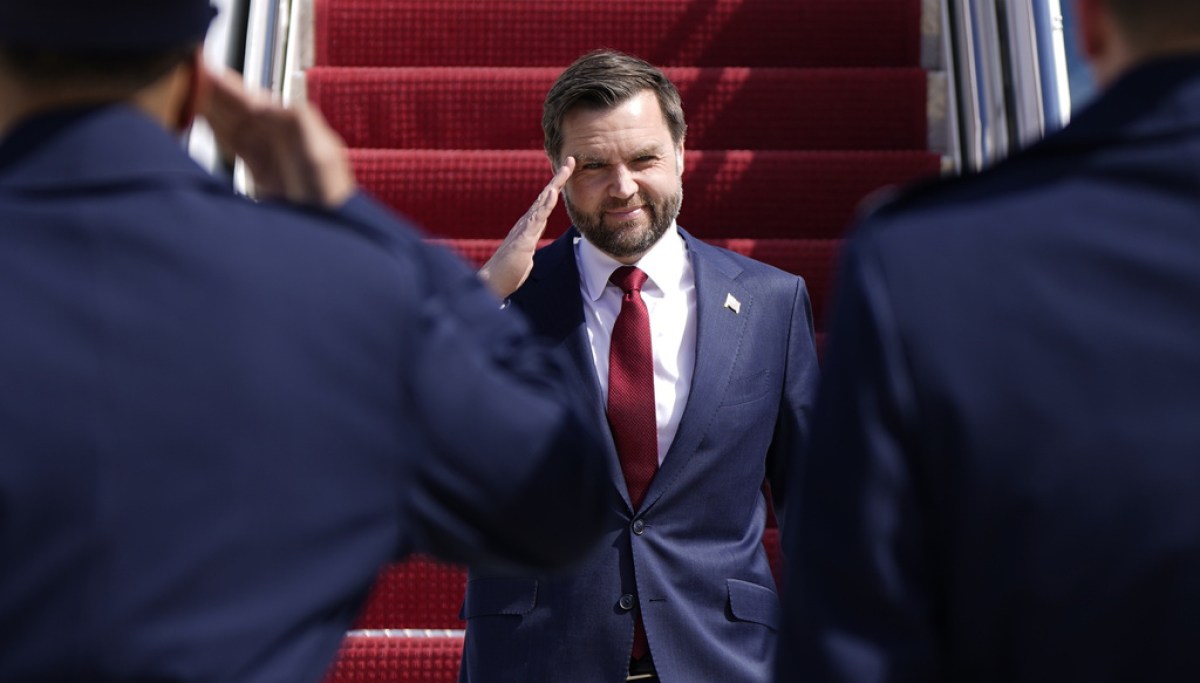
On Wednesday, Trump was busy with the most solemn of wartime duties, traveling to Delaware to attend the dignified transfer of the remains of six crew members killed when an Air Force refueling plane crashed last week in Iraq. Also on Wednesday, Vice President JD Vance visited a manufacturing plant in Auburn Hills, Michigan, to talk about the economy.
The short version of the day was: Trump fulfilled his role as commander in chief, while Vance touted the economy and assured voters the war won’t last long. That is the administration’s current midterm message.
Vance began with a small bow to working-class Republicans, the heart of the party in the Trump era. “So many of you are the very people who work with your hands, who work with your minds, and you keep this great American renaissance in manufacturing going,” Vance said, adding that “we added over 2,000 manufacturing jobs in this state since Donald Trump became president.”
Vance also praised a nearby robotics company as part of the “synergy” of the Trump economy. He devoted a good bit of his talk to the auto industry — “Last year, new U.S. vehicle sales rose by 2.4 percent, which is the biggest jump in American-made automobiles since 2019, the last time Donald J. Trump was president.” He praised Trump-Republican tax cuts and also the president’s historic success in stopping the flow of illegal immigrants across the U.S.-Mexico border.
But the war and related issues still touched on Vance’s remarks. First, he expressed concern and support for the people of Temple Israel in nearby West Bloomfield Township. On March 12, an immigrant from Lebanon, whose brother, a Hezbollah commander, and other family members were killed by an Israeli airstrike, rammed the synagogue with a truck stuffed with fireworks and containers of gasoline, hoping to set off a conflagration with 140 schoolchildren inside. “This particular incident happened to Jewish members of our American family,” Vance said, “and it is something that all of us have to stand up and say it’s disgusting, it’s unacceptable, and we’re not going to tolerate it in the United States of America.”
Vance also had to assure the audience that the U.S.-Israeli attack on Iran would not lead to the “forever wars” that he and Trump campaigned against. “Nobody likes war, right?” Vance said. “And I guarantee you the president of the United States is not interested in getting us in the kind of long-term quagmires that we’ve seen in years past.”
Vance also stressed to voters that war-related rising energy costs would not rise for long. “Look, gas prices are up, and we know they’re up and we know that people are hurting because of it, and we’re doing everything that we can to ensure that they stay lower,” Vance said. “I will say, the president said this, and I certainly agree with it: This is a temporary blip.”
The administration has to hope so. Trump has essentially declared victory a number of times in the three-week conflict. Friday on Truth Social, he wrote, “We are getting very close to meeting our objectives as we consider winding down our great military efforts in the Middle East with respect to the terrorist regime of Iran.”
It is not clear when that will actually happen. But until then, there is no doubt it is keeping the president from fully focusing on the issue likely to be the most important in the midterm elections. And in the president’s place, it falls to the vice president to carry on the campaign on the economy and promise that the war won’t last long.