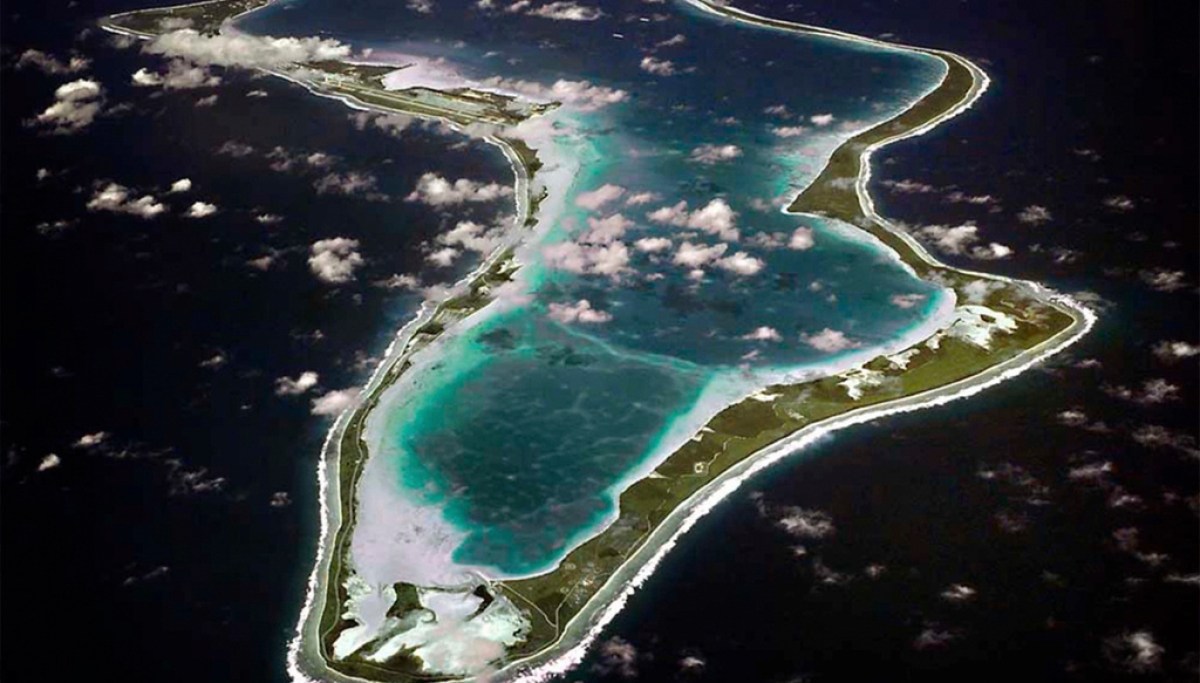
Iran launched two missiles at the United Kingdom‘s base in Diego Garcia, missing but exposing greater missile capabilities than previously known.
After the U.K. announced it would allow the U.S. to use its bases for defensive strikes against Iran, Tehran launched two intermediate-range ballistic missiles at Diego Garcia in the Indian Ocean, over 2,000 miles away, U.S. officials told the Wall Street Journal. Both missiles missed, with one failing and landing in the sea and a U.S. Navy warship firing an SM-3 interceptor at the other, though it’s not known if the interceptor made contact.
The missile launches, though unsuccessful, are hugely significant, likely changing many countries’ calculus regarding Tehran.
IRAN THREATENS UK BASES AFTER LONDON ALLOWS US USE FOR STRIKES
For one, the launches exposed Tehran in a lie — just last month, Iranian Foreign Minister Abbas Araghchi claimed that Iran had “deliberately limited” its missile range to just “2,000 kilometers,” or roughly 1,200 miles. Many experts speaking before the war had dismissed President Donald Trump’s claims that Tehran was close to developing such a weapon.
The new range puts nearly all of Europe within Iran’s missile range, and could change NATO countries’ calculus on whether to combat Iran.
Iran targeted the Indian Ocean island after the U.K. shifted its position on the use of its bases by the U.S. for strikes against Iran, allowing its usage for the striking of Iranian military assets targeting the Strait of Hormuz. Araghchi quickly warned that Iran could strike U.K. bases in response, but the main bases of interest in Diego Garcia and the U.K. proper were considered far out of range of Iran’s most advanced missiles.
The missile launches are likely to exert considerable pressure on Europe to begin devoting forces to reopen the Strait of Hormuz and bring Tehran to heel.
Trump’s effort to draw more countries into contributing to efforts to reopen the Strait of Hormuz has begun gaining traction in recent days. On Thursday, the United Kingdom, France, Germany, Japan, Italy, and the Netherlands voiced their joint readiness to contribute to efforts to reopen the Strait of Hormuz. The following day, another 14 countries signed on to the joint statement.
UK, FRANCE, JAPAN, GERMANY, AND OTHERS VOICE READINESS TO CONTRIBUTE TO SECURE STRAIT OF HORMUZ
“We express our readiness to contribute to appropriate efforts to ensure safe passage through the Strait. We welcome the commitment of nations who are engaging in preparatory planning,” the statement said.
Europe has been particularly affected by Iran’s blockade of the Strait of Hormuz due to its increasing reliance on liquefied natural gas from Qatar. It leaned heavily into this supply after Russia’s invasion of Ukraine, hoping to reduce its reliance on Russian energy imports. Iranian missile and drone attacks have wiped out nearly one-fifth of Qatar’s LNG production and left the rest unable to be exported.