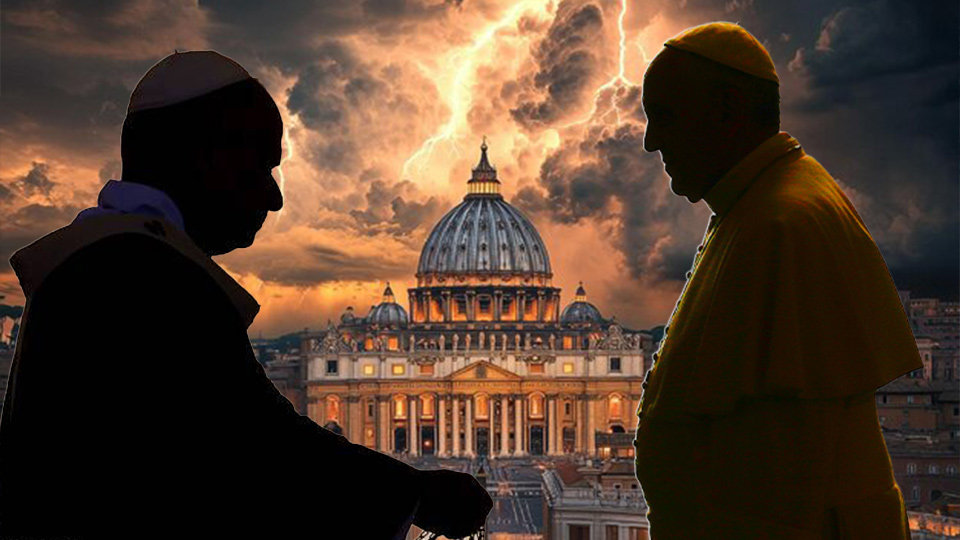
Leo XIV is not launching a post‑Bergoglian restoration, but rather a reorganization of the Curia grounded in cohesion — inclusive and structural — rather than doctrinal unity. Through appointments, decisions, and ecclesiological orientations, a substantial continuity with Francis emerges in terms of objectives, even if the methods differ, opening scenarios of profound transformation without any return to the Wojtyła–Ratzinger model.
In recent weeks, several important appointments have been interpreted by various analysts, Italian and otherwise, as a sign of a cautious reform of the Curia by Pope Leo XIV. The Augustinian Pope is said to be aware of the serious problems caused by the previous Pontificate and to be seeking to restore, very gradually but inexorably, the pre-Bergoglian status quo: this is what a certain narrative tells us. But is this really the case?
It has now been about ten months since May 8, 2025, which saw the little-known Robert Francis Prevost exalted to the Throne of Saint Peter with the name Leo XIV. Although we cannot, for obvious reasons, know the internal forum of the Pontiff, we can nevertheless take a look at what has happened so far in order to attempt to develop an “overall view” useful not only for understanding what is happening today in the Vatican, but also for outlining some scenarios of what will occur in the coming months and years.
Cohesion does not mean unity—it means holding together what may no longer be compatible. In the coming months, therefore, we will see further progress in the modification of the structure of governance of the Catholic Church.
The Pope of cohesion is not the Pope of unity
This analysis must begin from a premise reiterated several times: the entire agenda of Pope Leo XIV assumes as its supreme value and final objective the cohesion of the Church. This is well expressed by his episcopal motto, In illo uno unum (“In the one Christ we are one”).
However, it is essential to clarify that cohesion does not mean unity in the traditional theological sense.
- Unity, as a theological note of the Church, is founded on the unity of Catholic doctrine and is therefore exclusive: it cannot include those who do not accept to profess that doctrine in its entirety.
- Cohesion, on the other hand, is inclusive: it aims to maintain within the Church sensibilities and theological orientations that are even mutually irreconcilable or logically incompatible.
This vision is the key to understanding the Prevostian reinterpretation of synodality. No longer as the democracy of “base communities,” that is, the Latin American model carried forward by Bergoglio; nor as a qualitative equalization between laity and bishops, with the quantitative predominance of the former, that is, the German model; but as the structured participation of bishops and cardinals in the life of the Church, with the Pope in the role of arbiter and spokesperson of something akin to an ecclesiastical Parliament. One might say that the cardinals represent the Upper House and the episcopal conferences the Lower House. A sort of Anglicanization of the Catholic Church.
In this perspective, the role of the laity in synodality according to Prevost is not so much to determine doctrinal or disciplinary direction, except in an auxiliary manner, but to cooperate so that what the “Parliament of the Church”—that is, the College—establishes becomes effective in ecclesial life. In my view, these intentions will become even more evident in the coming years, unless factors intervene to interrupt or modify the process.
Many confirmations, however, are already accumulating in these days, beginning with the announcement of March 19, 2026 by Pope Leo, who convened, for next October, a meeting with “the presidents of the Episcopal Conferences from around the world, in an effort to proceed, in mutual listening, to a synodal discernment on the steps to be taken in order to proclaim the Gospel to families today, in light of Amoris Laetitia and taking into account what is currently being done in the local Churches.”
Cohesion aims to maintain within the Church sensibilities and theological orientations that are even mutually irreconcilable or logically incompatible.
A cohesion threatened on at least three fronts
The pursuit of cohesion at all costs naturally leads toward a very strong ecumenism, sometimes to the point of bordering on syncretism. However, this approach clashes with three major tensions—real or perceived—that today test even the formal unity of the Church.
- German Synodal Way, now led by Bishop Heiner Wilmer—a figure with at times “mystical” tones but certainly heterodox—is awaiting the judgment of the Holy See on the statutes approved in November 2025 by the ZdK and in February 2026 by the German Episcopal Conference. These are texts incompatible with canon law, and it is unlikely that the progressive and majority wing of the German episcopate will accept without resistance a possible rejection by Rome. And in Rome, of course, they are perfectly aware of this.
- Catholic Church in China. The secret agreements between the Holy See and the Chinese government—already renewed—will expire in 2028. Their management is extremely delicate, because it touches on the relationship between Rome and an ecclesial community divided between fidelity to the Pope and state control. The terms are now an open secret: the communist regime proposes the candidates and the Vatican retains the right of veto, with the commitment not to comment on any Chinese activity.
- Society of Saint Pius X. In July 2026, the Society will ordain five new bishops, an act that will likely reopen historical tensions and further complicate the dialogue—pretending that there has ever been one—with Rome. The so-called Holy See, today always zealous against defenders of Catholic Tradition, has threatened sanctions against the Society, the validity of which is doubted even by many laypeople and prelates who are not part of the Society (including myself: see this more in-depth analysis).
The appointments that would prove Leo XIV’s “reforming will”
In light of all this, in recent months a narrative has been constructed in Catholic-conservative circles according to which Pope Leo XIV would be aware of the problems of the Curia and would be working to remedy them all. If this reading could express cautious optimism in the very first months, today it risks appearing more like culpable naivety.
Let us begin, therefore, with the appointments of Pope Leo in support of this reading. On September 26, 2025, Pope Leo XIV appointed Bishop Filippo Iannone O.Carm. as the new Prefect for Bishops, disproving predictions that saw Tagle as the natural successor of Prevost himself to the most crucial body of the Curia, after the Secretariat of State and the Dicastery for the Doctrine of the Faith. Iannone, a canonist like the Pope, appears to be rather conservative in orientation.
Between extremes we find personalities—appointed or promoted—whom it is an understatement to call problematic, including Ronald A. Hicks (New York, USA), chosen because he is a supporter of the so-called “consistent ethic of life,” a heterodox bioethical vision widespread in progressive Catholic circles in the United States and supported by Leo XIV himself.
Then we witnessed the appointments of the personal secretaries. The Peruvian Edgard Iván Rimaycuna Inga, a loyalist of the Pope, was joined on September 27, 2025 by the Italian priest Marco Billeri, while the Argentine Daniel Pellizzon was progressively removed. Pellizzon had arrived in Rome as a personal secretary of Francis, also thanks to the operational collaboration he had long maintained with Cardinal Fernández.
There has also been news—still not officialized—of the choice of the new Prefect of the Pontifical Household, after years of vacancy following the masked exile imposed by Francis on Georg Gänswein. The decision would have fallen on the current nuncio for Italy and San Marino, Petar Rajič, who would be replaced by the controversial Edgar Peña Parra, currently Substitute of the Secretariat of State. Sources spoke of an agreement with the Italian State last March 5, but to date no formalization. This possible exchange of roles has also been interpreted as an attempt to restore the institutional arrangement to a balance prior to the Bergoglian era. However, it must be remembered that, on November 10, 2025, Pope Leo had already chosen the vice-regent of the Pontifical Household, the Augustinian Edward Daniang Daleng.
Finally, last March 12, the trusted collaborator of Francis, the Polish cardinal Konrad Krajewski, already Papal Almoner, was sent back to his homeland and, in his place, another Augustinian was appointed, the Spanish bishop Luis Marín de San Martín.
Are these appointments sufficient to speak of a reforming will?
On closer analysis, it would seem not. As regards Iannone, he was likely chosen for his experience with the German front. The bulk of appointments is, in reality, still in the hands of the Secretariat of State and the Secretary for Bishops Ilson Jesùs de Montanari, who sets a fully Bergoglian line on episcopal appointments. This is evidenced by the fact that Pope Leo XIV confirmed, last February 14, all the members of the Dicastery for Bishops of Bergoglian orientation, even adding one in this sense. A move that is at the very least strange for someone with reforming intentions.
Not to mention the bishops who, in recent months, continue to be appointed throughout the world—even in very important sees—and who more or less always present the same pattern: supporters of theological feminism and supporters of ecumenism pushed to the point of syncretism.
Obviously, there is a gradation of this pattern in the figures appointed, but it does not go beyond this pattern: one ranges from the extreme Joseph Grunwidl (Vienna, Austria), a probable future cardinal open also to “female cardinals,” to Filippo Iannone himself, more moderate, but who nevertheless recently criticized “resistance to synodality” insofar as it would denote a “lack of conversion.”
A change is indeed underway, but not necessarily a reform or revolution: it may be neutral; reorganization in continuity with the previous arrangement (Francis).
Between these extremes we find personalities—appointed or promoted—whom it is an understatement to call problematic: Sithembele Anton Sipuka (Cape Town, South Africa), Cyril Villareal (Kalibo, Philippines), Stanislav Přibyl (Prague, Czech Republic), Agnelo Jacinto Pinheiro (Sindhudurg, India), Francesco Antonio Soddu (Cagliari, Italy), José Antonio Satué (Malaga, Spain), not to mention Ronald A. Hicks (New York, USA), presented in the media as moderate or even conservative, but in reality chosen even because he is a supporter of the so-called “consistent ethic of life,” a heterodox bioethical vision widespread in progressive Catholic circles in the United States and supported by Leo XIV himself.
To all this must be added a very eloquent appointment such as that made last January 22, of Carlo M. Redaelli as the new Prefect of the Dicastery for the Clergy, a canonist like Prevost, but certainly not aligned with Tradition and the orthodoxy of the Church.
Even the enthusiasm for Krajewski’s repatriation is easily dampened by the observation that the newcomer Luis Marín de San Martín was the Number 2 of the ultra-Bergoglian cardinal Mario Grech within the General Secretariat of the Synod, and has already emphasized how the Church must absolutely not look to the past because “renewal is not restoration.”
Reform or reorganization?
As for the removal (confirmed only unofficially) of the controversial Peña Parra, it must not necessarily be interpreted as a will to reform the Secretariat of State, but can be read in continuity with the choices made regarding the personal secretaries.
According to the curial organizational chart, in fact, the Pontifical Household is the office that deals with directly serving the person of the Pope according to two dimensions. As sovereign of the Vatican City State, he is served by the Pontifical Family; as spiritual head of the Catholic Church, he is served by the Pontifical Chapel.
The members of the Pontifical Family organize the Pontiff’s audiences, both public and private, manage the various antechamber services, the agenda of meetings, archive confidential documents, and so on. These are, obviously, very delicate roles. The Vatileaks experience has shown how poor management of this office can jeopardize the reputation of the Pope and the security of sensitive data circulating within the Holy See.
Now, the Substitute of the Secretariat of State does not assume an important role only within the Secretariat of State, but is the most important figure precisely within the Pontifical Family. The removal of Peña Parra can therefore be read as an attempt to reorganize the Pontifical Family, that is, that restricted group which has direct access to the most private life of the Pope. If the objective had simply been to remove him from an influence deemed negative within the Secretariat of State, the choice to assign him to the nunciature in Italy would have been ineffective: the seat is in Rome and this would still allow him to maintain weight in Vatican balances, especially considering that the role of nuncio in Italy is almost entirely formal. This transfer, on the other hand, would make it much more difficult for Peña Parra to access what is exclusive to the Pontifical Family.
Moreover, alongside the rumoured removal of Peña Parra, one must also note the certain removal of a figure close to the world of liturgical Tradition from the Pontifical Chapel, that is, from those responsible for the Pope’s Masses and ceremonies, namely Marco Agostini, removed last January 1, apparently on a pretext.
Not only does Pope Leo XIV have a positive judgment of Francis, but he has a positive judgment of the Curia of Francis as a whole. Let us recall when Prevost, just elected, stated that “Popes pass, the Curia remains.”
This does not mean that Leo does not intend to give a new configuration to the Secretariat of State, who holds, at least since Paul VI, a de facto “parallel” power to that of the Pope and characterized by the diplomatic school of Villot, Casaroli and Silvestrini, interrupted so far only during the regency of Benedict XVI, but soon restored by Francis. To the presumed removal of Peña Parra, in fact, one must add that the mandate of Pietro Parolin should expire in January 2030 and his natural successor, Gabriele Giordano Caccia, has been “promoted” to nuncio to the United States.
The dossier on the Secretariat of State remains open, as does that on the Vicariate of the Vatican City, still led by controversial Cardinal Gambetti. In recent years, Gambetti has been accused of questionable management of the heart of Catholicism, to the point of making possible episodes of profanation within Saint Peter’s Basilica and even works for the opening of an inappropriate restaurant on its roof.
In light of all this, it must be acknowledged that a change is indeed underway, but not every change is necessarily a (positive) reform or (negative) revolution: it may be simple (neutral) reorganization in substantial—not accidental—continuity with the previous arrangement.
What is Pope Leo’s judgment on Francis?
In light of speeches and acts, both magisterial and of governance, it is clear that Pope Leo XIV has a very positive judgment of the Pontificate of Francis. He simply seems not to share the same method, but he certainly shares the same objectives and, at least in large part, the same vision of the Church. It is no longer necessary to know that Prevost participated in a ceremony in honor of the bloodthirsty Andean goddess Pachamama in the now distant 1995, thus anticipating Francis in the Vatican by 24 years, in order to understand this.
If Pope Leo had had a negative judgment on the governance or magisterium of Francis, he would not have adopted a document drafted under the Bergoglian pontificate but left unpublished, such as Dilexi Te (October 9, 2025)—which explicitly recalls from the very title a problematic magisterial document of Francis; he would not have allowed the publication of the heterodox Doctrinal Note on Marian titles (November 4, 2025), explicitly indicated by the Dicastery as one of Francis’s last acts; he would not have approved a document of the International Theological Commission in which the Bergoglian heresy of the infinite dignity of man is reiterated (March 4, 2026); he would not have indicated the heretical Apostolic Exhortation Amoris Laetitia as a “luminous message” to be further developed in the coming months (March 19, 2026); he would not have explicitly praised the documents of Fernández, listing them one by one, on the occasion of the Dicastery’s Plenary (January 29, 2026); he would not have corrected the juridical gaps of various acts of Francis, as done with the amendment of the Fundamental Law of the Vatican to make the governance of a laywoman juridically possible, but would rather have abrogated them, as he in fact did for other less welcome decisions of Francis, as in the case of the abolition of the IOR monopoly on investments or of Francis’ ideological decree that reduced certain cardinalatial privileges in residential terms.
Bergoglio is no longer an individual, but he is certainly a “spirit” that hovers, diffused in the Curia. What Leo is trying to do is dismantle the form of amoral familism that supports the Vatican machine, where figures of dubious morality, connected by a network of mutual blackmail, have sought to preserve their own power and influence.
Not only does Pope Leo XIV have a positive judgment of Francis, but he has a positive judgment of the Curia of Francis as a whole. Let us recall when Prevost, just elected, stated, on May 24, 2025, that “Popes pass, the Curia remains.” This was a problematic statement: in principle, in fact, the Curia should “die” with the Pope. Its power is vicarious, that is, totally derived from the Pontiff, and for this reason it should act in persona papae, not as a body endowed with its own autonomy or independent continuity.
Bergoglio is no longer an individual, but he is certainly a “spirit” that hovers, diffused in the Curia. What Leo is trying to do is dismantle the form of amoral familism that has supported the Vatican machine in these twelve years, where figures of dubious morality, connected by a network of mutual blackmail, have sought to preserve their own power and influence. See, in this regard, the scandalous outcome of the trial of Cardinal Angelo Becciu or the analogous plot once moved against Cardinal George Pell, or again the poor management of a very delicate case, which emerged last January 20, by the cardinal archbishop of Madrid Cobo Cano.
What awaits us in the coming months?
As I have already observed in another analysis, Pope Leo XIV is a “pope of synthesis”: in the course of his pontificate—which will presumably be long—he will seek to recompose even the tensions that have traversed the entire post-Conciliar period. Favoring this dynamic is also an evident demographic fact: the generations that lived through or interpreted the Second Vatican Council are now declining, and this opens space for a new phase of preparation and reflection.
As Ratzinger rightly pointed out at the time, the Second Vatican Council was not simply a pastoral council, as is still repeated today, but above all an ecclesiological council. If this dimension is ignored, the real scope of the Council is ignored.
In the coming months, therefore, we will see further progress in the modification of the structure of governance of the Catholic Church. There have already been, in reality, important signals in this sense, which, however, have been little perceived by analysts: the study document on the ecumenical reform of the role of the Bishop of Rome (2024) and the re-proposal of the old Montini’s project of the Fundamental Law of the Church, which should function as a sort of Constitution of canon law.
The Church is moving toward a profound ecclesiological reform and in this it proceeds along the path initiated by the Second Vatican Council: whether due to the conciliar magisterium or the interpretation given to it is another question. The fact remains that it is from that event that this process was triggered, which, for the moment, shows no sign of stopping.