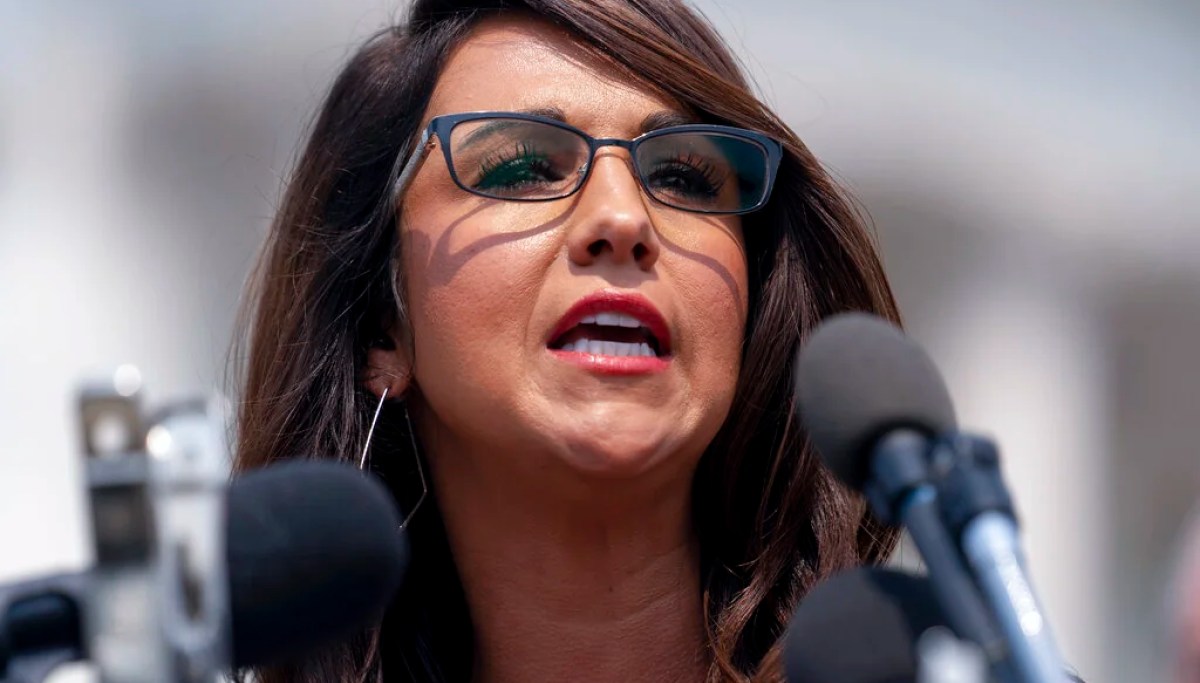
Rep. Lauren Boebert (R-CO) announced on Thursday that she will not support further funding for the United States’s war in Iran, marking an uphill battle for the Trump administration’s effort to secure additional financing from Congress.
“I’ve already told leadership, ‘I am a no on any war supplementals,’” Boebert told CNN. “I am so tired of spending money elsewhere. I am tired of the industrial war complex getting all of our hard-earned tax dollars. I have folks in Colorado who can’t afford to live.”
Boebert’s position comes as several other House Republicans have expressed skepticism about funding the war, whether for isolationist reasons or concerns that it would further add to the U.S.’s mounting debt. That puts House Speaker Mike Johnson (R-LA) in a precarious position, as he will need to persuade hesitant members among the Republican Party’s razor-thin majority in the lower chamber to coalesce around a funding bill for the war effort.
Boebert said she would not support more money for Iran under any circumstances because she believes it would not be “America First.” Other members, particularly those aligned with the fiscally conservative House Freedom Caucus, have raised questions about where the funding will come from, though they have not ruled out supporting the Pentagon’s proposed $200 billion supplemental request. Those lawmakers include Reps. Chip Roy (R-TX), Andy Ogles (R-TN), and Tim Burchett (R-TN), who want the funding offset with budget cuts in other areas.
Roy has emerged as a key figure in previous budget battles, making him a critical lawmaker for Johnson to win over. As of Thursday, Roy said he is open to funding, but wants more details and assurances that it won’t go toward “nation building” in Iran.
“I want to understand what the plan is, if they’re talking about boots on the ground, I want to know what the mission is,” Roy told the Hill, adding that he supports taking out Iran’s nuclear capabilities, “and taking out a lot of their bad guys that have been messing with the world for five decades.”
“But I’m not interested in nation building or soccer fields in Tehran like we were building in Baghdad [Iraq], and the American people aren’t either,” he added. “So, we need to understand, what’s the money for?”
When asked about the $200 billion figure earlier this week, Johnson said he was sure it was “not a random number,” affirming War Secretary Pete Hegseth’s push for more support.
“Obviously, it’s a dangerous time in the world, and we have to adequately fund defense, and we have a commitment to do that,” he said.
ADVANTAGES AND DRAWBACKS EMERGE FROM TRUMP-BACKED US DATA CENTER EXPANSION
Rep. Thomas Massie (R-KY) will also likely be a tough member for Johnson to corral, though he has not appeared to be a firm no on the $200 billion funding request.
“It begs the question, how long do they plan to be there? What are the goals? Is this the first $200 billion? Does this turn into a trillion?” Massie questioned on Thursday.